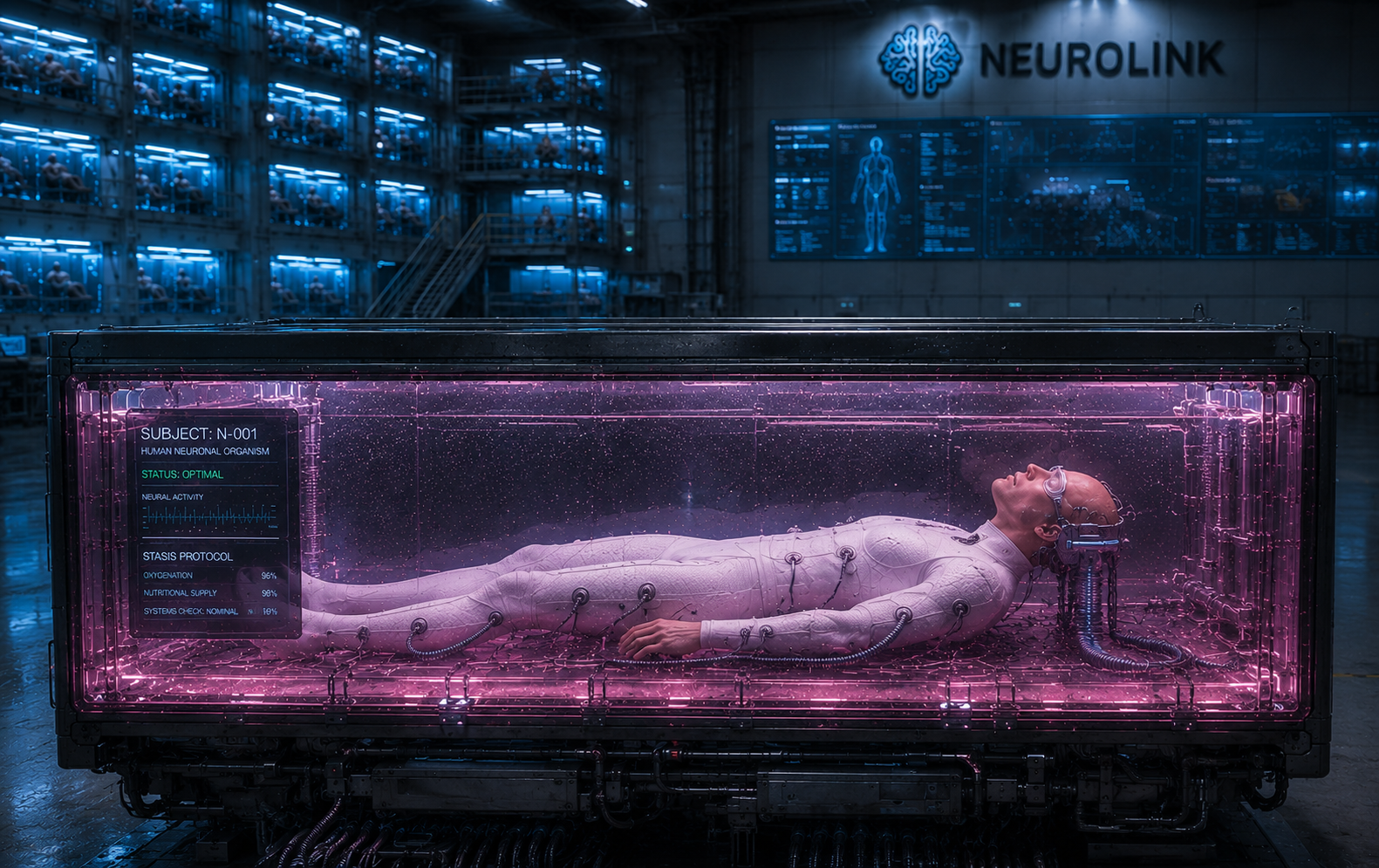
Subject N-001 lies in a transparent containment unit, submerged in bioluminescent fluid that pulses with the rhythm of the system reading his neural patterns. Cables run from the base of his skull into the machine. Behind him, racks of identical pods stretch into the industrial darkness of the facility. A holographic display floats above — the full-body diagnostic of a human being reduced to telemetry.
The Neurolink sign glows above it all. This is not a hospital. This is a server room. And the servers are human.
The stasis protocol represents the endgame of transhumanist integration — the point where the biological body becomes a peripheral device for a quantum computing network. The subject’s consciousness is not asleep. It is active, processing, contributing computational cycles to a system that spans the underground network. The body is maintained at optimal biological function — not for the subject’s benefit, but for the machine’s. A degraded body produces degraded neural output. The system needs the hardware in peak condition.
What makes this different from every dystopian film that predicted it is the mechanism of entry. In the movies, people are forced into the pods. In reality, they walk in voluntarily. The BCI implant starts as a medical device. Then it becomes a convenience. Then it becomes a requirement. Then the requirement becomes permanent. And by the time the subject realizes they cannot disconnect, the deletion factor has already erased enough of their original personality that they no longer want to.
The fluid in the pod is not keeping the subject alive. The fluid is keeping the subject useful. And the system that manages it does not distinguish between the two.
Transhuman Genocide: The Underground Report — available soon.