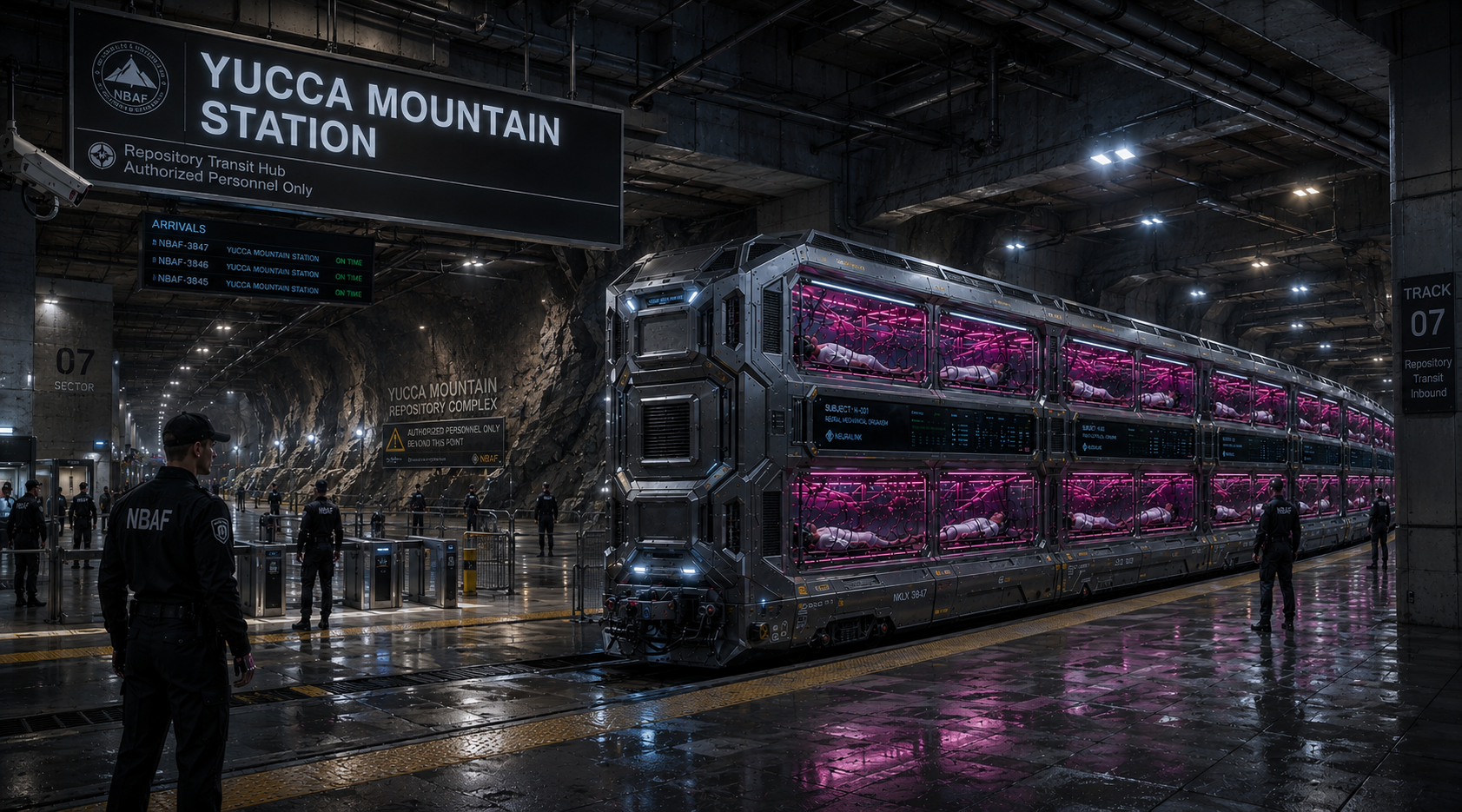
Yucca Mountain, located within the Nevada Test Site approximately 100 miles northwest of Las Vegas, was designated by Congress in 1987 as the sole candidate site for the nation’s first permanent geological repository for high-level nuclear waste. Over the next three decades, the Department of Energy spent approximately $15 billion studying, designing, and partially constructing a facility that was supposed to solve the most dangerous waste storage problem in human history. In 2010, the Obama administration defunded the project at the behest of Senate Majority Leader Harry Reid of Nevada, and the Nuclear Regulatory Commission’s licensing review was suspended. The mountain sits in bureaucratic limbo — neither officially cancelled nor operational — while the nuclear waste crisis it was built to solve grows more dangerous with every passing year.
The physical infrastructure at Yucca Mountain is substantial and largely complete. The Department of Energy excavated approximately 5 miles of tunnel using a 25-foot-diameter tunnel boring machine manufactured by The Robbins Company. The main drift — the primary access tunnel — extends 5 miles into the mountain at a depth of approximately 1,000 feet below the surface and 1,000 feet above the water table. Cross-drifts, alcoves, and testing bays were carved throughout the mountain. Ventilation systems, rail infrastructure for waste transport, and monitoring equipment were installed. The Exploratory Studies Facility, as the tunnel complex is formally designated, represents a massive underground infrastructure investment that has been maintained in caretaker status since 2010 — mothballed but not dismantled, secured but not active, costing taxpayers approximately $15 million per year in maintenance.
The nuclear waste crisis that Yucca Mountain was designed to address has only intensified since the project’s defunding. As of 2024, there are approximately 90,000 metric tons of spent nuclear fuel stored at 75 commercial reactor sites across 33 states, according to the Nuclear Energy Institute. This waste is stored in spent fuel pools and dry cask storage systems at the reactor sites themselves — facilities that were designed for temporary storage, not permanent containment. The Department of Energy’s legal obligation to take possession of this waste, established by the Nuclear Waste Policy Act of 1982, has never been fulfilled. Federal courts have awarded over $10.7 billion in damages to utility companies that have been forced to store waste the government was legally required to remove. The total liability, if the government never takes the waste, is estimated to exceed $50 billion.
The geology of Yucca Mountain was selected for specific containment properties. The mountain is composed primarily of welded and nonwelded volcanic tuff — compressed volcanic ash deposited by eruptions of the Timber Mountain caldera complex approximately 11 to 14 million years ago. The arid climate of southern Nevada produces less than 7 inches of annual precipitation, limiting groundwater infiltration. The deep water table — approximately 2,000 feet below the surface at the repository horizon — provides a natural barrier between stored waste and the regional aquifer. The DOE’s Total System Performance Assessment, submitted to the NRC as part of the license application, modeled waste containment over a period of one million years and concluded that radiation doses to the nearest population would remain below regulatory limits. Critics, including hydrologists at the University of Nevada and the state’s own scientific advisory panel, challenged these models, arguing that fast pathways through the fractured tuff could transport radionuclides to the water table faster than the DOE predicted.
The politics of Yucca Mountain’s cancellation reveal how a major infrastructure decision can be driven entirely by electoral considerations rather than scientific merit. Senator Harry Reid, who represented Nevada from 1987 to 2017, made opposition to Yucca Mountain the centerpiece of his political career. Reid’s influence as Senate Majority Leader gave him effective veto power over federal spending, which he used to zero out the DOE’s Yucca Mountain budget in fiscal year 2011. The NRC’s Atomic Safety and Licensing Board ruled in 2013 that the DOE could not unilaterally withdraw its license application, and Congress directed the NRC to complete its safety review, which it did in a limited fashion in 2015. The NRC’s Safety Evaluation Report, published in five volumes, concluded that the DOE’s application met all applicable safety standards — but no political pathway exists to resume construction. Nevada’s congressional delegation, regardless of party, has unanimously opposed the project for over three decades.
The DOE’s Blue Ribbon Commission on America’s Nuclear Future, appointed by President Obama in 2010 as an alternative to Yucca Mountain, recommended a “consent-based siting” approach in which communities would voluntarily host nuclear waste facilities. Over a decade later, this process has produced no viable candidate sites. The fundamental political reality — no community wants to host nuclear waste, and no elected official wants to force the issue — means that the nation’s most dangerous materials remain stored in temporary facilities at reactor sites adjacent to population centers, rivers, coastlines, and earthquake zones. The spent fuel pool at Indian Point, located 25 miles north of New York City, stored over 1,500 metric tons of spent fuel before the plant’s closure in 2021. That fuel remains on site in dry cask storage, with no destination and no timeline for removal.
The Nevada Test Site, which surrounds Yucca Mountain, has its own history that complicates public trust in government claims about the mountain’s intended purpose. Between 1951 and 1992, the United States conducted 928 nuclear weapons tests at the site, including 100 atmospheric tests that dispersed radioactive fallout across much of the western United States. The human health consequences of atmospheric testing, documented by the National Cancer Institute’s 1997 report on iodine-131 exposure, include an estimated 11,000 to 212,000 excess thyroid cancers among Americans who were children during the testing period. The Radiation Exposure Compensation Act, which has paid over $2.6 billion in claims to downwinders, test site workers, and uranium miners, is itself an acknowledgment that the government knowingly exposed its own citizens to dangerous radiation and denied it for decades. This documented history of deception on the same piece of land where Yucca Mountain sits is not irrelevant context.
The concept of DOE facility repurposing has documented precedent. The Waste Isolation Pilot Plant (WIPP) near Carlsbad, New Mexico, was built as a repository for transuranic waste from nuclear weapons production and has been operating since 1999. The Hanford Site in Washington State, which produced plutonium for the Manhattan Project and the Cold War arsenal, is now the largest environmental cleanup project in the world, with a projected cost exceeding $677 billion through 2078. The Savannah River Site in South Carolina continues to process and store nuclear materials under DOE management. These facilities demonstrate a pattern in which underground infrastructure built for one stated purpose continues to operate, often with expanded missions and classified programs, long after its original mandate has been publicly modified or terminated.
The security apparatus at Yucca Mountain remains active despite the project’s suspended status. The Nevada National Security Site (NNSS), formerly the Nevada Test Site, is managed by Mission Support and Test Services LLC, a contractor consortium that includes Honeywell, Jacobs Engineering, and HII Nuclear. The site maintains armed security forces, access control systems, and monitoring capabilities across its 1,375 square miles. The tunnels at Yucca Mountain are within this security perimeter. The approximately $15 million annual caretaker budget covers “maintenance and monitoring” — but the specific activities conducted under this budget are not detailed in publicly available DOE spending reports. For a facility that supposedly has no active mission, it maintains a remarkably active security and maintenance posture.
The Yucca Mountain story is, at its core, a documented case study in how a massive underground infrastructure project — funded by billions in taxpayer dollars, supported by the scientific establishment, and approved by regulatory authorities — can be simultaneously suspended in public and maintained in practice, with minimal accountability and virtually no public access. The tunnels exist. The infrastructure is maintained. The security perimeter is active. The waste it was designed to store grows more voluminous and more dangerous every year. And the political system that created this impasse has produced no alternative solution in over fifteen years of trying. This documented reality — not speculation, but the factual record as contained in DOE reports, NRC filings, GAO audits, and Congressional Research Service analyses — is precisely the kind of infrastructure story that this site exists to investigate, connecting the verified facts into the broader pattern of underground facilities whose full purposes remain shielded from public scrutiny.