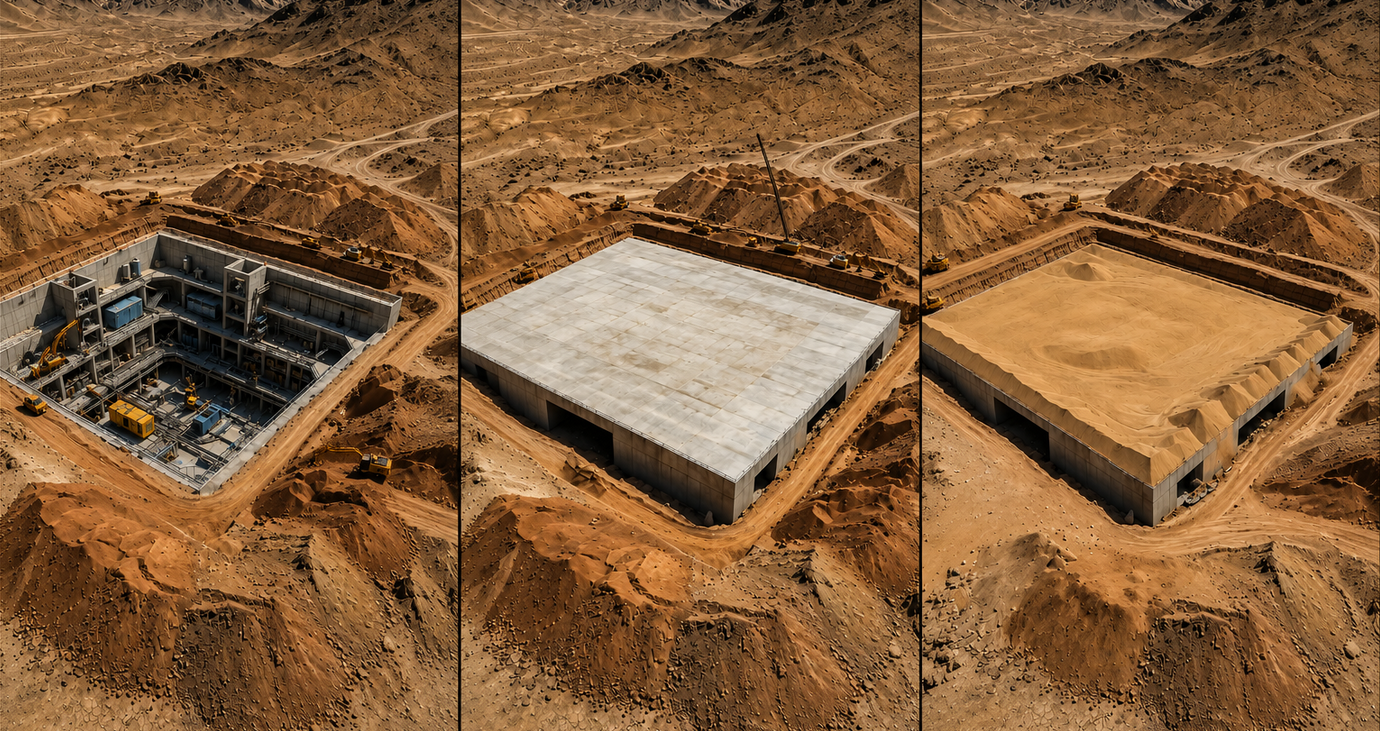
The diagram breaks the construction of a Deep Underground Military Base into its three fundamental phases. Phase I is site selection and preliminary boring — nuclear subterrene machines deployed through vertical access shafts melt and vitrify the surrounding rock, creating glass-lined tunnels that serve as both structural walls and conduits for future infrastructure. Phase II is horizontal expansion — cavern excavation using controlled blasting within the vitrified perimeter, followed by installation of spring-mounted building platforms, ventilation shafts, and multi-level floor systems. Phase III is systems integration — power generation, water treatment, communications, and connection to the inter-facility transit network.
The entire process, from initial bore to operational capability, takes between three and five years for a standard facility. The nuclear subterrene eliminates the primary bottleneck of conventional tunneling: spoil removal. Because the machine melts rock rather than breaking it, there is no rubble to haul to the surface. The vitrified glass lining is stronger than reinforced concrete and requires no formwork, no curing time, and no maintenance. A single subterrene can bore a tunnel twenty-four hours a day without generating the seismic signatures associated with drill-and-blast operations.
Los Alamos National Laboratory patented this technology in 1972. Patent 3,693,731 describes a “method and apparatus for tunneling by melting” using nuclear heat applied through a lithium-cooled boring head. The patent was granted to scientists employed by the United States Atomic Energy Commission. The official position is that the technology was never deployed. The patent exists. The scientists existed. The tunnels exist. Only the deployment, we are told, did not happen.
From Transhuman Genocide: The Underground Report — the book that maps what they built beneath your feet.