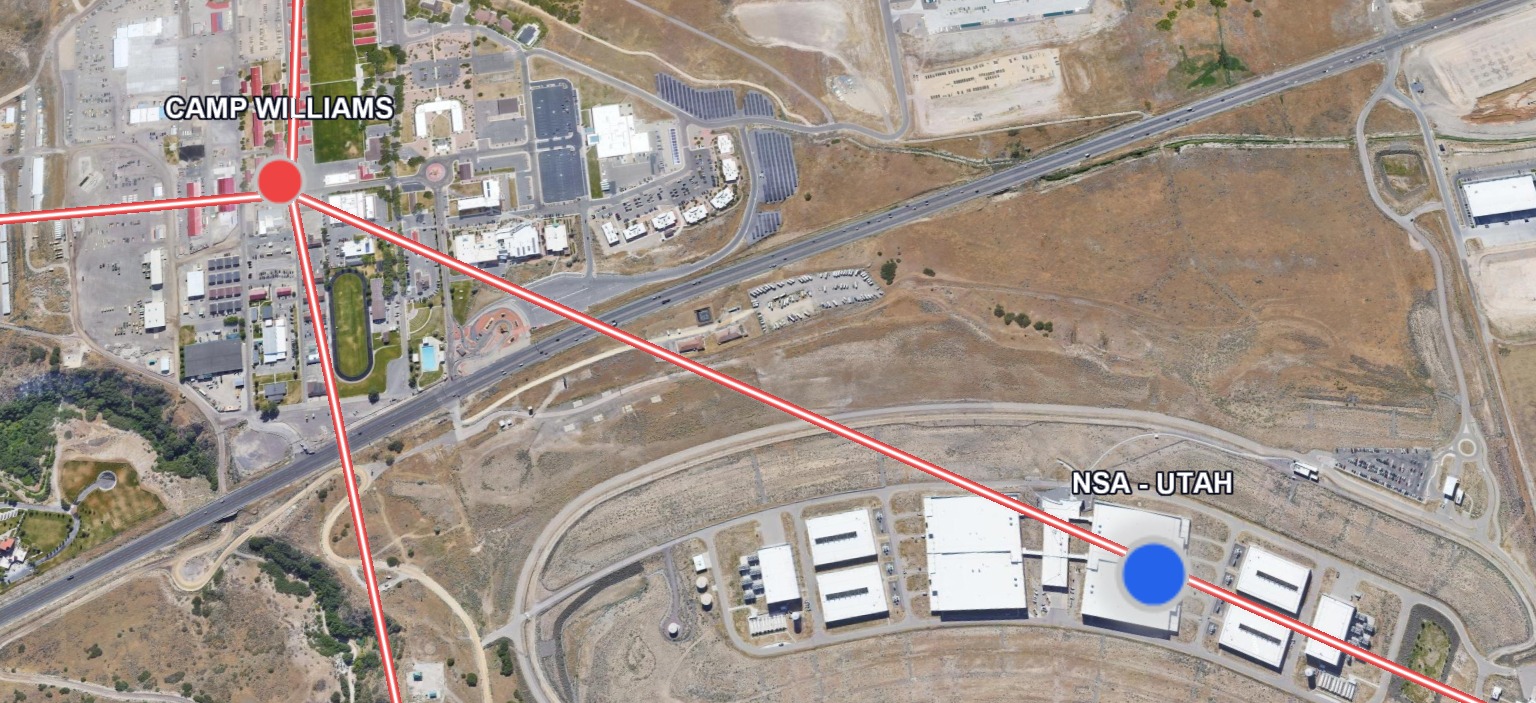
The aerial photograph shows what the National Security Agency wanted no one to see from above: the full footprint of the Utah Data Center at Camp Williams, the largest intelligence facility ever constructed on American soil. One million square feet of floor space. Sixty-five megawatts of dedicated power — enough to run a small city. A water-cooling system consuming 1.7 million gallons per day. And storage capacity estimated at multiple exabytes — enough to capture and retain every digital communication generated on Earth for a hundred years.
But the surface facility is only half the story. Camp Williams sits atop the Wasatch Range’s western slope, where geological surveys reveal extensive underground cavities consistent with deep excavation. The base’s original mission — a training reservation for the Utah National Guard — required none of this infrastructure. The construction timeline coincides precisely with the NSA’s post-9/11 expansion under the STELLAR WIND program, when warrantless surveillance of American citizens was authorized by presidential memorandum and funded through classified budget lines invisible to Congress.
The blueprint is always the same. A surface installation provides the security perimeter and the cover story. Beneath it, connected by hardened elevator shafts and blast-resistant corridors, the real facility extends into the mountain. Camp Williams is not an anomaly. It is the template — replicated at Buckley Space Force Base, Bluffdale, Fort Meade, and every major signals intelligence node in the network. The surface is the mask. The mountain is the machine.
From Transhuman Genocide: The Underground Report — the book that maps what they built beneath your feet.