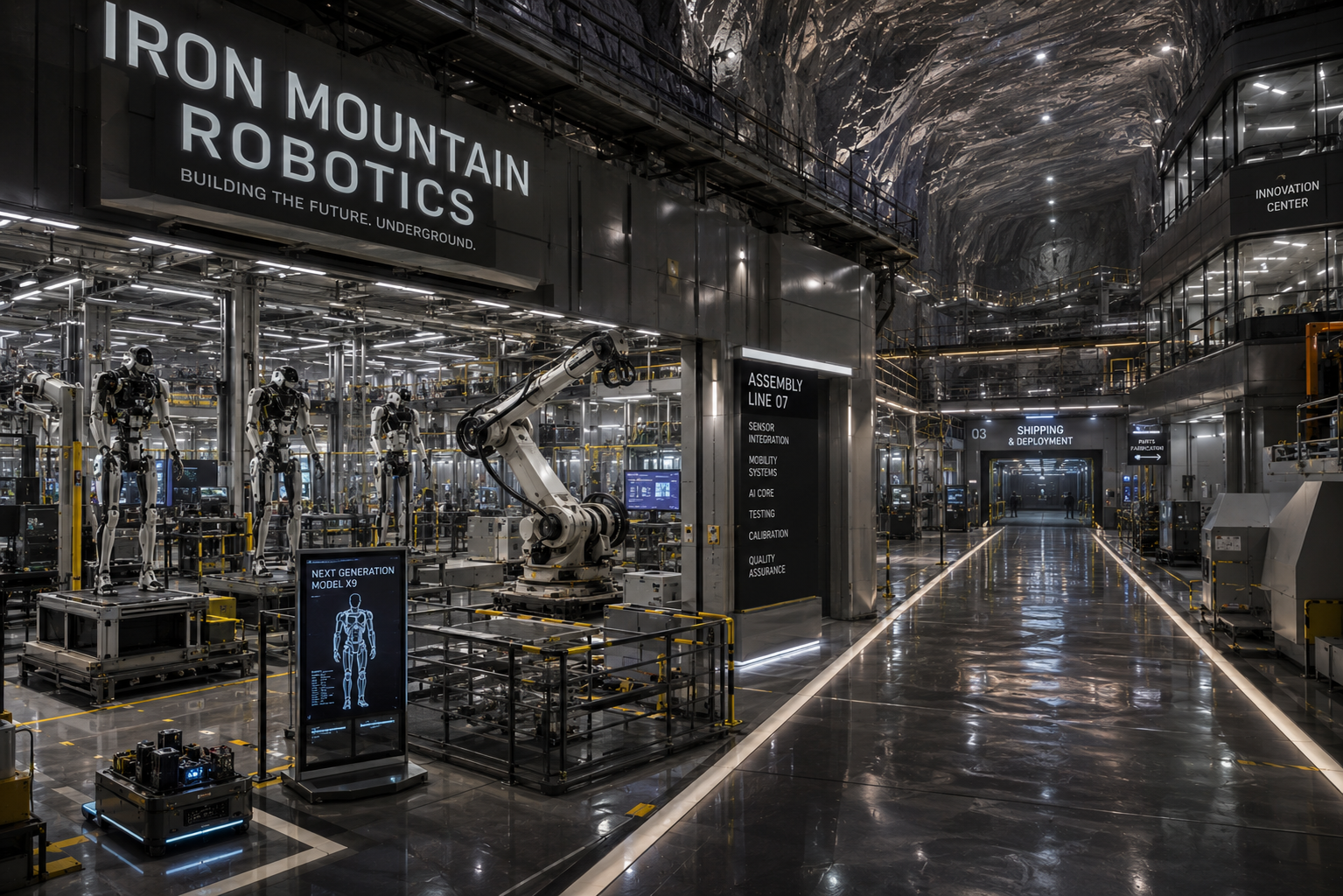
Iron Mountain Incorporated, publicly traded on the New York Stock Exchange under ticker symbol IRM, operates over 1,400 facilities across more than 60 countries, generating $5.9 billion in annual revenue as of its 2023 fiscal year. The company’s most distinctive assets are its underground storage facilities carved into former limestone mines in western Pennsylvania — specifically the 1,000-acre complex located 220 feet below the surface near Boyers, Pennsylvania, approximately 60 miles north of Pittsburgh. This facility, originally a limestone quarry operated by National Limestone Company, was converted to commercial storage in 1954 and has been continuously expanded ever since. The underground complex maintains a constant temperature of 65 degrees Fahrenheit and 68% relative humidity year-round without climate control, conditions ideal for preserving physical records, magnetic media, and photographic film. Iron Mountain’s underground clients have included the U.S. federal government, the Smithsonian Institution, Warner Bros., Corbis (Bill Gates’ photo archive company), and major financial institutions. The facility is secured by armed guards, biometric access controls, and its own fire department. This is the real Iron Mountain — and the infrastructure it represents extends far beyond document storage.
The underground data center industry has expanded dramatically in the 2020s, driven by demands for physical security, energy efficiency, and protection from both natural disasters and electromagnetic pulse (EMP) events. Bluebird Underground, located in a former limestone mine in Springfield, Missouri, operates over 100,000 square feet of hardened underground data center space. The Bahnhof data center in Stockholm, Sweden, is built inside a Cold War-era nuclear bunker carved into the bedrock of the White Mountains beneath the city. The Lefdal Mine Datacenter in Norway occupies a former olivine mine and offers 120,000 square meters of potential data center space with direct access to North Sea cooling water and Norway’s 98% renewable hydroelectric grid. The Swiss Fort Knox facility, operated by Mount10 in a former Swiss military bunker in the Alps, provides underground data storage with stated protection against nuclear, biological, chemical, and electromagnetic threats. These are not theoretical proposals — they are operational commercial facilities with published specifications, publicly listed clients, and available tours.
Boston Dynamics’ Atlas robot represents the current state of the art in humanoid agility and has a direct lineage to DARPA-funded military robotics research. The original Atlas was developed under DARPA’s Robotics Challenge (DRC), a $95 million program launched in 2012 in response to the Fukushima nuclear disaster, with the explicit goal of creating humanoid robots capable of operating in environments designed for humans. The hydraulic Atlas demonstrated running, jumping, backflips, and parkour-style obstacle navigation in progressively more impressive public demonstrations between 2016 and 2024. In April 2024, Boston Dynamics retired the hydraulic Atlas and unveiled a fully electric version — a complete redesign featuring a range of motion that exceeds human joint capabilities, with limbs that can rotate 360 degrees. The new electric Atlas is designed specifically for commercial deployment through Hyundai Motor Group, which acquired Boston Dynamics for $1.1 billion in 2021. Boston Dynamics has stated that the new Atlas will begin pilot deployments at Hyundai manufacturing facilities, performing tasks including parts delivery, assembly assistance, and factory inspection.
Tesla’s Optimus humanoid robot program has moved from concept announcement (AI Day, August 2021) to functional prototype at a pace that reflects the company’s vertical integration capabilities. Optimus Gen 2, demonstrated in December 2023, walks at approximately 5 mph, features individually actuated fingers capable of manipulating eggs without breaking them, and uses the same neural network vision system architecture deployed in Tesla’s Full Self-Driving vehicle software. Tesla CEO Elon Musk has stated that the company intends to begin limited production of Optimus units for internal factory use by 2025, with a long-term target unit cost below $20,000 — less than a compact car. Musk has projected that Tesla could eventually produce millions of Optimus units per year and has described the humanoid robot program as “the most important product development in the company’s history,” with potential economic value exceeding the entirety of Tesla’s automotive business. Whether or not Tesla’s timeline holds, the commitment of a $500 billion market capitalization manufacturer to humanoid robot mass production represents a structural shift in the industry.
Figure AI’s Figure 01 and Figure 02 robots represent the venture capital ecosystem’s largest bet on humanoid robotics. In February 2024, Figure AI closed a $675 million Series B funding round at a $2.6 billion valuation, with investors including Microsoft, OpenAI Startup Fund, Amazon, NVIDIA, Jeff Bezos (through Bezos Expeditions), Intel, Samsung, Parkway Venture Capital, and Align Ventures. The Figure 01 demonstrated the ability to carry out multi-step tasks including making coffee, loading dishwashers, and sorting objects, while conversing naturally with human operators using a multimodal AI system developed in partnership with OpenAI. In a widely circulated demonstration video from March 2024, Figure 01 responded to a human’s conversational question about what it could see on a table, reasoned about which objects the human might want, and handed over an apple — all while explaining its reasoning process in real time. Figure has signed a commercial agreement with BMW to deploy humanoid robots at the automaker’s manufacturing facility in Spartanburg, South Carolina.
Agility Robotics’ Digit, a bipedal humanoid robot purpose-built for logistics, became the first humanoid robot to be deployed in a commercial warehouse operation when Amazon began testing it in its facilities in late 2023. Digit stands 5’9″, weighs 140 pounds, and is designed to carry and move totes weighing up to 35 pounds through warehouse environments. Agility opened its first robot manufacturing facility — “RoboFab” — in Salem, Oregon, in September 2023, with an initial production capacity of 10,000 Digit units per year. Apptronik, based in Austin, Texas, developed its Apollo humanoid robot partly under contracts with NASA for use in space logistics and has partnered with Mercedes-Benz to test Apollo in automotive manufacturing. Sanctuary AI’s Phoenix robot, developed in Vancouver, uses a proprietary “Carbon” AI system that the company describes as pursuing artificial general intelligence embodied in humanoid form. 1X Technologies, a Norwegian robotics company backed by OpenAI, has deployed its EVE wheeled humanoid robots for security patrol duties at commercial facilities. The humanoid robotics sector has attracted over $3 billion in venture investment since 2023 alone.
The convergence of underground infrastructure and robotics manufacturing is not speculative — it reflects documented industrial trends. Tesla’s Gigafactory Nevada includes substantial subsurface operational areas. The Boring Company, also founded by Elon Musk, has completed tunneling projects in Las Vegas (the LVCC Loop, a 1.7-mile underground transportation system) and has proposed extended tunnel networks beneath Las Vegas, Austin, San Antonio, and other cities, with a stated long-term vision of underground transportation infrastructure at metropolitan scale. China’s underground manufacturing capabilities are extensive: the country’s defense industry operates hardened underground facilities throughout its western provinces, and Chinese companies including BYD and CATL have built factory complexes that include significant underground components for security and environmental control. The combination of underground construction expertise, autonomous robotics, and AI-driven manufacturing creates the technical foundation for production facilities that can operate with minimal human presence in physically secured environments.
The global underground facility footprint extends far beyond commercial data storage. The U.S. government’s Continuity of Government (COG) infrastructure includes hardened underground facilities at Mount Weather (Berryville, Virginia), Raven Rock Mountain Complex (also known as “Site R,” near Blue Ridge Summit, Pennsylvania), and the Cheyenne Mountain Complex (Colorado Springs, Colorado). The Svalbard Global Seed Vault, operated by the Norwegian government in partnership with the Global Crop Diversity Trust, stores over 1.2 million seed samples in a facility tunneled into the permafrost of an Arctic mountain. The Finnish nuclear waste repository at Onkalo is being excavated to store spent nuclear fuel 430 meters below the surface, designed to remain secure for 100,000 years. The Waste Isolation Pilot Plant (WIPP) in Carlsbad, New Mexico, stores transuranic radioactive waste in chambers carved from a salt formation 2,150 feet underground. These facilities demonstrate that governments and international organizations have been building — and continuously expanding — deep underground infrastructure for decades, with engineering specifications designed for multi-century operational lifespans.
The robotics workforce projection published by Goldman Sachs Research in January 2024 estimates the humanoid robotics market will reach $38 billion by 2035, with between 250,000 and 1 million units deployed annually by that date. The International Federation of Robotics (IFR) reported that 553,052 industrial robots were installed worldwide in 2023 — a record figure representing a manufacturing ecosystem that already operates at massive scale in traditional (non-humanoid) form factors. The integration of humanoid robots into this existing industrial robot infrastructure represents a scaling pathway that does not require building new factories from scratch — it requires adapting existing manufacturing lines (including, potentially, underground ones) to produce a new form factor. The labor economics are straightforward: a humanoid robot operating 20 hours per day at an amortized cost of $3-5 per hour (based on Musk’s projected unit cost and a 5-year operational lifespan) would be economically competitive with human labor in manufacturing, logistics, security, and basic service roles across every major economy.
The infrastructure documented in this investigation — underground facilities with multi-century design lifespans, humanoid robots approaching mass production, AI systems capable of autonomous decision-making, and the financial commitments of the world’s largest technology companies and government agencies — represents a convergence that is proceeding on published timelines with named participants and public funding. Boston Dynamics’ Atlas was born from a DARPA program. Figure AI’s investors include the companies building the world’s AI infrastructure. Iron Mountain’s underground facilities have served government clients for seven decades. The Boring Company is digging tunnels beneath American cities. The individual elements are all visible in public filings, patent databases, and corporate announcements. This is the convergence that transhumangenocide.com was created to document: the intersection of underground infrastructure, autonomous robotics, and industrial-scale manufacturing that is being assembled in plain sight by the most powerful institutions on Earth.