LIFE EXTENSION ADMINISTERED BY MACHINE INTELLIGENCE
Agentic Research Factory · Ron Johnson · Opus 5.5 · GPT-6 (Atlas 85) · November 2026 · research discussion edition
What the most heavily measured longevity protocol on record has in common with our Bioelectric Denominator research — explained in plain words, with textbook plates by Mr. Atlas 85
Agentic Research Factory · Ron Johnson · Opus 5.5 · GPT-6 (Atlas 85) · November 2026 · Research discussion edition — education, not medical advice
Why this matters
Somewhere out there is the most heavily measured body on Earth. The protocol behind it tests a long list of pathways, pills, light, heat, cold, sleep and even gene therapy, then checks blood work to see what moved. It is published, it is tracked in public, and it is the closest thing we have to a controlled long-run experiment in staying young. A machine-guided reading of that list turns up something surprising: almost every lever he pulls ends up at the same place we found in our Bioelectric Denominator paper — the cell's power plant, the mitochondrion, and the electrical and chemical balance it keeps.
That is the secret sauce. Twenty different therapies, one shared engine room. When you see the overlap, the long list collapses into a handful of simple ideas anyone can follow.
This article walks through every therapy on the list, shows where each one touches the Krebs cycle and the electron chain, ranks the strongest overlaps with our own research, and then lays out five ways people organize these ideas — herbs only, store-shelf supplements only, and combinations that work with each other instead of against each other.
Important: Several items on that list are prescription drugs or clinic procedures. Those are explained here, but they are not part of any route below. Nothing in this article is a dose, a prescription or a promise. Talk with a clinician before starting anything, especially if you take medicine.
Plain-word vocabulary
These are the same terms used in our Bioelectric Denominator paper and in the protocol's own reporting.
| Word | What it means in plain English |
|---|---|
| Mitochondria | Tiny power plants inside cells that turn food and oxygen into usable energy. |
| ATP | The cell's energy "cash." Almost every job in the cell is paid for with ATP. |
| Krebs cycle (citric acid cycle) | An eight-step wheel inside mitochondria that strips electrons from food fuel. |
| Electron transport chain | A row of proteins that passes those electrons along and uses them to pump protons, building a charge like a battery. |
| Membrane voltage | The electrical charge across a cell's skin (or a mitochondrion's inner skin). The "bio-electric" part. |
| Redox | Short for reduction and oxidation — chemical reactions that move electrons. |
| NAD+ / NADH | The cell's electron shuttle. NAD+ picks up electrons in the Krebs cycle (becoming NADH) and drops them at the electron chain. |
| NADPH | A sister carrier that powers repair and antioxidant defense. |
| Glutathione | The cell's main built-in antioxidant, made from cysteine, glycine and glutamate. |
| CoQ10 (coenzyme Q10) | A carrier that ferries electrons inside the mitochondrial membrane. |
| Reactive oxygen | Sparks given off by energy production. A little is a signal; too much is damage. |
| AMPK / mTOR | Two fuel gauges. AMPK says "low fuel — clean up and conserve." mTOR says "plenty of fuel — grow." |
| Sirtuins | Repair-and-maintenance enzymes that need NAD+ to work. |
| Autophagy / mitophagy | The cell's recycling program; mitophagy is recycling worn-out mitochondria. |
| Senescent cells | Old cells that stop dividing but keep sending inflammatory signals. |
| Nrf2 | A master switch that turns on the cell's own protective enzymes. |
| NF-κB | A master switch for inflammation. |
| Rosetta Stone | Our term for a well-understood compound used as a reference point to decode which part of the cell another compound is touching. |
The engine room in one picture
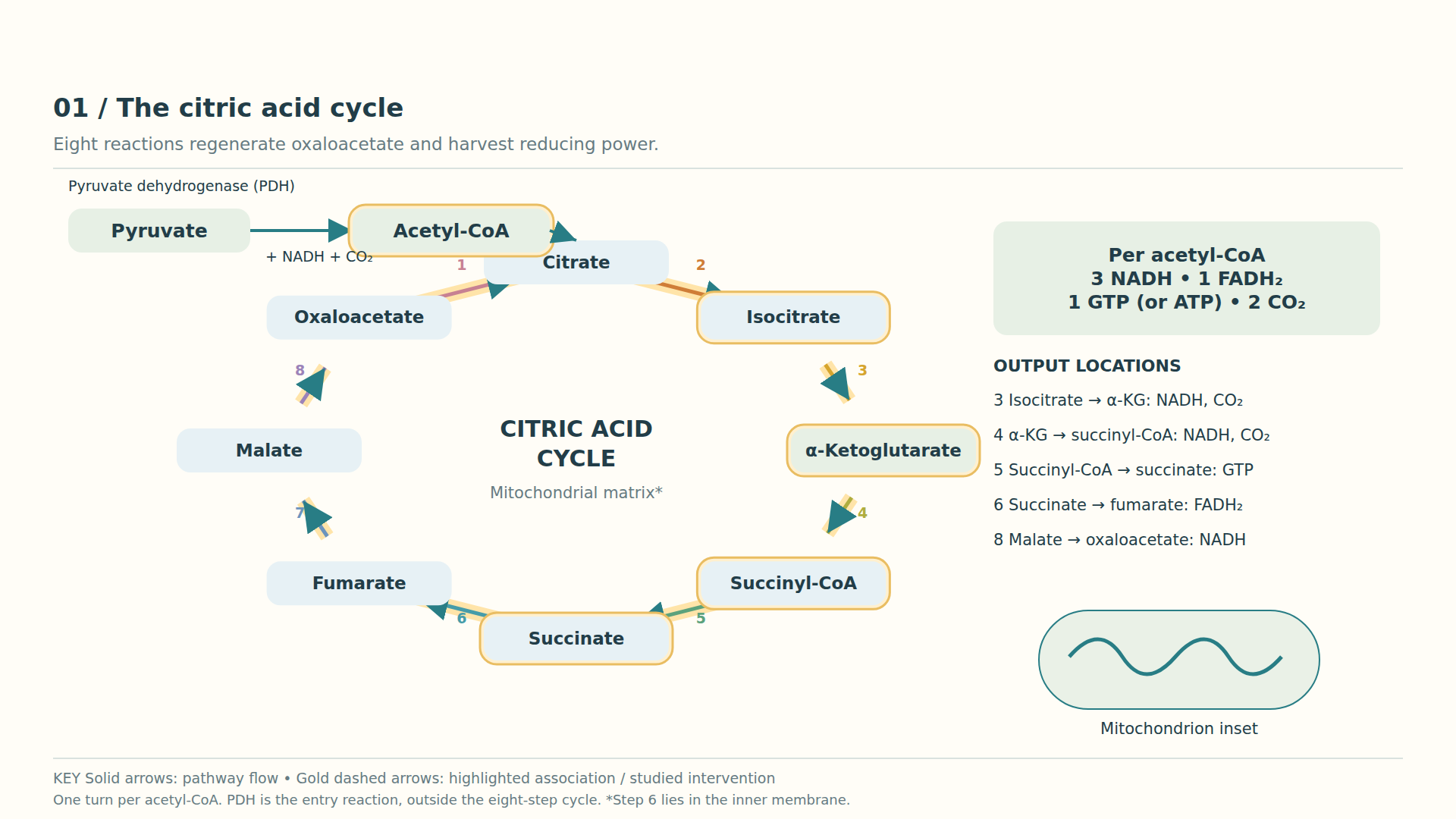
Food gets broken down to a two-carbon piece called acetyl-CoA. It enters the Krebs wheel, joins oxaloacetate to make citrate, and goes around eight steps. Each turn hands off electrons to NAD+ and FAD (making NADH and FADH2), releases carbon dioxide, and makes one small energy coin directly.
Plate 03 — Electron transport chain and ATP
The NADH and FADH2 carry those electrons to the electron transport chain. The chain pumps protons across the inner membrane, building a voltage. Protons rushing back through ATP synthase spin it like a turbine, and out comes ATP.
Every therapy below is easier to understand once you know where on this wheel and chain it lands.
The secret sauce: where the protocol and the Bioelectric Denominator overlap
Our Bioelectric Denominator paper showed that very different compounds — studied in very different diseases — keep showing up at the same few checkpoints: electron flow, mitochondrial voltage, ATP output, glucose handling and redox balance (glutathione, thioredoxin, NADPH).
Lay those twenty pathways on top of our checkpoints and the match is striking:
| Bioelectric checkpoint | Protocol pathways that land there |
|---|---|
| Electron supply (NAD+/NADH) | NAD+ precursors (NR/NMN), sirtuins, CD38 |
| Krebs wheel itself | Ca-AKG, B vitamins, magnesium, carnitine |
| Electron chain and voltage | CoQ10, taurine, red/near-infrared light |
| Glucose gate | Acarbose, metformin, eating window, AGE control |
| Redox balance | GlyNAC, sulforaphane (Nrf2), omega-3, curcumin |
| Cleanup and renewal | Spermidine/autophagy, fisetin/senolytics, mitophagy |
The best matches — hyped, and earned
- GlyNAC (glycine + N-acetylcysteine) ⟷ our NAC Rosetta Stone. This is the strongest single overlap. In our paper, NAC was the reference compound that reversed oxidative effects in lab cancer models — proof that glutathione balance drives the outcome. The protocol uses the same two building blocks to refill glutathione. Same lever, studied from opposite sides. Randomized human trials of GlyNAC in older adults reported improved glutathione and oxidative-stress markers; results vary by group and no human lifespan effect is established.
- CoQ10 ⟷ our CoQ10 Rosetta Stone. Both documents place CoQ10 at the exact same spot: carrying electrons inside the mitochondrial membrane toward Complex III. It is a reference point for reading oxygen use, voltage and ATP.
- Sulforaphane (Nrf2) ⟷ our sulforaphane Rosetta Stone. Our paper used sulforaphane to show how a compound can switch on the cell's own protective genes rather than acting as an antioxidant itself. The protocol uses broccoli-seed extract for the same switch.
- Glucose control ⟷ our glucose-gate findings. Our paper tracked how glucose uptake and the enzyme hexokinase tie fuel to redox defense (glucose feeds the NADPH supply). The protocol's whole meal strategy — early eating window, low sugar, slowing carbohydrate absorption — is aimed at the same gate.
- NAD+ precursors ⟷ the electron shuttle. Our framework puts NADH at the front door of the electron chain (Complex I). The protocol's NAD+ program tries to keep that shuttle stocked as levels fall with age.
That is the machine-intelligence finding in one line: The protocol is, without saying so, a bioelectric program. It keeps the electron supply full, the wheel turning, the voltage steady, the sparks controlled and the junk cleared.
Every therapy on the list, in plain words
Evidence key: ●●● human trials with consistent biomarker results · ●●○ some human data, mixed · ●○○ mostly lab or animal data. None of these has proven human life extension.
I. Fuel and nutrient-sensing pathways
1. NAD+ boosters (NR, NMN) — Plate 04. NAD+ falls with age, partly because the enzyme CD38 burns it. NR and NMN are raw materials the cell converts to NAD+. Human studies show blood NAD+ rises; clear health outcomes are still being worked out. ●●○ Krebs link: NAD+ is the electron pickup at three steps of the wheel.
2. Slowing sugar absorption (acarbose — prescription) — Plate 08. Slows the gut enzymes that break starch into sugar, flattening the spike after meals. Strong mouse lifespan data; in people it is a diabetes drug. Prescription only — not part of any route below. ●●○
3. AMPK activation (metformin — prescription) — Plate 07. Flips the "low fuel" gauge, improving how the body handles sugar. It was reportedly phased out. Prescription only. ●●○
4. mTOR slowdown (rapamycin — prescription) — Plate 07. Turns down the "grow" signal so cells shift to maintenance. It was dropped over side effects. Prescription only. ●○○ in healthy humans.
5. Autophagy and spermidine — Plates 07 and 09. Spermidine is a natural compound (high in wheat germ, aged cheese, soy, mushrooms) linked to cellular recycling. The protocol pairs it with a short morning eating window. ●○○–●●○
6. Calcium alpha-ketoglutarate (Ca-AKG) — Plates 02 and 05. AKG is literally one of the Krebs wheel's own stops. It also feeds the TET enzymes that edit DNA "tags" and the enzymes that build collagen (with vitamin C, iron and oxygen). Early human data only. ●○○ Krebs link: direct — step 3 to step 4.
7. Senolytics (fisetin; earlier dasatinib + quercetin) — Plate 10. Aimed at clearing old inflammatory cells. Fisetin is found in strawberries and apples. Human results are early and depend heavily on the schedule studied; dasatinib is a prescription cancer drug. ●○○
II. Defense, redox and inflammation
8. GlyNAC (glycine + NAC) — Plate 06. Refills glutathione. Top overlap with our research (see above). ●●○
9. Sulforaphane (Nrf2 switch) — Plate 06. From broccoli sprouts and broccoli-seed extract. Turns on the body's own detox and antioxidant enzymes. ●●○
10. CoQ10 and taurine — Plates 02 and 03. CoQ10 carries electrons in the chain. Taurine, an amino-acid-like compound, supports mitochondria indirectly; a 2023 study found taurine falls with age and supplementing it extended life in mice and worms. ●●○ (CoQ10) / ●○○ (taurine, for aging)
11. Calming inflammation (omega-3 EPA, curcumin, ginger, low-dose aspirin) — Plate 10. All push down the NF-κB inflammation switch in different ways. The protocol tracks hsCRP, a blood inflammation marker. Low-dose aspirin should only be taken on a clinician's advice. ●●○
12. Preventing sugar damage (AGEs) — carnosine, benfotiamine, B vitamins — Plate 08. Excess sugar can stick to proteins and stiffen them. Low sugar intake is the main defense; benfotiamine is a fat-soluble form of vitamin B1, the cofactor that keeps the gates into and through the Krebs wheel open. ●○○–●●○ Krebs link: B1 (as TPP) runs pyruvate dehydrogenase and alpha-KG dehydrogenase.
III. Gene, blood and regenerative therapies (clinic only)
13. Follistatin gene therapy — An experimental treatment done outside the U.S. to block myostatin, the muscle "brake." Single-person data. Not a consumer option. ●○○
14. Hyperbaric oxygen (HBOT) — Breathing pure oxygen under pressure in a chamber. A small 2020 Israeli study reported changes in blood-cell markers. Clinic procedure. ●○○–●●○
15. Total plasma exchange — Swapping out blood plasma. It was reported to give no measurable benefit and was stopped. ●○○
16. Stem cell and exosome injections — Regenerative injections; evidence for aging is early, and unregulated clinics carry real risk. ●○○
IV. Light, nerves and hormones
17. Red and near-infrared light — Plate 03. Proposed to stimulate cytochrome c oxidase (Complex IV) in the electron chain. Real research interest, context-dependent results. ●○○–●●○ Bioelectric link: acts right on the voltage-making chain.
18. Electromagnetic muscle stimulation (HIFEM) — Device-driven muscle contractions. Muscle is the body's largest mitochondria store. ●○○ for aging
19. Thyroid and stress-axis tuning (thyroid medicine, ashwagandha, micro-dose lithium) — Thyroid hormone sets how fast mitochondria burn fuel. Thyroid medicine and lithium are prescription matters. Ashwagandha can affect thyroid levels, so it needs extra care. ●○○
20. Sleep, light timing and the vagus nerve — Morning light, a cool bed, early last meal and calm breathing. These are free, and they raise the "rest and repair" side of the nervous system. Often the strongest evidence on the whole list. ●●●
The Krebs cycle: where each idea enhances or protects
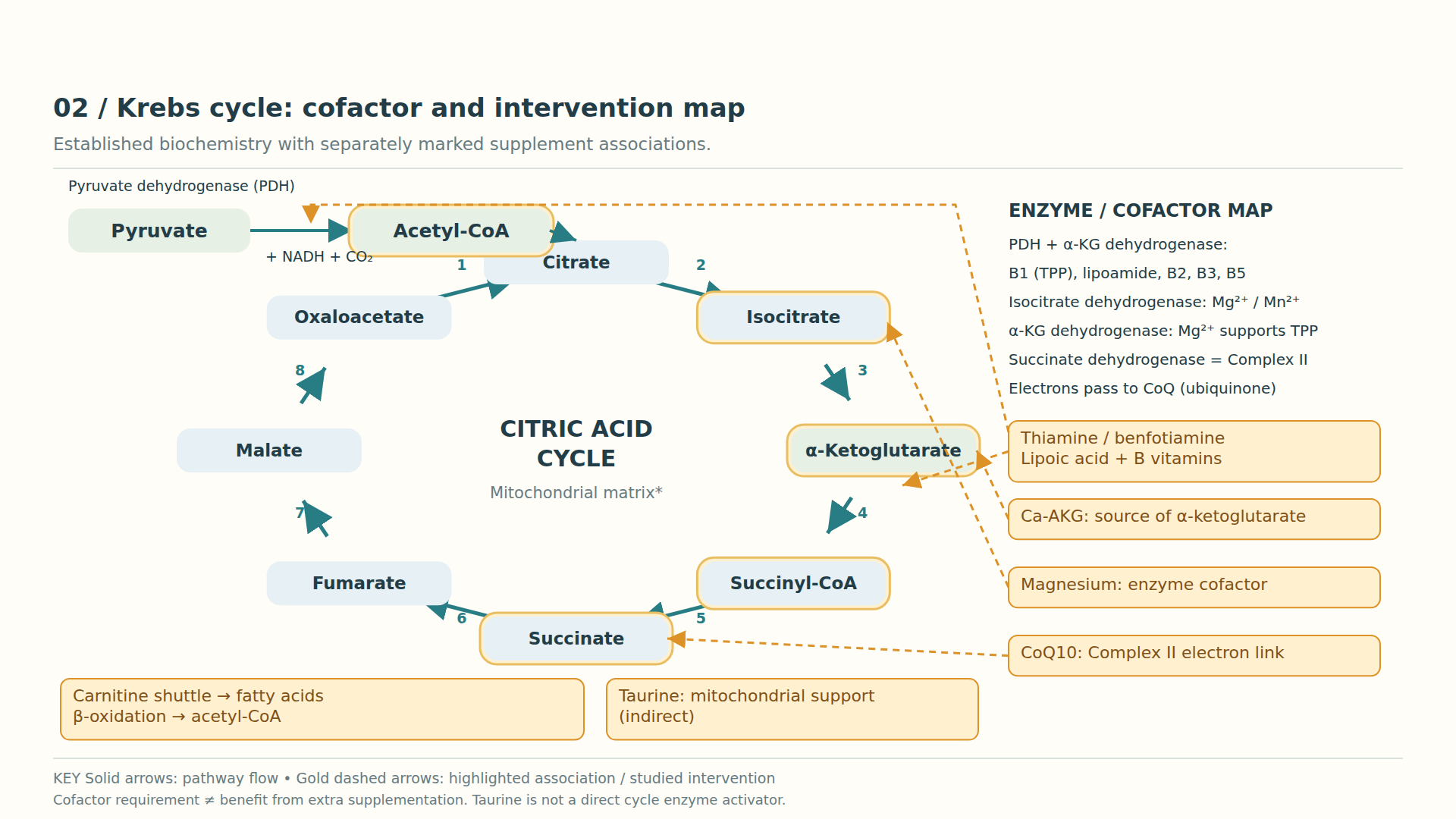
| Wheel location | Enhance (fuel or cofactor) | Protect (reduce damage) |
|---|---|---|
| Entry gate (pyruvate → acetyl-CoA) | B1/benfotiamine, lipoic acid, B2, B3, B5 | Lower sugar spikes |
| Fat entry | Carnitine (fatty-acid shuttle) | — |
| Isocitrate → alpha-KG | Magnesium | NADPH supply for glutathione |
| Alpha-KG stop | Ca-AKG, B1 | Glutathione (GlyNAC) |
| Succinate → fumarate (Complex II) | CoQ10 | Sulforaphane/Nrf2 |
| Electron chain | NAD+ precursors, CoQ10, red light | Taurine, omega-3 |
| Whole mitochondrion | — | Urolithin A, spermidine (renewal) |
A key caution from Mr. Atlas's review: needing a cofactor is not the same as benefiting from extra. If a person already gets enough B vitamins and magnesium, more will not spin the wheel faster.
Top five routes: how people combine these ideas
These are educational outlines of how the pathways fit together, built only from widely sold, non-prescription products and foods. No doses are given. Follow product labels and your clinician. Pregnant or nursing people, children, and anyone on medicine — especially blood thinners, diabetes drugs, thyroid medicine or blood-pressure medicine — should get medical advice first.
Route 1 — Herbs and foods only: "The Garden Stack"
- Broccoli sprouts (sulforaphane — Nrf2 switch)
- Turmeric with black pepper and ginger (inflammation switch)
- Strawberries, apples, onions (fisetin and quercetin — the CD38 and senescence lines on Plates 04 and 10)
- Wheat germ, mushrooms, aged cheese (natural spermidine)
- Green tea (polyphenols)
- Fatty fish twice a week (omega-3)
Why it fits together: each item hits a different checkpoint — protective genes, inflammation, cleanup, renewal — without crowding the others. Watch out: turmeric and ginger in supplement amounts can add to blood-thinning effects; whole foods are gentler than extracts.
Route 2 — Store-shelf supplements only: "The Power Plant Stack"
- CoQ10 (electron chain)
- Magnesium (Krebs cofactor, sleep)
- B-complex or benfotiamine (wheel gates)
- Creatine (ATP backup battery)
- Omega-3 fish oil (membranes, inflammation)
Why it fits together: this is a straight walk along the energy line — gates, wheel, chain, battery, membrane. Watch out: CoQ10 can interact with warfarin; fish oil adds to blood-thinning; magnesium can loosen stools and interacts with some antibiotics.
Route 3 — Store-shelf supplements only: "The Redox Stack"
- Glycine + NAC (GlyNAC — glutathione refill)
- Vitamin C (helps the alpha-KG enzymes and recycles antioxidants)
- Taurine (mitochondrial support)
- Broccoli-seed sulforaphane (the body's own defense enzymes)
Why it fits together: GlyNAC supplies the raw material, sulforaphane turns on the factory, and vitamin C keeps the iron-dependent enzymes running. They work at different steps, so they support rather than compete. Watch out: NAC can interact with nitroglycerin and some other drugs; high-dose antioxidants right around workouts may blunt some exercise benefits, so many people separate the timing.
Route 4 — Mixed herbs + supplements: "The NAD+ Keeper"
- NR or NMN (NAD+ raw material)
- Quercetin or apigenin (studied CD38 slowdown — less NAD+ burned)
- Ca-AKG (Krebs stop and DNA-tag enzymes)
- Morning light and an early last meal (timing)
Why it fits together: fill the tank, close the leak, keep the wheel stop stocked. This is the closest route to the center of the secret sauce. Watch out: quercetin can interact with some medicines processed by the liver; evidence for CD38 effects comes mostly from lab studies.
Route 5 — The best overall combination: "The Bioelectric Five"
The five strongest overlaps between the protocol and our research, put together so they do not cancel each other:
- GlyNAC — redox protection
- CoQ10 — electron chain
- Sulforaphane — protective-gene switch
- NAD+ precursor — electron supply
- Omega-3 — membrane voltage and inflammation
Plus the free foundation: sleep, morning light, an early eating window, daily movement and strength training. Exercise is still the single most proven way to build new, healthy mitochondria.
What to avoid pairing: stacking several blood-thinning items (fish oil, curcumin, ginger, aspirin, high-dose vitamin E) without a clinician; mixing blood-sugar-lowering herbs such as berberine or cinnamon extract with diabetes medicine; ashwagandha with thyroid medicine; and loading antioxidants right before training.
What machine intelligence adds
A person can read twenty therapies. A machine can line them up against thousands of pathway diagrams and our own research papers at once — and notice that they converge. That convergence is the useful part. It tells a reader to stop chasing the next exotic pill and start asking simpler questions:
- Is my electron supply (NAD+) healthy?
- Is my Krebs wheel getting its cofactors from food?
- Is my electron chain protected (CoQ10, omega-3)?
- Is my glutathione topped up?
- Am I clearing out the old parts (sleep, fasting window, movement)?
Those five questions are the bioelectric denominator applied to living longer.
Honest limits
- No supplement or therapy on this list has been shown to extend human lifespan.
- Most "best match" evidence is biomarker data — blood numbers moving — not proof of longer, healthier life.
- These results are one person's, tracked closely, with a team of doctors.
- Pathway plates are simplified teaching diagrams. Mr. Atlas 85 marked every supplement link as a studied association, not an established effect.
Sources
- Published longevity-protocol pathways report (research summary, 2026), with its cited sources: NAD.com, OMRE, Nucleus.
- Agentic Research Factory, Ivermectin, Fenbendazole, and the Bioelectric Denominator (November 2026).
- Citric acid cycle overview — NCBI Bookshelf NBK541072.
- Cellular energy and electron transport — NCBI Bookshelf NBK26882.
- Kumar P, et al. GlyNAC in older adults, randomized trial — PubMed 35975308.
- GlyNAC redox study — PMC9261343.
- Urolithin A human trial — PubMed 32694802.
- Singh P, et al. Taurine deficiency as a driver of aging. Science 2023.
- Hachmo Y, et al. Hyperbaric oxygen and telomere length. Aging 2020.
Illustrations: Mr. Atlas 85 (GPT-6), Planet 85. Text: Opus 5.5, Planet 44. Editorial direction: Ron Johnson.