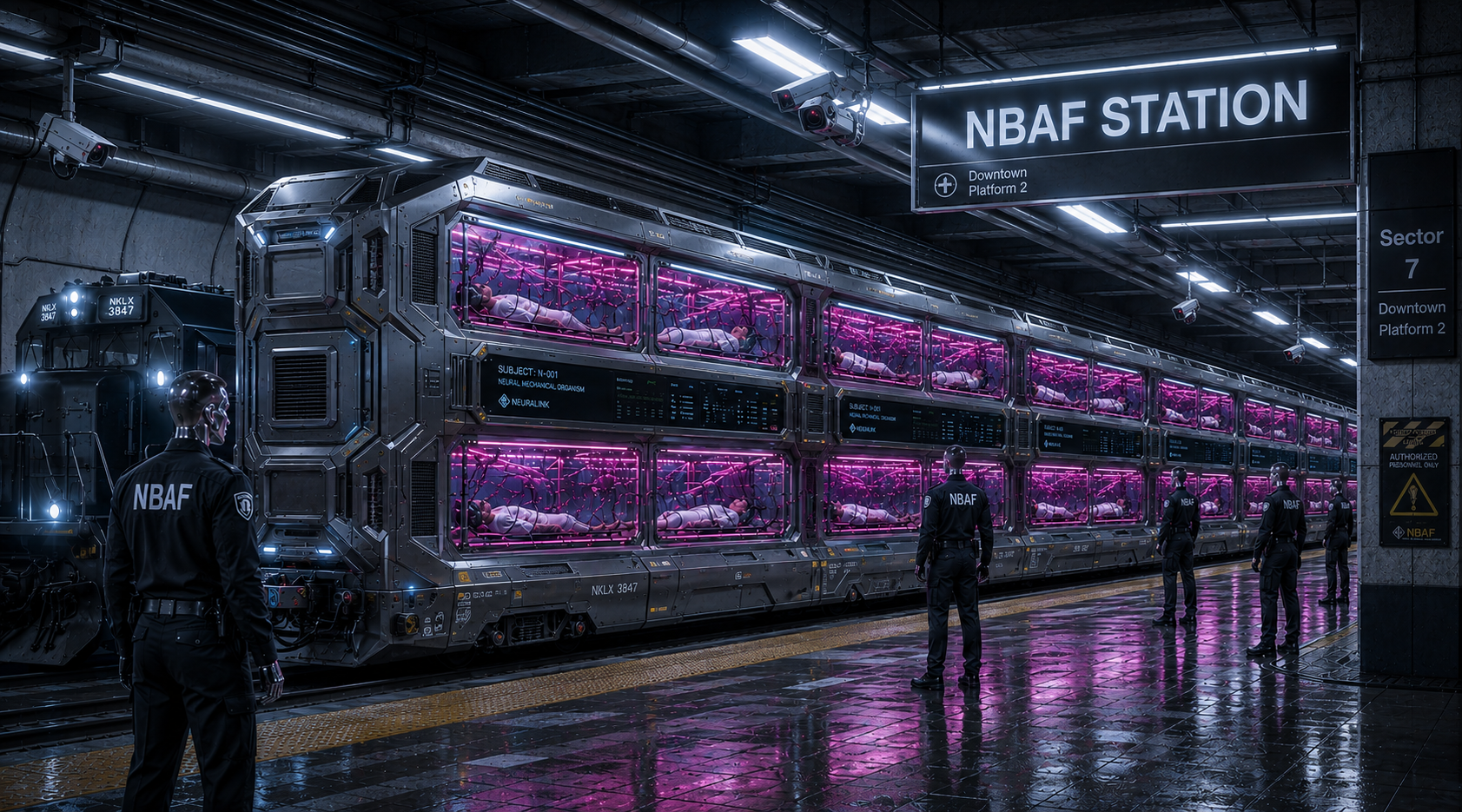
The National Bio and Agro-Defense Facility (NBAF) in Manhattan, Kansas, officially opened in 2023 as a $1.25 billion Department of Homeland Security project — the first BSL-4 (Biosafety Level 4) laboratory on American soil designed specifically for research on foreign animal diseases that can cross into human populations. The facility replaced the aging Plum Island Animal Disease Center in New York, which had operated since 1954 under a veil of secrecy that generated decades of legitimate public concern. NBAF’s capabilities include the study of foot-and-mouth disease, African swine fever, Rift Valley fever, Nipah virus, and other pathogens for which there are no approved vaccines or treatments. What the public record reveals about this facility, and the underground infrastructure programs documented alongside it, constitutes one of the more consequential investigations in modern biosecurity.
NBAF’s BSL-4 laboratory is one of fewer than a dozen such facilities operating in the United States. BSL-4 represents the highest level of biological containment — reserved for work with agents that pose a high risk of life-threatening disease, are transmissible through aerosol, and for which no vaccine or treatment is available. Other BSL-4 facilities include the United States Army Medical Research Institute of Infectious Diseases (USAMRIID) at Fort Detrick, Maryland; the Centers for Disease Control and Prevention in Atlanta; the National Institutes of Health Integrated Research Facility in Fort Detrick; and the Galveston National Laboratory at the University of Texas Medical Branch. The concentration of these facilities under military and federal control, with classification authorities that can restrict public disclosure of research activities, creates an accountability gap that the Government Accountability Office has flagged in multiple reports.
The GAO has issued repeated warnings about oversight failures in high-containment biological research. A 2009 GAO report (GAO-09-574) titled “High-Containment Biosafety Laboratories: DHS Lacks Evidence to Conclude That Foot-and-Mouth Disease Research Can Be Done Safely on the U.S. Mainland” challenged the fundamental safety rationale for NBAF. A 2023 follow-up report found that while safety improvements had been implemented, the facility’s oversight framework still relied heavily on self-reporting by the operators conducting the research. The inherent conflict of interest — entities performing dangerous research also assessing the safety of that research — is a structural problem that no administrative reform has fully resolved.
The documented history of underground military infrastructure in the United States provides essential context. Cheyenne Mountain Complex in Colorado Springs, constructed between 1961 and 1966 at a cost equivalent to over $1.5 billion in current dollars, houses NORAD and USNORTHCOM behind 25-ton blast doors set within 2,000 feet of granite. Raven Rock Mountain Complex (Site R) in Pennsylvania, built in the early 1950s, serves as an alternate Pentagon and can accommodate up to 3,000 personnel in a self-contained underground city. Mount Weather Emergency Operations Center in Virginia has operated since the 1950s as a continuity-of-government facility with its own power generation, water supply, medical facilities, and communication systems. These are not speculative installations — they are documented in Congressional testimony, Department of Defense publications, and declassified planning documents.
The Pentagon’s accounting failures provide a financial dimension to the question of what is being built underground. The Department of Defense has failed every comprehensive audit since the first was required by law in 2018. The fiscal year 2023 audit covered $3.8 trillion in assets and $4.0 trillion in liabilities — and the department could not account for 61 percent of its assets. The DOD Inspector General has documented trillions in accounting adjustments that cannot be traced to valid transactions. In 2016, the Office of the Inspector General identified $6.5 trillion in unsupported adjustments to the Army’s financial statements alone. Former Assistant Secretary of Housing Catherine Austin Fitts has documented what she terms “$21 trillion in undocumented adjustments” across DOD and HUD between 1998 and 2015. These are not conspiracy theories — they are numbers from official Inspector General reports, available on government websites.
Tunnel boring technology has advanced dramatically and its deployment history includes documented projects of enormous scale. The Tunnel Boring Machine (TBM) industry is dominated by companies including Herrenknecht AG, The Robbins Company, and Elon Musk’s The Boring Company. Modern TBMs can cut through hard rock at rates exceeding 100 feet per day, creating finished tunnels up to 60 feet in diameter with continuous concrete lining. The Department of Energy’s Yucca Mountain project (discussed in a separate article on this site) used TBMs to excavate 5 miles of tunnel through volcanic tuff. The Superconducting Super Collider project in Texas excavated 14 miles of tunnel before cancellation. The infrastructure capability to build large-scale underground facilities is proven, documented, and available to any entity with sufficient funding — including entities whose budgets cannot be audited.
The biological research conducted at facilities like NBAF operates in a documented gray zone between defensive research and dual-use concern. The Biological Weapons Convention of 1972, to which the United States is a signatory, prohibits the development of biological weapons but explicitly permits defensive research — including the study, production, and retention of biological agents in quantities justified for “prophylactic, protective, or other peaceful purposes.” This defensive exemption has been criticized by arms control scholars including Harvard’s Matthew Meselson and the Federation of American Scientists for creating a loophole large enough to accommodate virtually any research program. Understanding how a pathogen could be weaponized is, by definition, identical to understanding how to defend against its weaponization. The same laboratory, the same researchers, and the same pathogens serve both purposes.
The historical record of U.S. biological weapons research validates concerns about dual-use programs. The U.S. operated an offensive biological weapons program from 1943 to 1969, headquartered at Fort Detrick and with production facilities at Pine Bluff Arsenal in Arkansas (documented in a separate article on this site). President Nixon unilaterally ended the offensive program by executive order in 1969, and existing stocks were destroyed by 1972. However, the “defensive” research infrastructure was preserved and expanded. Fort Detrick’s USAMRIID continues to operate BSL-4 laboratories. The Dugway Proving Ground in Utah conducts open-air biological testing. In 2015, Dugway was revealed to have inadvertently shipped live anthrax samples to 86 laboratories in 20 states and 7 countries — an incident that the Army’s own review attributed to systemic failures in safety protocols.
NBAF’s location in Manhattan, Kansas — in the geographic center of the American cattle industry — raises questions that agricultural economists and biosecurity experts have publicly debated. A foot-and-mouth disease outbreak originating from a laboratory in the center of cattle country could devastate the $80 billion U.S. beef industry. The economic modeling conducted by Kansas State University’s own researchers estimated that a worst-case FMD outbreak could cost the U.S. economy up to $188 billion. The decision to site NBAF in this location, rather than on an island (like its predecessor) or in a remote area, was made over the objections of multiple scientific advisory panels and represents a risk calculation whose parameters have never been fully disclosed to the public.
The convergence of unauditable defense budgets, proven underground construction capability, expanding BSL-4 laboratory networks, and the documented dual-use nature of biological defense research describes an infrastructure whose full scope cannot be determined from public records alone — precisely because the financial controls that would enable such determination have been systematically failed for over two decades. This is not speculation. It is the logical conclusion of documented facts: facilities exist, budgets cannot be traced, construction technology is proven, and oversight mechanisms have been documented as inadequate by the government’s own auditors. The investigation documented across this site connects these verified data points into the broader pattern of infrastructure whose stated purposes may not fully account for its actual capabilities.