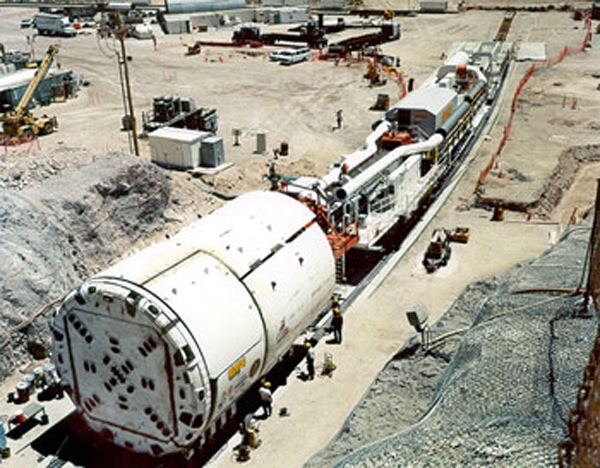
The machine descends. The boring head — a thermal cutting face powered by a compact nuclear heat source — enters the access shaft at an angle calibrated for the target depth. Behind it, the tunnel takes shape: a perfectly circular bore with walls of vitrified rock that will never need maintenance, never crack, never leak. The spoil does not exist. The rock was not removed. It was restructured — transformed from fractured geology into a structural material stronger than anything human engineers could pour or place.
The descent angle determines the facility’s relationship to the surface. Shallow angles connect to existing infrastructure — airports, military bases, government buildings — through access tunnels that can be sealed and concealed within surface-level security perimeters. Steep angles provide direct vertical access for personnel elevators and material handling. The deepest facilities, at depths exceeding one mile, are accessible only through the transit tunnel network itself. They have no surface connection. They have no visible footprint. They exist entirely within the geological formation.
Every deep underground facility begins with this moment: the machine entering the earth. Once the bore begins, the construction timeline is measured in months, not years. The nuclear subterrene does not rest. It does not require shift changes. It does not generate noise detectable at the surface. It simply melts forward, inch by inch, mile by mile, creating the corridors of an infrastructure that its builders intend to outlast every structure on the surface above it.
From Transhuman Genocide: The Underground Report — the book that maps what they built beneath your feet.