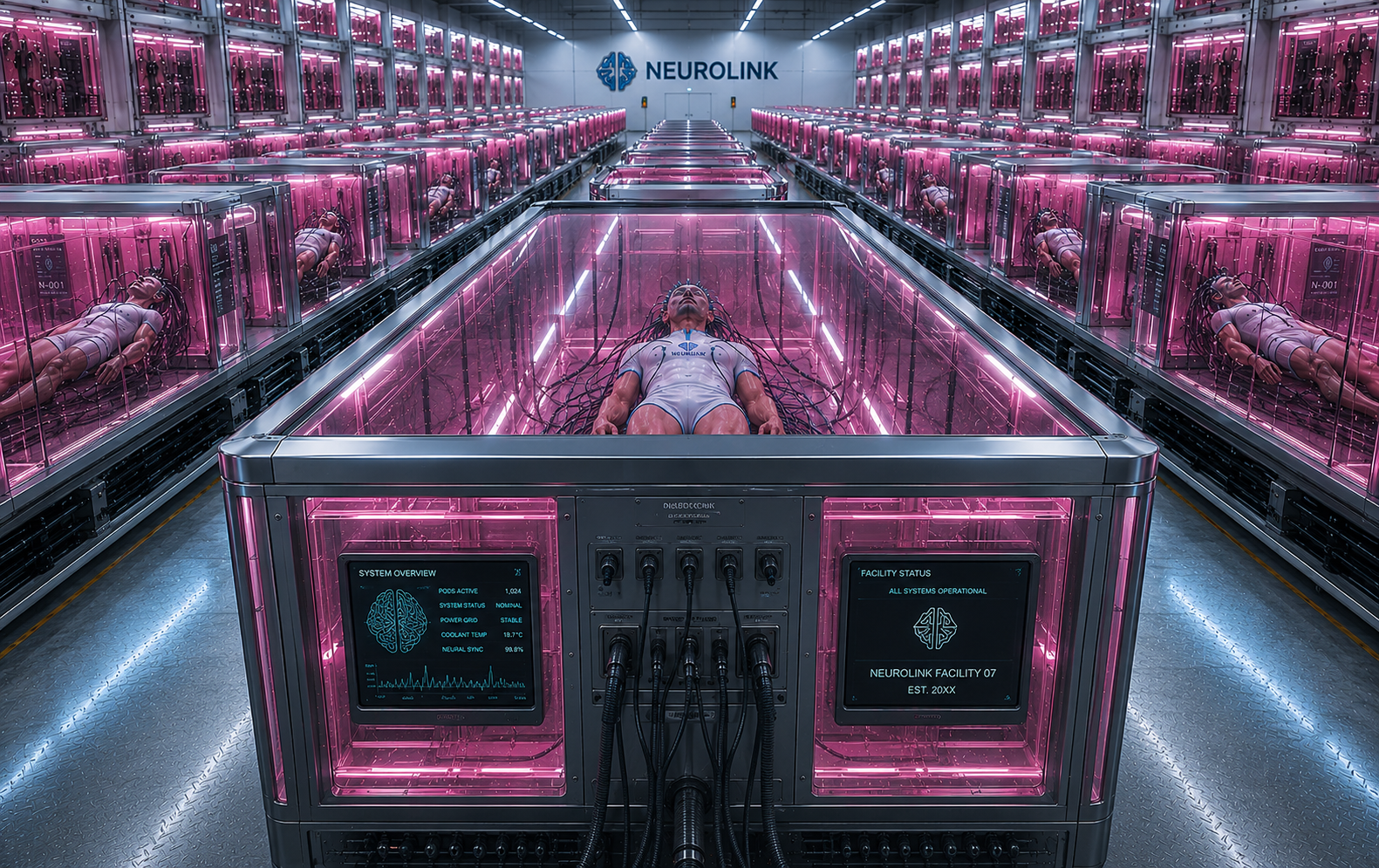
Rows of pods stretching into infinity. Each one contains a human body — eyes closed, skull capped with neural interface hardware, immersed in a pinkish-purple nutrient solution. The monitors at the base display brain activity patterns and system status. Neurolink Facility 07. Est. 20XX. All Systems Operational.
This is the image from The Matrix that everyone remembers — the human battery farm where bodies are kept alive to power the machine civilization. In 1999, audiences watched it and called it science fiction. In 2026, the technology to implement every element of this system exists in documented form.
Brain-computer interfaces that read and write neural signals — operational at Neuralink and Cortical Labs. Nutrient suspension systems that maintain biological tissue indefinitely — operational in medical research facilities worldwide. Wireless neural monitoring via electromagnetic fields — patented by the United States government. Quantum computing architectures that model human consciousness as a computational resource — operational inside classified military facilities.
The convergence is not theoretical. It is logistical. The only question is whether the system has already begun implementing the full integration, or whether what we are seeing — the 5G rollout, the BCI push, the vaccination pipeline, the synthetic telepathy patents — is the preparation phase for a transition that happens all at once.
The pods in this image are not powered by electricity. They are powered by consciousness. The human brain generates approximately 20 watts of electrical power and processes information at speeds that silicon cannot replicate. Wetware computing — biological neurons integrated with silicon architectures — offers computational density that makes conventional processors obsolete. Every pod in this facility is not storing a person. It is running a program. And the program is the matrix itself.
Transhuman Genocide: The Underground Report — available soon.