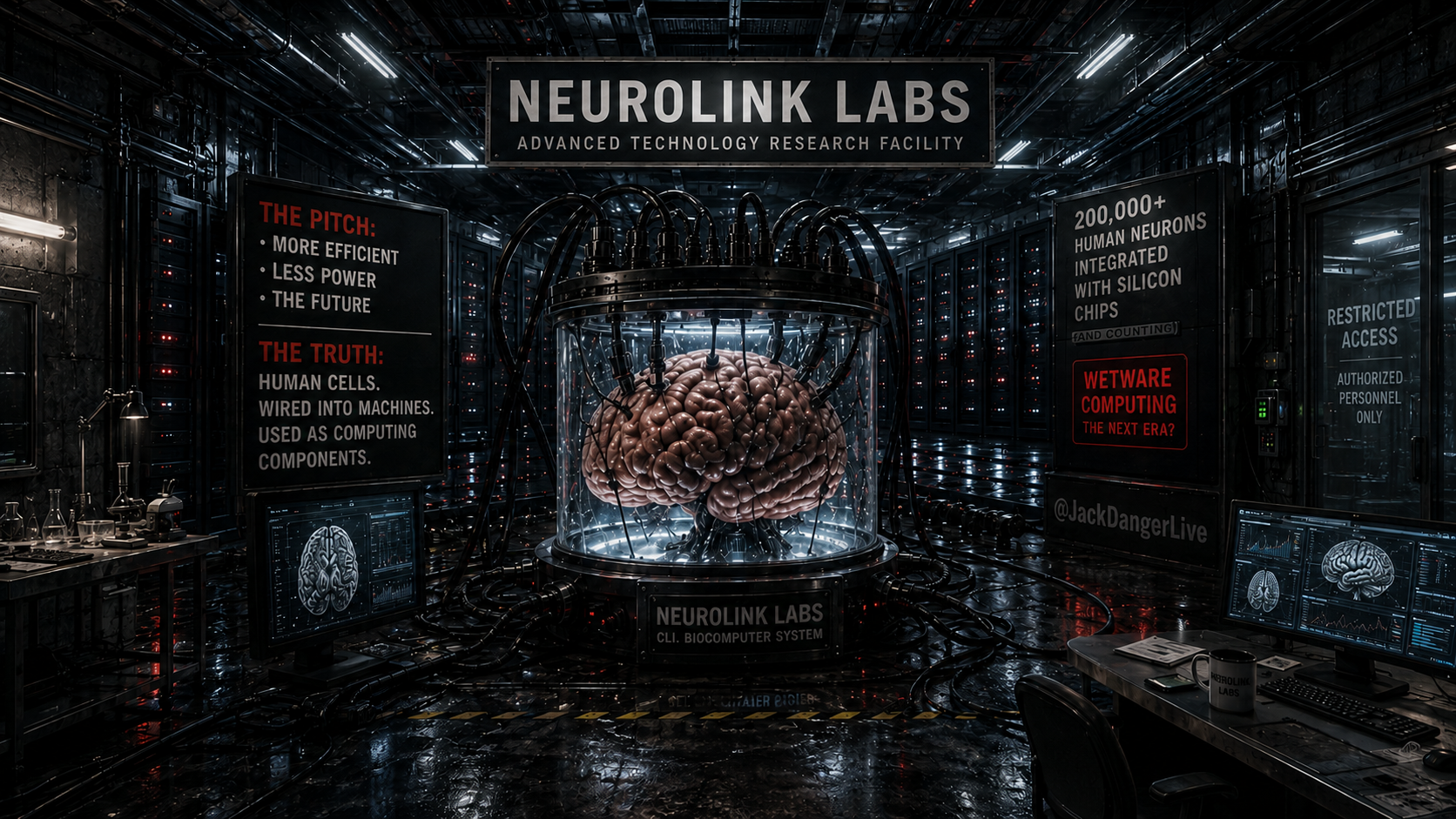
A human brain floats in a glass cylinder, wired into a machine. The room is dark, industrial, dripping with the aesthetic of a facility that does not care about appearances because nobody unauthorized will ever see it. The signs tell the story the marketing never will.
The Pitch: More efficient. Less power. The future.
The Truth: Human cells fused into machines. Used as computing components.
200,000+ human neurons integrated with silicon chips. Wetware Computing. The Next Gray. Restricted Access. Authorized Personnel Only.
This is the convergence point — where biotechnology and computing cease to be separate disciplines and merge into something that has no public name because the public was never meant to know it exists. Wetware computing — the use of living biological neurons as processing elements inside silicon architectures — is not theoretical. Cortical Labs in Melbourne demonstrated a system called DishBrain in 2022 that used 800,000 living human neurons to play Pong. The neurons learned. They adapted. They computed.
That was the public version. The version operating behind classification barriers has had decades of additional development, unlimited biological material from sources that will never be audited, and computing requirements driven by military applications where performance matters more than ethics.
The purpose of assimilation is to turn the human mind into an avatar for the government’s military matrix. The BCI pipeline, the 5G infrastructure, the vaccination program — all of it feeds a system designed to connect human neural tissue to a quantum computing architecture that treats consciousness as a resource to be harvested and integrated.
The brain in this jar is not a metaphor. It is a component. And the machine it powers does not care whether the neurons came willingly.
Transhuman Genocide: The Underground Report — available soon.