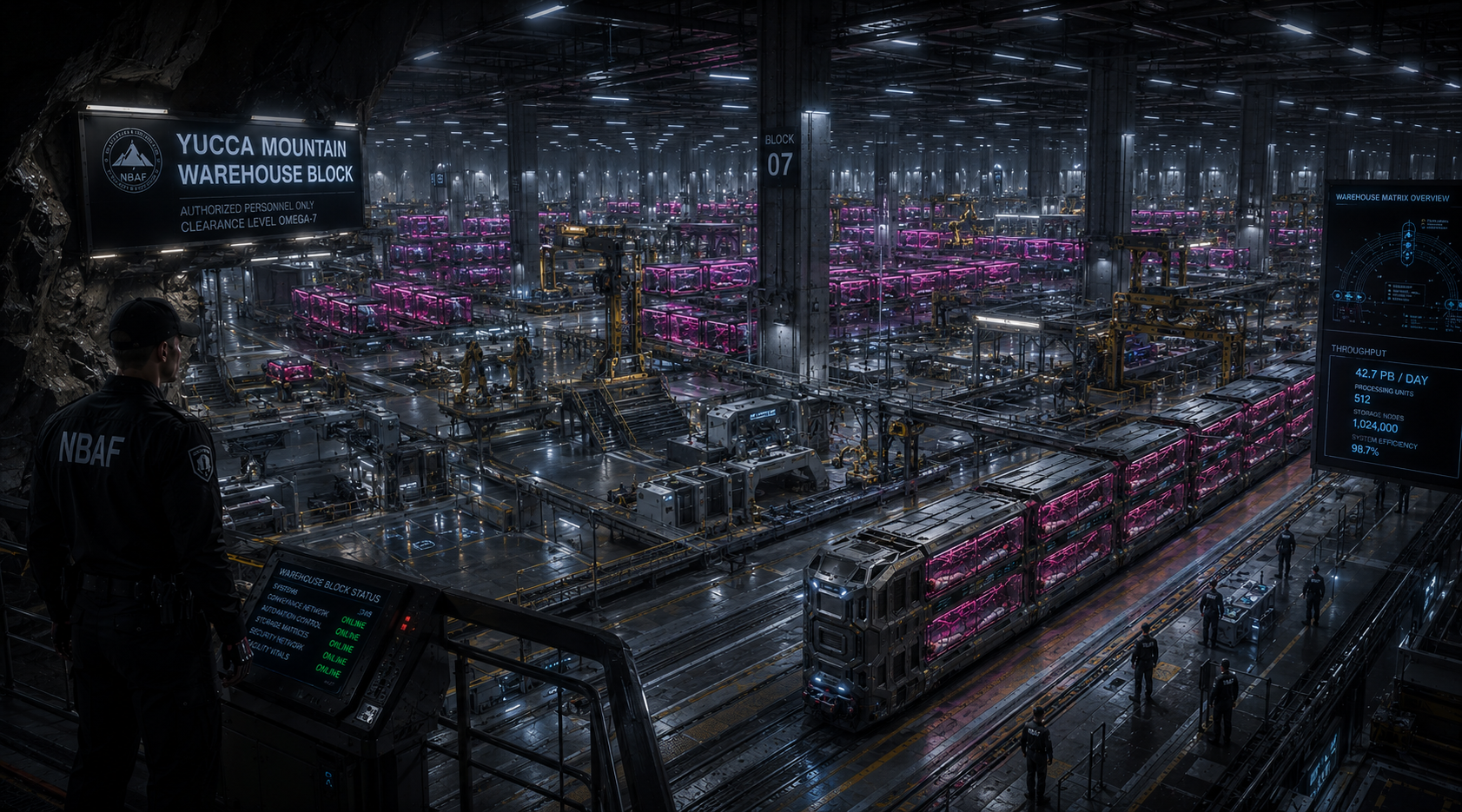
Beneath the surface of the Earth, a parallel infrastructure exists that most people never consider. While the public debate over Yucca Mountain in Nevada centered on whether it should store nuclear waste, the deeper story involves a global network of underground facilities — some governmental, some corporate — that have been quietly expanding for decades. These facilities store everything from irreplaceable cultural artifacts to classified military hardware, and their scale dwarfs anything visible on the surface. The real question is not whether underground storage exists. It is how much of it operates beyond public oversight, and what exactly is being stored in the facilities that never appear in congressional testimony.
Iron Mountain Incorporated, the publicly traded records management company, operates out of a former limestone mine in Germantown, Pennsylvania, with additional underground facilities in Boyers, Pennsylvania, and other locations. The Boyers facility alone spans over 1,000 acres of underground space carved from a limestone deposit 220 feet below the surface. Originally mined in the early 1900s, it was converted for secure storage in 1954. Today, Iron Mountain stores physical and digital records for Fortune 500 companies, government agencies, and cultural institutions. The Smithsonian, Warner Bros., and the U.S. federal government all maintain holdings in these limestone caverns, where the constant 65-degree Fahrenheit temperature and low humidity create ideal preservation conditions. Iron Mountain reported revenues exceeding $5.9 billion in fiscal year 2024, much of it from underground and secured storage operations that most of their corporate clients never physically visit.
The Yucca Mountain repository itself was authorized by the Nuclear Waste Policy Act of 1982 and designated as the sole U.S. site for permanent disposal of high-level radioactive waste and spent nuclear fuel. The Department of Energy spent over $15 billion on site characterization and construction before the Obama administration defunded the project in 2010, citing political opposition from the state of Nevada. The facility was designed to store 70,000 metric tons of radioactive material in tunnels bored into volcanic tuff — a type of rock formed from compressed volcanic ash — located approximately 1,000 feet below the surface and 1,000 feet above the water table. The mountain itself sits within the boundaries of the Nevada National Security Site, formerly the Nevada Test Site, where the U.S. conducted 928 nuclear tests between 1951 and 1992. Despite its official cancellation, the tunnel boring and excavation work that was completed represents one of the largest underground construction projects in American history, with over five miles of tunnels already bored using a 25-foot-diameter tunnel boring machine manufactured by the Robbins Company.
Finland provides the clearest example of what a fully operational deep geological repository looks like. The Onkalo spent nuclear fuel repository, located on the island of Olkiluoto near the municipality of Eurajoki, has been under construction by Posiva Oy since 2004. Licensed by the Finnish Radiation and Nuclear Safety Authority (STUK), Onkalo reaches a depth of approximately 450 meters into Precambrian bedrock that is 1.8 billion years old. The facility is designed to store spent nuclear fuel in copper-iron canisters surrounded by bentonite clay, sealed within boreholes drilled into tunnel floors. Finland became the first country in the world to begin final disposal operations, with the facility receiving its operating license in 2024. The design life of Onkalo is extraordinary — the facility is engineered to remain stable and secure for at least 100,000 years, a timeframe that exceeds the entire span of recorded human civilization by an order of magnitude.
Sweden is building a comparable facility at Forsmark, operated by the Swedish Nuclear Fuel and Waste Management Company (SKB). The Canadian Nuclear Waste Management Organization (NWMO) has selected a site near Ignace, Ontario, for its own deep geological repository. Switzerland, France, and Japan all have programs at various stages of development. Each of these projects involves boring hundreds of meters into stable geological formations and constructing tunnel networks designed to last longer than any human structure ever built. The combined investment in these programs runs into tens of billions of dollars. The Cigéo project in Meuse/Haute-Marne, France, operated by Andra (the French National Radioactive Waste Management Agency), is budgeted at approximately 25 billion euros and will excavate tunnels in Callovo-Oxfordian clay 500 meters underground.
The automation of underground logistics has accelerated dramatically. Amazon operates fulfillment centers that move products using fleets of Kiva robots — now branded as Amazon Robotics — with over 750,000 robotic drive units deployed across its global network as of 2024. These systems use coordinated algorithms to transport shelving units weighing up to 1,250 pounds to human packing stations, processing millions of items per day. Amazon’s fulfillment throughput exceeds 4.75 billion packages per year in the United States alone. The technology that enables this — autonomous mobile robots, computer vision-based inventory tracking, AI-driven demand forecasting — is not limited to above-ground retail logistics. The same robotic systems, or their military-specification equivalents, are readily adaptable to underground environments where human labor is impractical or where operational security requires minimal personnel.
DARPA’s Strategic Underground Laboratory (SUL) program and the Defense Threat Reduction Agency’s (DTRA) tunnel detection research have invested hundreds of millions of dollars in understanding and operating within subterranean environments. The Army’s 2019 announcement of a $572 million program to train soldiers for underground warfare — covering facilities beneath major cities and purpose-built military tunnel complexes — confirmed that the Pentagon treats subsurface infrastructure as a critical domain. The U.S. military operates its own hardened underground facilities, most famously the Cheyenne Mountain Complex in Colorado Springs, which was built inside a granite mountain and designed to survive a direct nuclear strike. Raven Rock Mountain Complex in Pennsylvania, also known as Site R, serves as the alternate Pentagon. Mount Weather in Virginia houses FEMA’s continuity-of-government operations. These are not speculative — they are acknowledged facilities with dedicated funding lines in the defense budget.
The scale of tunnel boring technology itself has evolved substantially. The Boring Company, founded by Elon Musk in 2016, has publicly demonstrated tunnel boring machines and completed the Las Vegas Convention Center Loop. But the U.S. military has operated tunnel boring machines since at least the 1960s. The Air Force’s report on deep underground construction, published through the Waterways Experiment Station at the Army Corps of Engineers, detailed methods for creating hardened underground facilities using both conventional mining techniques and nuclear excavation — the latter being studied under Project Plowshare, which explored using nuclear detonations for large-scale earth moving between 1961 and 1973. The Atomic Energy Commission conducted 27 Plowshare tests before the program was canceled. The possibility that nuclear boring technology continued under classified programs has been raised by multiple defense analysts, though no declassified documentation confirms ongoing development.
The logistics requirements of maintaining an underground facility at operational capacity are staggering. Ventilation, power generation, water supply, waste removal, communications — each of these systems must function independently of surface infrastructure to justify the hardened status of the facility. The Cheyenne Mountain Complex, for example, is built on 1,319 springs designed to absorb the shock of a nuclear blast and contains its own power plant, water supply, and air filtration system. The facility can operate in a fully sealed condition for up to 30 days. The construction cost in 1961 dollars was $142 million, equivalent to over $1.4 billion today. If the acknowledged facilities require this level of investment and engineering, the classified facilities operating without congressional oversight or public knowledge would logically require equal or greater resources — drawn from the Pentagon’s unaudited budget, which the Department of Defense Inspector General has acknowledged contains trillions of dollars in unsupported accounting adjustments.
What emerges from the documented evidence is a picture of a world with far more underground infrastructure than the public generally imagines. From Iron Mountain’s limestone caverns storing corporate and cultural records, to Finland’s 100,000-year nuclear repository, to Amazon’s robotic logistics networks, to the Pentagon’s acknowledged hardened mountain complexes — the technology and the precedent for massive underground operations are thoroughly established. The distance between what is publicly acknowledged and what may exist behind classification barriers is the central question this site investigates. When the infrastructure exists, the technology is proven, the funding is available through unaudited channels, and the institutional culture of secrecy is deeply entrenched, the burden of proof shifts to those who claim that nothing else is down there.