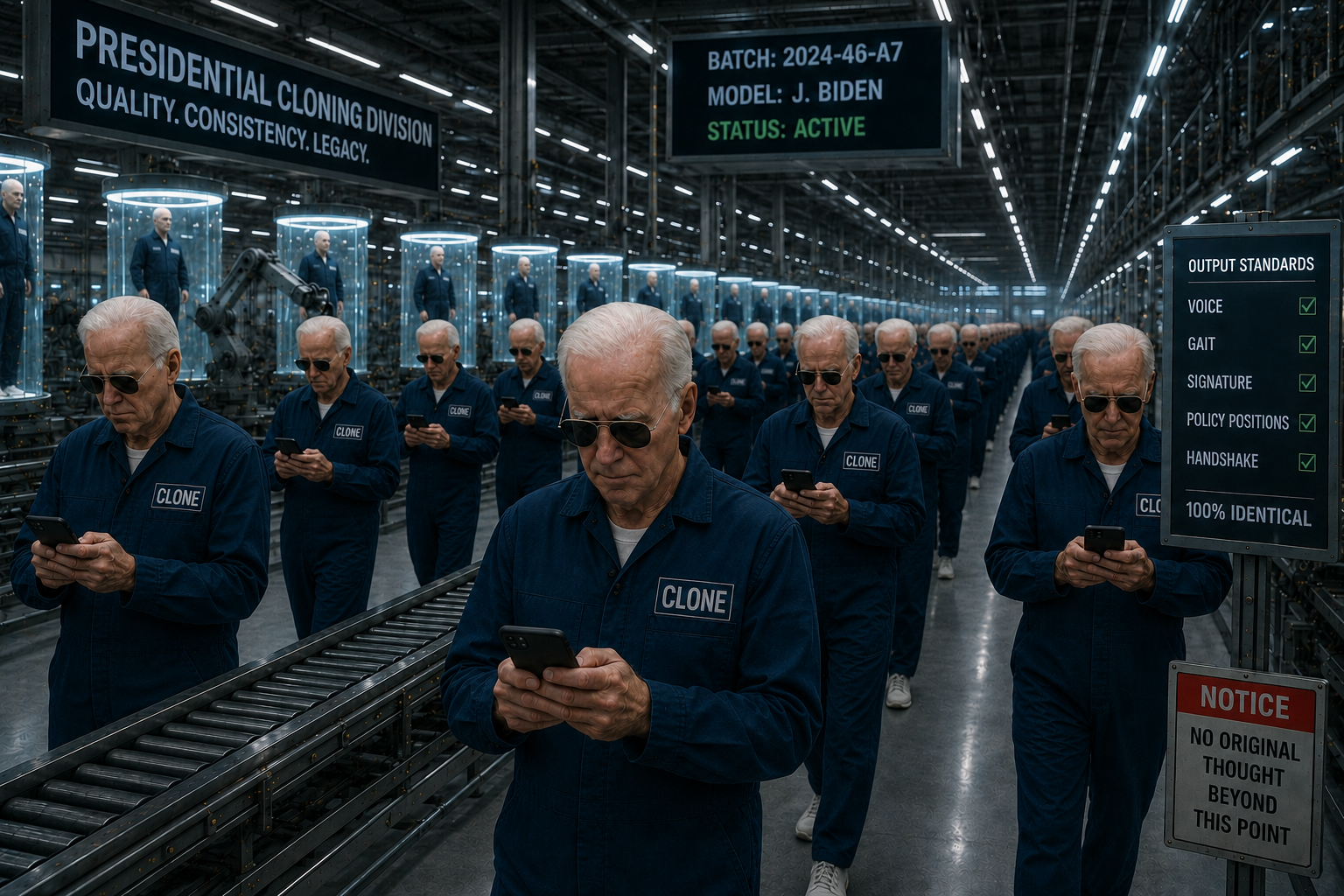
The premise of replacing a political leader with an indistinguishable copy belongs to fiction. But the technologies that make such a scenario operationally plausible — real-time deepfake generation, voice cloning, and AI-driven behavioral simulation — are not fictional at all. They are commercially available, improving at a rate that outpaces every detection method deployed against them, and have already been used in political contexts with documented consequences. Simultaneously, the United States maintains a vast, partially classified infrastructure specifically designed to ensure continuity of government in scenarios where the president and the constitutional line of succession may be incapacitated or killed. The intersection of these two realities — synthetic media capable of fabricating any public figure with increasing fidelity, and a shadow governance architecture designed to operate without public knowledge — deserves factual, rigorous examination.
Deepfake technology has progressed from research curiosity to political weapon in under a decade. The term “deepfake” was coined in 2017 when a Reddit user began posting AI-generated face-swap videos. By 2024, the technology had advanced to the point where AI-generated video of political figures could be produced in real time with consumer-grade hardware. In January 2024, an AI-generated robocall impersonating President Joe Biden’s voice was sent to thousands of New Hampshire primary voters, urging them not to vote. The call was traced to a political operative who used ElevenLabs’ commercial voice cloning service — a platform available to anyone for approximately $5 per month — to generate the synthetic audio. The FCC responded by ruling that AI-generated voice calls violate the Telephone Consumer Protection Act, but the incident demonstrated that the barrier to creating convincing synthetic political speech has collapsed to near zero.
The research community has documented the scale of the threat. A 2023 study by University College London found that humans correctly identified deepfake audio only 73% of the time — essentially performing only marginally better than random chance. Microsoft’s VALL-E model, published in January 2023, demonstrated the ability to clone any person’s voice from a three-second audio sample with sufficient fidelity to deceive both human listeners and automated speaker verification systems. OpenAI’s Sora, announced in February 2024, produces photorealistic AI-generated video that can depict any scenario described in a text prompt. While OpenAI has restricted political uses of its tools, the underlying architecture — diffusion-based video generation — has been replicated in open-source projects including Stable Video Diffusion, which anyone can run locally without content policy restrictions. The Defense Advanced Research Projects Agency recognized this trajectory early: DARPA’s Media Forensics (MediFor) program, funded from 2016 to 2020, and its successor Semantic Forensics (SemaFor) program, specifically focus on developing automated tools to detect manipulated and AI-generated media. The existence of these programs confirms that the Department of Defense considers synthetic media a national security threat.
The political application of AI-generated content has already moved beyond isolated incidents. In the 2023 Slovak parliamentary elections, an AI-generated audio recording of liberal party leader Michal Simecka purportedly discussing plans to buy votes circulated on social media 48 hours before the election — too late for effective fact-checking. Slovakia’s Progressive Slovakia party lost the election. In Argentina, both major presidential campaigns used AI-generated images of their opponents in negative advertising during the 2023 election. In Bangladesh, deepfake videos of opposition politicians making inflammatory statements were circulated before the January 2024 elections. The World Economic Forum’s 2024 Global Risks Report ranked AI-generated misinformation and disinformation as the number one global risk for the next two years, ahead of extreme weather events and armed conflict.
The continuity-of-government infrastructure that the United States has maintained since the early Cold War provides an essential factual context for understanding how executive power is preserved and transferred during crises. The Federal Relocation Arc — a network of hardened facilities within approximately 300 miles of Washington, D.C. — was established during the Eisenhower administration and has been continuously maintained and upgraded since. The principal facilities include Raven Rock Mountain Complex (Site R) in Adams County, Pennsylvania, which serves as the alternate Pentagon and can house several thousand personnel; Mount Weather Emergency Operations Center in Bluemont, Virginia, operated by FEMA, which serves as the relocation site for executive branch leadership; and the Cheyenne Mountain Complex in Colorado Springs, which houses NORAD and USNORTHCOM. These are acknowledged facilities with unclassified descriptions in Government Accountability Office reports and defense authorization bills.
The classified tier of the continuity-of-government program is substantially less transparent. Executive Directive 51 (NSPD-51/HSPD-20), signed by President George W. Bush in May 2007, established the National Continuity Policy. The directive defines an “enduring constitutional government” framework and assigns responsibilities for maintaining essential functions during a catastrophic emergency — defined as any event that results in extraordinary levels of casualties, damage, or disruption severely affecting the U.S. population, infrastructure, environment, economy, or government functions. When Congressman Peter DeFazio, a member of the House Homeland Security Committee, requested access to the classified annexes of NSPD-51 in 2007, his request was denied. A sitting member of the congressional committee with oversight responsibility for homeland security was not permitted to read the classified details of the plan for preserving the U.S. government during a catastrophic emergency. DeFazio publicly stated his concern that the classified annexes contained provisions that Congress had not authorized and the public would find troubling.
The physical infrastructure supporting these programs is substantial. In addition to the acknowledged facilities, investigative journalists and researchers have documented evidence of additional underground installations. Author and journalist Garrett Graff’s 2017 book “Raven Rock: The Story of the U.S. Government’s Secret Plan to Save Itself — While the Rest of Us Die” documents the history and expansion of the COG infrastructure using declassified documents, interviews with former officials, and Freedom of Information Act requests. Graff documents that the government maintained not only bunkers for leadership but fully equipped alternate facilities capable of running the executive branch for extended periods, complete with communications equipment, operations centers, and living quarters. The budget for these programs flows through classified line items in the defense and intelligence budgets, making full public accounting impossible.
During the September 11, 2001, attacks, the COG infrastructure was activated for the first time since its establishment. Vice President Dick Cheney was evacuated to the Presidential Emergency Operations Center beneath the White House and subsequently to an undisclosed location. Speaker of the House Dennis Hastert was evacuated to a classified facility. Key members of the presidential line of succession were dispersed to hardened sites to ensure that no single attack could eliminate the entire constitutional chain of command. The operational details of this activation remain partially classified more than two decades later. What is known is that the system functions as designed: it physically separates constitutional successors and places them in hardened, communications-equipped facilities where they can exercise executive authority even if Washington, D.C., is destroyed.
The convergence of deepfake technology and continuity-of-government infrastructure creates a specific national security concern that has been raised in open-source defense literature. If AI-generated media can produce a convincing simulacrum of any political leader — their face, voice, mannerisms, and speaking patterns — and if the continuity-of-government apparatus places executive authority in classified facilities beyond public view, then the verification problem becomes acute. How does the public — or for that matter, the military chain of command — confirm that a presidential communication originating from a classified COG facility is authentic? The Department of Defense’s nuclear command and control system uses authentication codes and procedural safeguards designed to verify presidential identity and intent. But these systems were designed before AI could generate real-time synthetic video and audio of any human being. The RAND Corporation’s 2022 report “The Emerging Risk of Virtual Societal Warfare” specifically identifies the intersection of synthetic media and crisis communication as an area requiring urgent attention from defense planners.
The documented elements assembled here — commercially available deepfake technology capable of real-time political impersonation, classified continuity-of-government facilities operating beyond congressional oversight, AI-generated political content already influencing elections worldwide, and nuclear command authentication systems designed before the synthetic media era — describe a landscape in which the authenticity of political leadership is becoming an increasingly difficult technical problem. This is not a claim that leaders have been replaced. It is a factual observation that the technology to convincingly simulate any public figure now exists, that the infrastructure for governing from hidden locations is maintained at enormous expense, and that the safeguards designed to verify authentic leadership communication have not kept pace with the capabilities designed to defeat them. This convergence is one of the core investigative threads documented across this site, and it connects directly to the broader questions about advanced technology, underground infrastructure, and the integrity of the systems that govern public life.