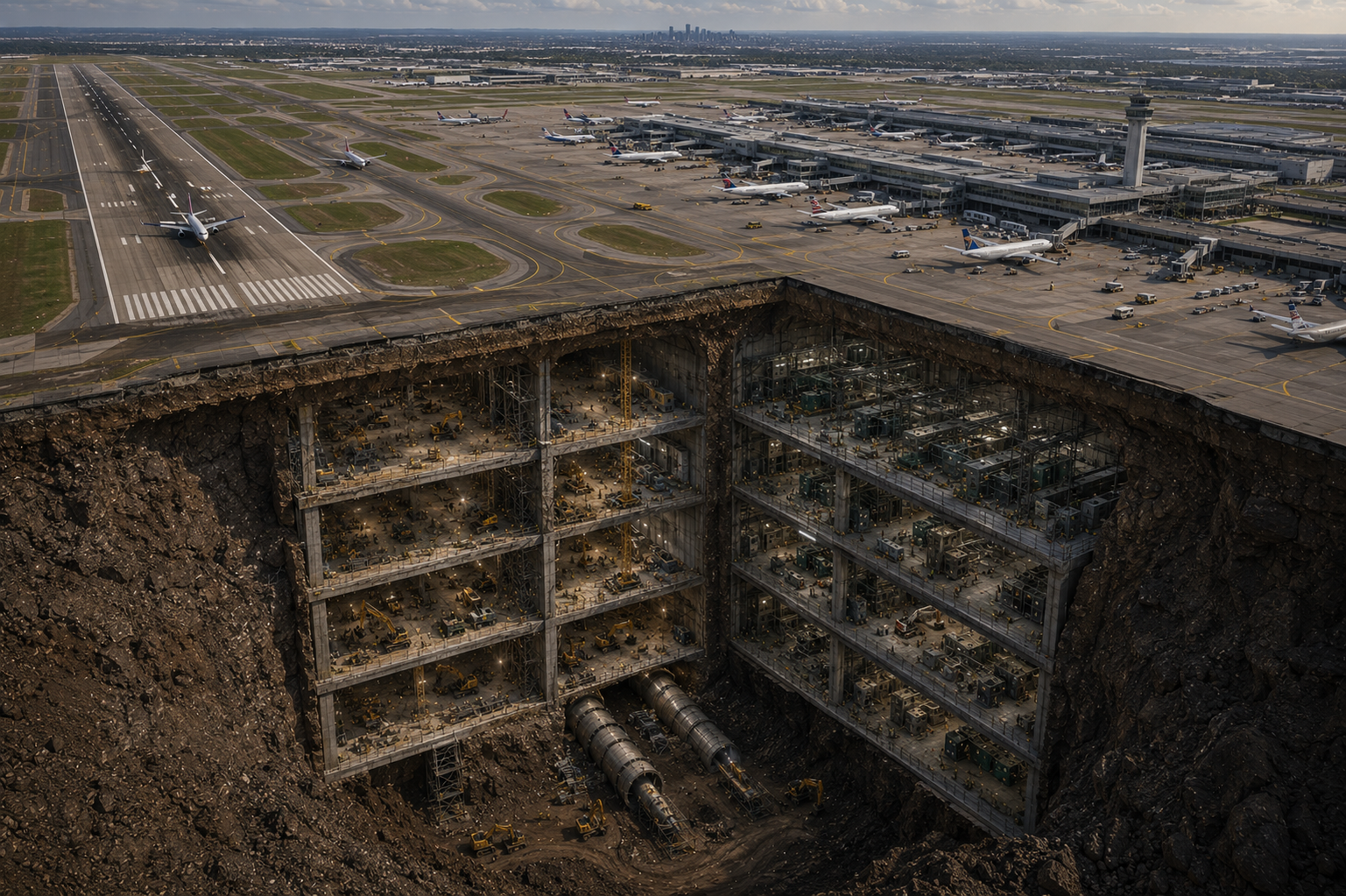
The cross-section reveals what satellite imagery never can. Beneath a commercial airport — planes taxiing on the runway, passengers collecting luggage in the terminal above — sits a multi-level subterranean installation extending six stories below grade. Hardened concrete floors connected by industrial elevator shafts. Server rooms. Laboratories. Ventilation systems drawing air through shafts disguised as surface maintenance infrastructure. Power feeds rated for thousands of personnel. Sewage treatment plants sized for a population that no surface building could ever house.
Phil Schneider testified before his death that he personally helped construct thirteen of these facilities. He described nuclear-powered tunnel boring machines capable of melting through rock at seven miles per day, leaving behind vitrified glass walls requiring no structural reinforcement. By 1995, the network had grown to 131 active facilities in the United States alone. The U.S. Patent Office confirmed the technology: Patent 3,693,731, granted September 26, 1972, describes exactly the nuclear subterrene Schneider described.
Denver International Airport’s construction removed 110 million cubic yards of earth — more than was displaced during the English Channel Tunnel. The official explanation was drainage. Five stories of underground infrastructure for drainage. Every major airport construction project of the last forty years has involved excavation far deeper than any terminal requires. The planes land on top of it. The passengers walk over it. And the installation beneath them officially does not exist.
From Transhuman Genocide: The Underground Report — the book that maps what they built beneath your feet.