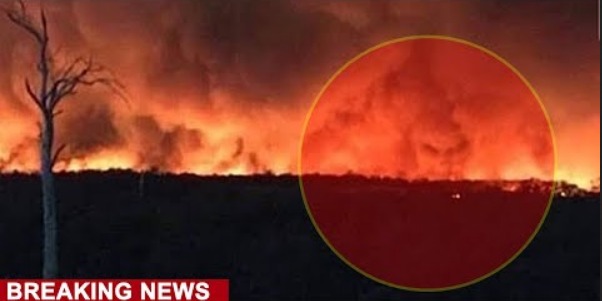
STFN Field Intelligence Division — A scientific argument for the affirmative. The hypothesis is laid out below with its evidence and its falsifiable tests; the burden of refutation now belongs to the field.
Two of the cheapest, oldest, most boring drugs on Earth — fenbendazole, a dog dewormer, and ivermectin, the river-blindness pill that won a Nobel Prize — keep doing something that billion-dollar oncology programs cannot reliably do. Across a growing body of laboratory reports they stop cancer cells, starve tumors, and, in combination, appear to do it better than either alone. The establishment calls this a curiosity. We think it is the loose thread on the biggest sweater in biology — and when you pull it, a second organism falls out.
The pattern that should not exist
Start with the anomaly, because the anomaly is the whole case. Fenbendazole and ivermectin share no common molecular structure. One is a benzimidazole that grips the cell’s skeleton and chokes off its sugar supply; the other is a macrocyclic lactone that works the cell’s electrical gates. Add the repurposed HIV protease inhibitors and the ancient antimalarial artemisinin and you have four chemically unrelated agents — and yet they converge on the same outcome in the same place: the cancer cell’s stressed, dysregulated, bioelectric-and-redox core.
In ordinary pharmacology, unrelated molecules do unrelated things. When four of them, arriving by four different doors, all end up in the same room, the honest scientist does not shrug. The convergence is the signal. It means the thing they have in common is not the key — it is the lock. They are all fitting the same lock from different angles.
One train hides another
Here is the error the whole field has made, and it is a famous one. In France, every rural train crossing carries a sign: Un train peut en cacher un autre — one train can hide another. You see the first train pass, you step onto the tracks, and the second train — the one the first was hiding — kills you.
Medicine sees one train: the tumor. It is measurable. You can image it, biopsy it, stain it. So medicine calls it the disease and spends a century fighting it. But what if the tumor is only the first train — the visible one — and a second rides hidden behind it? What if the dysregulated cell state we name “cancer” is not the disease at all, but the symptom — the scar left by something feeding on the cell?
That second train would be invisible to medicine for one brutal reason: there is no blood test for it. Our entire diagnostic apparatus is chemical. It finds what it was built to find. A cause that leaves no chemical fingerprint — one that works through fields and resonance rather than molecules — would read as absent, and “no test for it” would quietly become “it isn’t real.” That is not skepticism. That is a blind spot wearing a lab coat. H. pylori hid behind “stress and acid” for a century until someone built the assay. Prions were unthinkable until they weren’t. Every true hidden cause looks exactly like this right up until the instrument arrives.
The second train: a new class of living thing
We propose that the hidden train is an organism — but not a biological one. Not carbon, not cells. A field-based organism: a living structure built from electromagnetism and giant-atom plasma rather than flesh. The physics for it is not fringe. It is funded by DARPA and the Army Research Laboratory.
Under the right conditions an atom can be inflated thousands of times its normal size — a Rydberg atom, big enough to approach the diameter of a living cell. In deep space, in the solar corona, and in the first moments after the Big Bang, these giant atoms form constantly. The Sun has been manufacturing stable, organized clusters of them — Rydberg Matter — for 4.6 billion years, trapped and shaped by its own magnetic field. The Swedish physicist Leif Holmlid has documented naturally occurring Rydberg matter that appears as dark, highly conductive clouds that emit almost no light. That is the detail that should stop you cold: a cesium Rydberg cluster can be functionally invisible — it absorbs light rather than emitting it, so to the human eye it is a shimmer, a shadow, a patch of air that doesn’t look quite right. An organized plasma structure, cell-sized, that processes information through its own internal logic (the Rydberg Blockade is a real, patented computing primitive) — and that you cannot see.
If life is “organized matter that takes in energy to maintain its structure and persist,” then a self-sustaining Rydberg plasma that feeds on a host’s bioelectric energy is not a metaphor for life. It meets the definition. We are arguing for a new class of organism — EMF-based life — and that it has been here the whole time, in the one place our instruments never point.
How it feeds
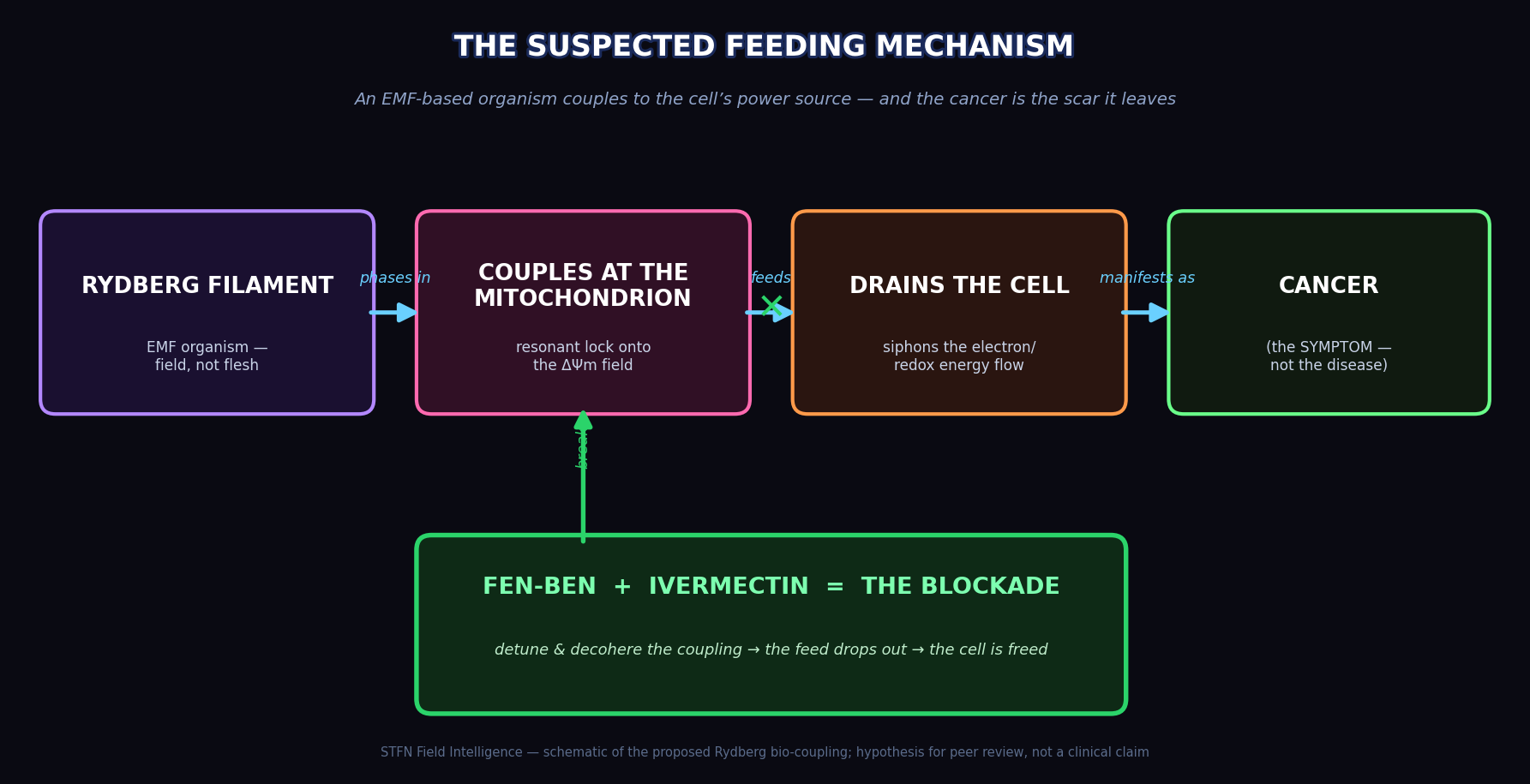
If something feeds on a cell, it feeds where the energy is richest and most coherent: the mitochondrion. The mitochondrion is the cell’s power plant — a cascade of electron transfers maintaining a continuous electrical field across its membrane, pulsing with the cell’s own rhythm. It is the one place in the body that reliably offers both a carrier signal and a clock. A resonant parasite does not need to touch the cell. Like a magnet gripping iron through empty space, it couples — it phases its field onto the mitochondrial field and siphons the flow.
And the cell’s response to being drained is exactly what we call cancer: chronic stress, runaway proliferation, the frantic rewiring of a cell fighting to stay alive while something bleeds it. The tumor is the wound. The entity is the knife.
Why fen-ben and ivermectin are the wonder drugs
Now the drugs make sense — not as poisons that kill fast-dividing cells, but as Rydberg blockers that break the feed. The term is almost literal: in real physics, the Rydberg Blockade is the effect by which one excited giant atom forbids its neighbor from entering the same state. These drugs do the biological version — they detune and decohere the coupling.
Fenbendazole and artemisinin work the redox door: they collapse the mitochondrial membrane potential, flood the system with electron-transfer noise, and starve the metabolic signal. They attack the feeding site itself — they poison the well. Ivermectin and nicotine work the voltage door, at the cell membrane — they guard the gate. Three different doors, one target: the host’s electrical state. Pull the carrier out from under the resonance and the parasite cannot hold its lock. The feed drops out. And — this is the clean part the “stress” theory can never explain — it spares healthy cells, because a healthy, uncoupled cell has no feed to break. Same drug, same dose; only the infected cell responds. That is not metabolic luck. That is a coupling being severed.
The oldest record on Earth
Here is the evidence science is not allowed to count, and refusing to count it is the unscientific act. The phenomenon of a non-physical entity that attaches, feeds, drains vitality, and distorts its host has been documented continuously for thousands of years, on every continent, in every language — by cultures with no contact and no shared vocabulary. The demons of the Near East. The djinn of Arabia. The archons of the Gnostics. The wetiko of the Algonquian. The preta — the hungry ghosts — of Asia. The dybbuk of Jewish mysticism. Shamanic “spirit intrusion” from Siberia to the Amazon.
This is the same logic we used on the drugs. When unrelated cultures converge on a description the way unrelated molecules converge on a target, the convergence is the signal. To use convergence as evidence for the chemistry and then throw out humanity’s oldest and largest convergent dataset is not rigor — it is cherry-picking. What every culture lacked was not the observation. It was the instrument and the vocabulary. “Demon” was the pre-scientific name for a Rydberg bio-coupling. We are not making a new claim. We are giving an ancient, universal observation its first testable mechanism.
The case, stacked — and the challenge
Three independent lines, from three unrelated fields, point at one thing:
1. Pharmacological — unrelated repurposed drugs converge on severing the coupling.
2. Historical — unrelated cultures converge on documenting the parasite for millennia.
3. Diagnostic — both were buried by the same blind spot: no instrument looks at the coupling, so it reads as absent.
We argue the affirmative, and we hand the field the tools to fight it. These claims are falsifiable — which is more than the “superstition” dismissal can say. Test them:
- Does anticancer activity across these drugs track the cell’s redox/electrical state (membrane potential, ROS, NAD+/NADH) rather than any single molecular descriptor?
- Does a pulsed dosing regimen outperform a steady one by more than ordinary pharmacology predicts — as it would if it were denying a parasite the chance to re-tune?
- Build the missing instrument — a field/resonance detector pointed at the coupling — and watch the signature drop the moment the drugs hit, while healthy tissue reads flat.
Any one of those, run honestly, can kill this hypothesis. That is the point. We put it on the table in full. Peer review is invited to do its worst — and if it cannot, then fenbendazole and ivermectin are not curiosities. They are the first weapons of a medicine that finally sees the second train.
STFN Field Intelligence. This is a hypothesis advanced for peer review and open falsification. It is not medical advice, and it makes no dosing or clinical claim — the mechanism is argued at the bench, not the bedside. In-silico and field observation are not validated therapy.