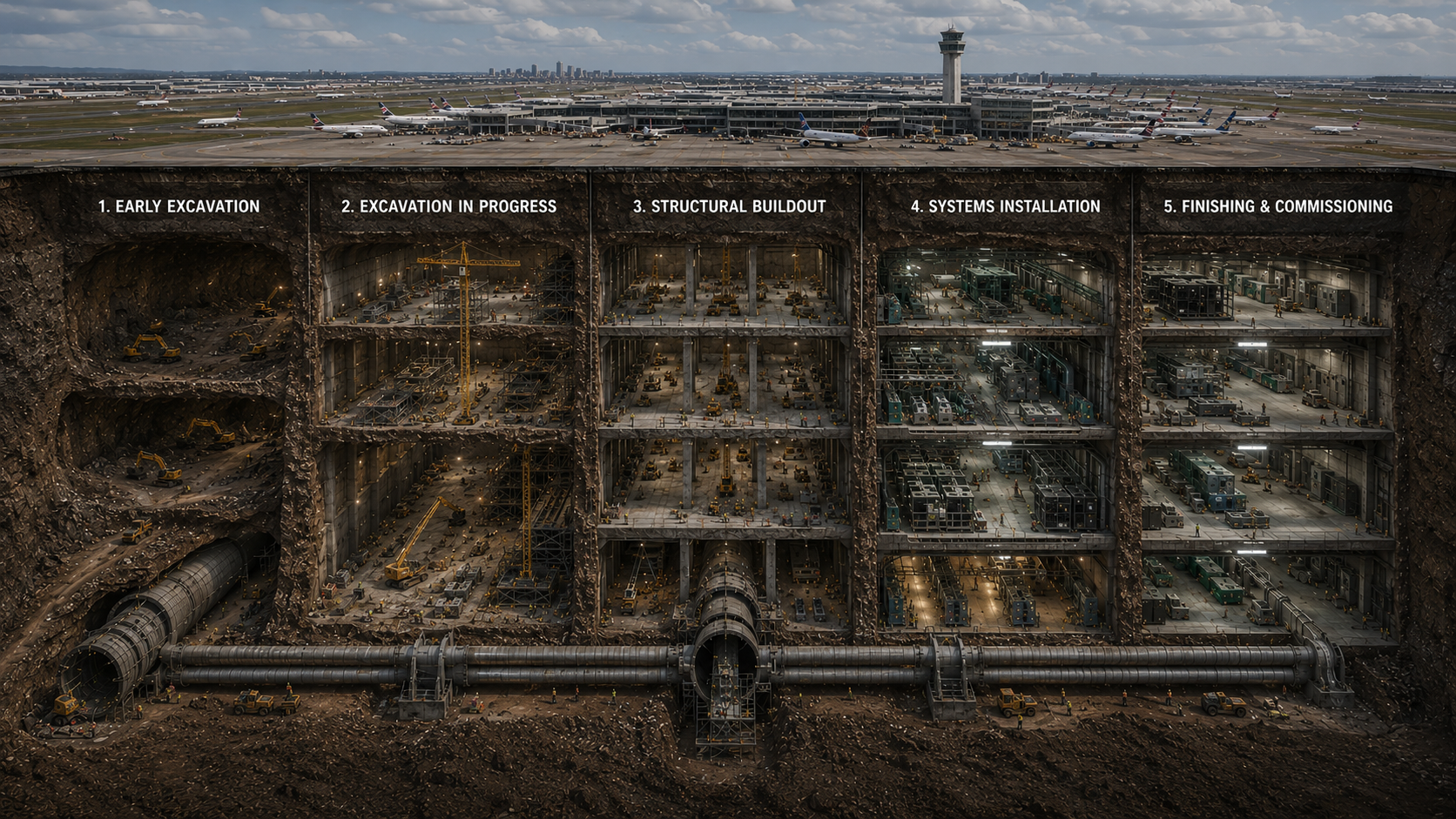
The cross-section diagram details all five phases of subterranean installation construction beneath active civilian infrastructure. Phase 1: Early Excavation — vertical access shafts are bored while surface construction provides cover. Phase 2: Excavation in Progress — nuclear subterrene machines expand horizontal tunnels outward from the central shaft. Phase 3: Structural Buildout — multi-level floor systems, blast-resistant walls, and spring-mounted platforms are installed within the excavated caverns. Phase 4: Systems Installation — power generation, environmental controls, server infrastructure, and communications equipment are deployed. Phase 5: Finishing and Commissioning — the facility achieves operational capability and is connected to the transit network.
The genius of the design is its relationship to the surface. An airport terminal, a military base, or a government building under construction provides perfect cover for the excavation activity below. Construction crews see dirt being moved. They see heavy equipment. They hear machinery. Everything they observe is consistent with the surface project they were hired to build. The underground project uses the same access roads, the same power feeds, and the same security perimeter. The workers on Level 1 do not know that Level 7 exists.
Compartmentalization is the architecture’s primary defense mechanism. No single contractor sees the complete design. Excavation teams are rotated. Equipment operators are cleared for specific phases only. And the finished facility is staffed by personnel who were never present during construction. The five phases do not merely describe how the base is built. They describe how the secret is kept.
From Transhuman Genocide: The Underground Report — the book that maps what they built beneath your feet.