In September 2023, Neuralink Corporation received FDA approval to begin its first human clinical trial, designated the PRIME Study (Precise Robotically Implanted Brain-Computer Interface). By January 2024, the first human patient — Noland Arbaugh, a 29-year-old quadriplegic — had a Neuralink N1 chip implanted in his motor cortex. Within weeks, Arbaugh was controlling a computer cursor with his thoughts, playing chess online, and browsing the internet hands-free. The N1 device contains 1,024 electrodes distributed across 64 ultra-thin polymer threads, each thinner than a human hair, inserted into brain tissue by a proprietary surgical robot designated R1. This is not speculative technology. This is a commercial product undergoing human trials with FDA oversight, manufactured by a company valued at over $5 billion as of its 2024 funding round.
Neuralink is not operating in a vacuum. The brain-computer interface (BCI) market was valued at approximately $2.13 billion in 2023 and is projected to exceed $6.2 billion by 2030, according to Grand View Research. Competitors include Synchron, which received FDA approval for its Stentrode device — a BCI implanted via blood vessel rather than open brain surgery — and successfully implanted its first U.S. patient in July 2022 at Mount Sinai Hospital in New York. Blackrock Neurotech, based in Salt Lake City, has had its Utah Array implanted in over 40 human patients since the early 2000s, making it the most-implanted intracortical BCI in history. Paradromics, funded by DARPA through its Neural Engineering System Design (NESD) program, is developing a high-bandwidth BCI called the Connexus Direct Data Interface, targeting 65,000 simultaneous neural channels — orders of magnitude beyond Neuralink’s current 1,024.
The integration of neural interfaces with autonomous vehicles is no longer confined to research papers. Tesla’s Full Self-Driving (FSD) system, which uses a vision-only neural network architecture running on the company’s HW4 computer, has logged over 1.5 billion miles of supervised autonomous driving as of early 2025. Elon Musk has publicly stated his intention to eventually link Neuralink’s BCI technology with Tesla’s autonomous platform, creating what he describes as a “symbiotic” human-vehicle interface. While no direct Neuralink-Tesla integration product has been announced, the organizational overlap is significant: both companies share a CEO, engineering talent has moved between them, and Tesla’s Dojo supercomputer — designed to train autonomous driving neural networks — uses architectural principles directly applicable to processing neural signal data from BCI implants.
The military trajectory of BCI technology is extensively documented in public records. DARPA’s Restoring Active Memory (RAM) program, launched in 2013 with a budget exceeding $77 million, developed implantable neural devices capable of forming and recalling memories in patients with traumatic brain injury. DARPA’s Next-Generation Nonsurgical Neurotechnology (N3) program, announced in 2018, specifically targets bidirectional brain-computer interfaces that require no surgery — using technologies including focused ultrasound, magnetogenetics, and infrared optical signaling. The program’s stated goal is a wearable BCI with “read and write” capability to at least one million neurons simultaneously. The N3 program issued contracts to six research teams including Battelle Memorial Institute, Carnegie Mellon University, Johns Hopkins University, Rice University, and Teledyne Scientific.
Consumer neural interface products have already entered the market at lower invasiveness tiers. Emotiv, founded in 2011, sells EEG-based headsets including the EPOC X (14-channel) and the MN8 (2-channel), used by over 100,000 customers for applications ranging from neurofeedback to controlling software with thought commands. NextMind, acquired by Snap Inc. in 2022, developed a visual cortex BCI that allowed users to control AR interfaces with focused attention — a technology Snap is integrating into its Spectacles augmented reality platform. Kernel, founded by Bryan Johnson (who also founded Braintree/Venmo), produced the Kernel Flow helmet — a $50,000 non-invasive neuroimaging device using time-domain functional near-infrared spectroscopy (TD-fNIRS) that maps brain hemodynamics with millimeter precision.
The autonomous drone sector has developed in parallel and is converging with neural interface research. The U.S. Air Force Research Laboratory’s Autonomous Collaborative Platforms (ACP) program, along with the Collaborative Combat Aircraft (CCA) initiative, is developing AI-piloted drone wingmen designed to operate alongside manned fighters. Skydio, the leading American drone manufacturer, uses visual-inertial navigation and deep learning to achieve fully autonomous flight without GPS. Shield AI’s V-BAT and Hivemind autonomy stack have been deployed in combat zones for autonomous ISR (intelligence, surveillance, reconnaissance) missions. In 2023, DARPA’s Air Combat Evolution (ACE) program demonstrated an AI pilot defeating a human F-16 pilot in a live dogfight — the first time this had been publicly achieved. The trajectory toward neurally-linked drone swarm control is documented in multiple DARPA solicitations and Air Force research papers.
Humanoid robotics has reached a commercial inflection point. Boston Dynamics’ Atlas robot transitioned from hydraulic to fully electric actuation in April 2024, with the new platform designed explicitly for commercial deployment through Hyundai (which acquired Boston Dynamics for $1.1 billion in 2021). Tesla’s Optimus (Gen 2), demonstrated in December 2023, walks autonomously, manipulates objects with individually actuated fingers, and is targeted for factory deployment at a projected unit cost below $20,000. Figure AI’s Figure 01, backed by a $675 million funding round that included Microsoft, OpenAI, Amazon, NVIDIA, and Jeff Bezos, demonstrated conversational interaction and autonomous task completion using a multimodal AI powered by OpenAI’s models. Agility Robotics’ Digit is already deployed in Amazon warehouses. Apptronik’s Apollo, developed partly under NASA contracts, is designed for logistics and manufacturing. The humanoid robotics market is projected to reach $38 billion by 2035 according to Goldman Sachs Research.
The convergence of these technologies — BCIs, autonomous vehicles, drone systems, and humanoid robotics — is producing an integrated ecosystem that major defense contractors are actively assembling. Lockheed Martin’s Advanced Technology Center has published research on human-machine teaming using neural interfaces. Raytheon (now RTX Corporation) holds patents on “cognitive augmentation” systems for military operators. Northrop Grumman’s autonomous systems division is developing platforms that explicitly anticipate neural-link human operators. The Defense Advanced Research Projects Agency alone has invested over $500 million in neural interface programs since 2000, according to its own published budget documents. These are not classified programs — they are publicly funded, publicly documented, and proceeding on published timelines.
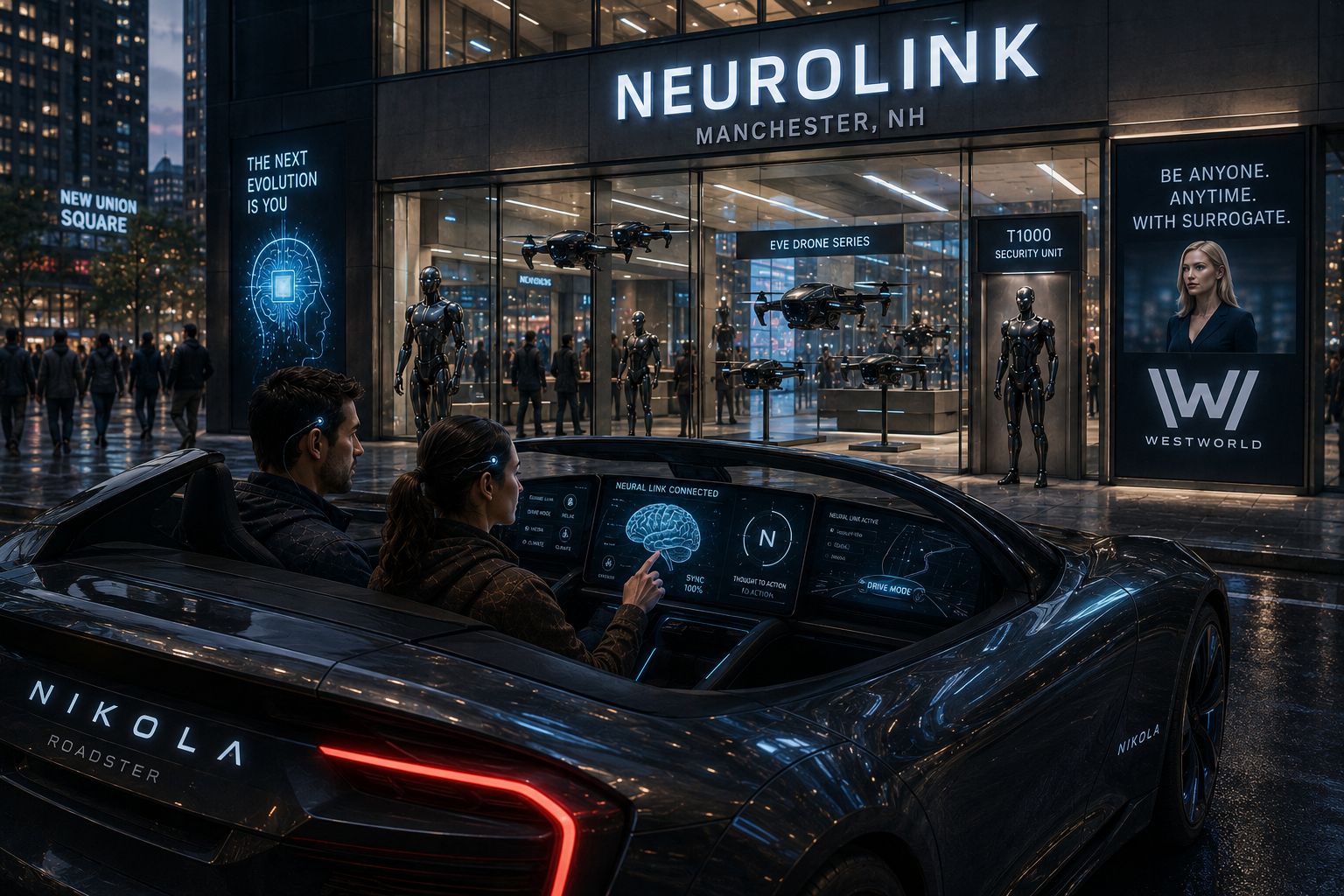
The retail presentation of this technology — the consumer storefront, the friendly branding, the promise of human enhancement — obscures the scale of what is being built. When Neuralink opens its first consumer clinic (planned for late 2025-2026), it will be selling a device whose core technology was developed through decades of DARPA-funded research at universities including Brown, Stanford, MIT, and the University of Pittsburgh. The surgical robot was designed by engineers who previously built surgical systems for Intuitive Surgical (maker of the da Vinci system). The electrode array architecture draws on the Utah Array developed at the University of Utah with federal funding since the 1990s. The consumer product is the visible tip of a research infrastructure that spans the entire U.S. defense and intelligence establishment.
The commercial BCI market represents a transition point in the relationship between human biology and engineered systems. Every major technology company — including Meta (which funded BCI research at UCSF capable of decoding speech from brain activity), Google (through its DeepMind neuroscience division), Apple (which has filed patents for EEG-integrated AirPods), and Microsoft (through its neural interface research group) — is investing in some form of brain-computer interface technology. The question is no longer whether neural interfaces will become consumer products, but who will control the platforms, who will own the neural data, and what regulatory frameworks — if any — will govern direct access to human cognitive architecture. This is the landscape that transhumangenocide.com was built to document: the real, funded, operational programs that are reshaping the boundary between human and machine, reported not through speculation but through the public record these programs have left behind.