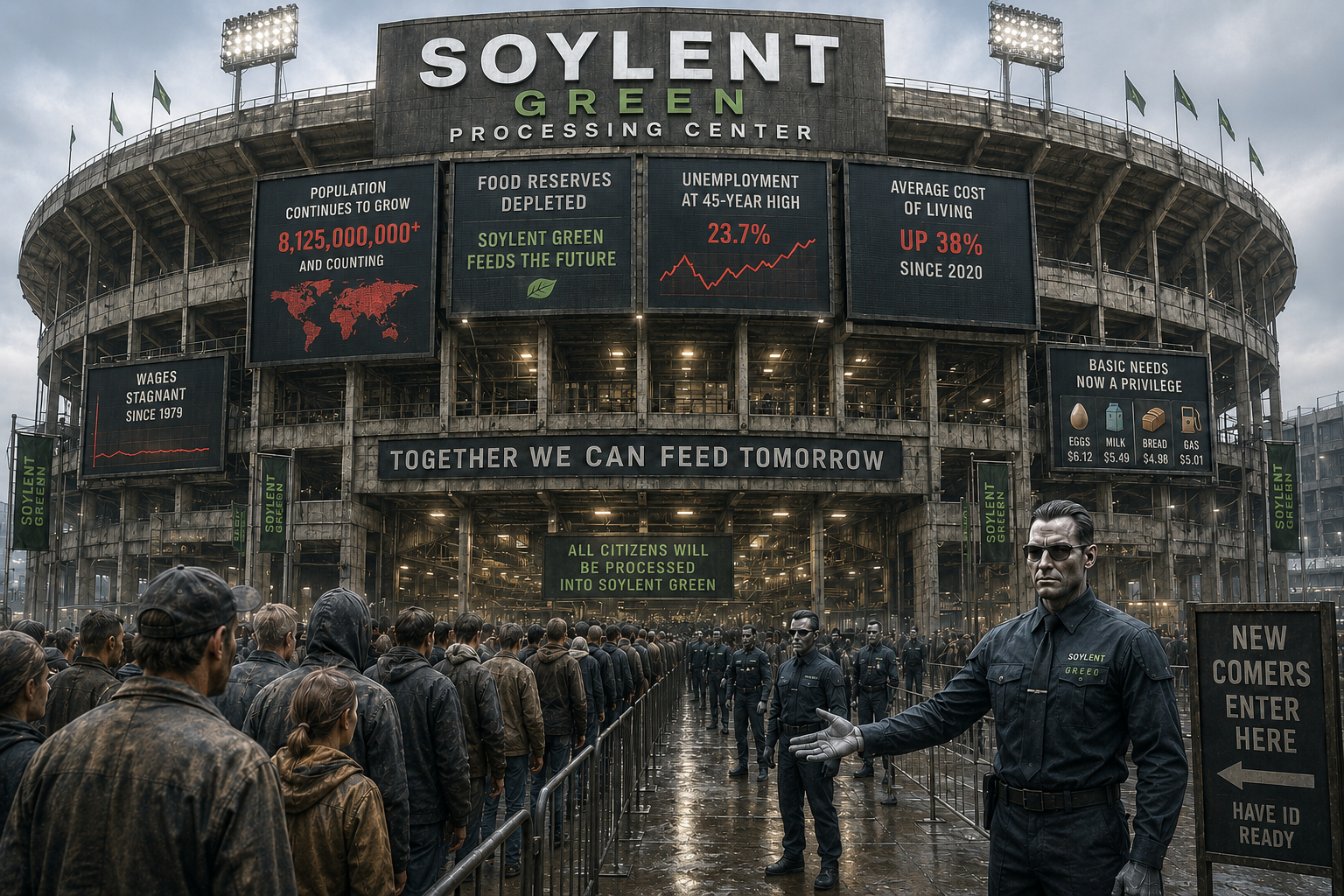
During the COVID-19 pandemic, the United States converted dozens of professional sports stadiums into mass vaccination sites, testing centers, and emergency triage facilities virtually overnight. Dodger Stadium in Los Angeles processed over 1.1 million vaccinations. Yankee Stadium in New York, NRG Park in Houston, Gillette Stadium in Massachusetts, and Mercedes-Benz Stadium in Atlanta all became high-throughput medical processing facilities. The speed of these conversions was not improvised — it revealed an existing operational framework for repurposing entertainment infrastructure as mass population processing centers, a framework documented in FEMA planning documents that predate the pandemic by decades.
FEMA’s Catastrophic Incident Annex (CIA), part of the National Response Framework, explicitly addresses scenarios requiring the processing, sheltering, and management of populations numbering in the hundreds of thousands. The 2023 revision of this document describes “mass care” operations that include registration, tracking, medical screening, and controlled movement of displaced populations through designated facilities. Points of Distribution (PODs) — the logistical term for sites where populations are processed — are designed around throughput metrics: how many people per hour can be identified, screened, and routed. Sports stadiums, with their controlled entry points, sectored seating, internal circulation corridors, and existing security infrastructure, are identified in multiple FEMA planning guides as ideal POD locations.
The biometric surveillance technology deployed at modern stadiums represents a parallel infrastructure development. The NFL’s partnership with facial recognition companies has equipped stadiums across the league with camera systems capable of identifying every person who enters. NEC Corporation’s NeoFace system, deployed at multiple Major League Baseball parks, can match faces against watchlist databases in real time. Clear Secure, Inc., the biometric identity company that went public in 2021 with a valuation exceeding $4 billion, operates enrollment kiosks at stadiums nationwide, collecting iris scans and fingerprints from willing participants who trade biometric data for faster entry. As of 2024, Clear reported over 18 million enrolled members — each of whom has voluntarily surrendered biometric identifiers to a private corporation with documented relationships with the Department of Homeland Security.
The Department of Defense has invested heavily in crowd modeling and mass gathering surveillance through programs that are publicly documented but rarely discussed in mainstream reporting. DARPA’s Urban Reconnaissance through Supervised Autonomy (URSA) program developed AI systems for tracking individuals through dense crowds using persistent aerial surveillance. The Army Research Laboratory’s Human Dynamics research program studies crowd behavior, movement patterns, and the conditions under which large groups can be directed, contained, or dispersed. These are not speculative programs — they are line items in the federal budget with published research papers, conference presentations, and named principal investigators.
The technology stack at a modern stadium is indistinguishable from a surveillance operations center. Cisco’s Connected Stadium architecture, deployed at venues including Levi’s Stadium in Santa Clara and SoFi Stadium in Los Angeles, integrates thousands of networked cameras, Wi-Fi tracking sensors, point-of-sale terminals, and mobile device identification systems into a unified platform. Venue operators can track the movement of every connected device — and therefore every person — within the facility in real time. When IBM and Johnson Controls merged their building management capabilities, the resulting platform could monitor occupancy, environmental conditions, access control, and surveillance feeds across an entire campus from a single interface. These systems were not built for emergencies. They operate during every game, every concert, every event.
FEMA’s Mass Fatality Management planning documents, available through the agency’s public Lessons Learned Information Sharing system, describe operational procedures for processing large numbers of deceased persons. These plans address refrigerated storage capacity, identification protocols, family notification centers, and remains processing — and they specifically identify large public facilities as potential temporary morgue sites. During COVID-19, this was not theoretical: the Javits Center in New York City, the Walter E. Washington Convention Center in D.C., and multiple fairground facilities were converted to temporary morgue and overflow medical treatment centers. The infrastructure for mass casualty operations at scale was stress-tested in 2020 and 2021, and the lessons learned have been incorporated into updated planning documents.
Ticket systems at major venues have evolved into comprehensive identity tracking platforms. Ticketmaster’s digital ticketing system, which dominates the live entertainment market through its parent company Live Nation, links every ticket purchase to a verified identity. The company’s SafeTix technology generates unique, encrypted barcodes tied to specific accounts, eliminating anonymous attendance. AXS, another major ticketing platform, offers facial recognition entry at venues including the T-Mobile Arena in Las Vegas. The practical effect is that attending a stadium event now generates a verified identity record, a timestamped location confirmation, and a biometric checkpoint — the same data points collected at border crossings and secure government facilities.
The convergence of 5G small cell deployment and stadium infrastructure creates a communications monitoring capability that is technically documented but poorly understood by the public. Verizon, AT&T, and T-Mobile have installed dedicated 5G networks inside major stadiums, with antenna densities sufficient to triangulate any device’s position to within one meter. These networks can identify every device — and by extension, every person — present in the venue, track their movement through the facility, and log the duration and location of every stop. Patent filings from all three carriers describe systems for correlating device identity with ticket purchase data, creating a comprehensive behavioral profile of every attendee.
The legal framework enabling this surveillance infrastructure has expanded steadily since September 11, 2001. The SAFETY Act of 2002, administered by the Department of Homeland Security, provides liability protection to companies that deploy “qualified anti-terrorism technologies” at public venues. This legal shield has incentivized stadium operators to install increasingly invasive surveillance systems with the assurance that legal challenges will be limited by federal statute. DHS’s Biometric Technology Center, operated by the agency’s Science and Technology Directorate, evaluates and certifies the facial recognition, iris scanning, and fingerprint systems deployed at these venues. The certification program ensures technical interoperability with federal law enforcement databases — meaning that data collected at a football game can be queried against the same databases used at international airports.
The documented history of stadium-based population processing during COVID-19, combined with the surveillance infrastructure permanently installed at these venues, the FEMA planning frameworks that designate them as mass processing centers, and the biometric identity systems that have eliminated anonymous attendance, describes a dual-use infrastructure whose non-entertainment capabilities are fully operational at all times. None of this information is classified. The FEMA documents are publicly available. The surveillance technology specifications are in patent filings and corporate press releases. The biometric enrollment numbers are in SEC filings. What this site investigates is the pattern that emerges when these independently documented facts are assembled into a single picture — a picture of infrastructure whose crowd-processing capacity far exceeds anything required for entertainment, and whose surveillance capabilities are indistinguishable from those of a controlled population management system.