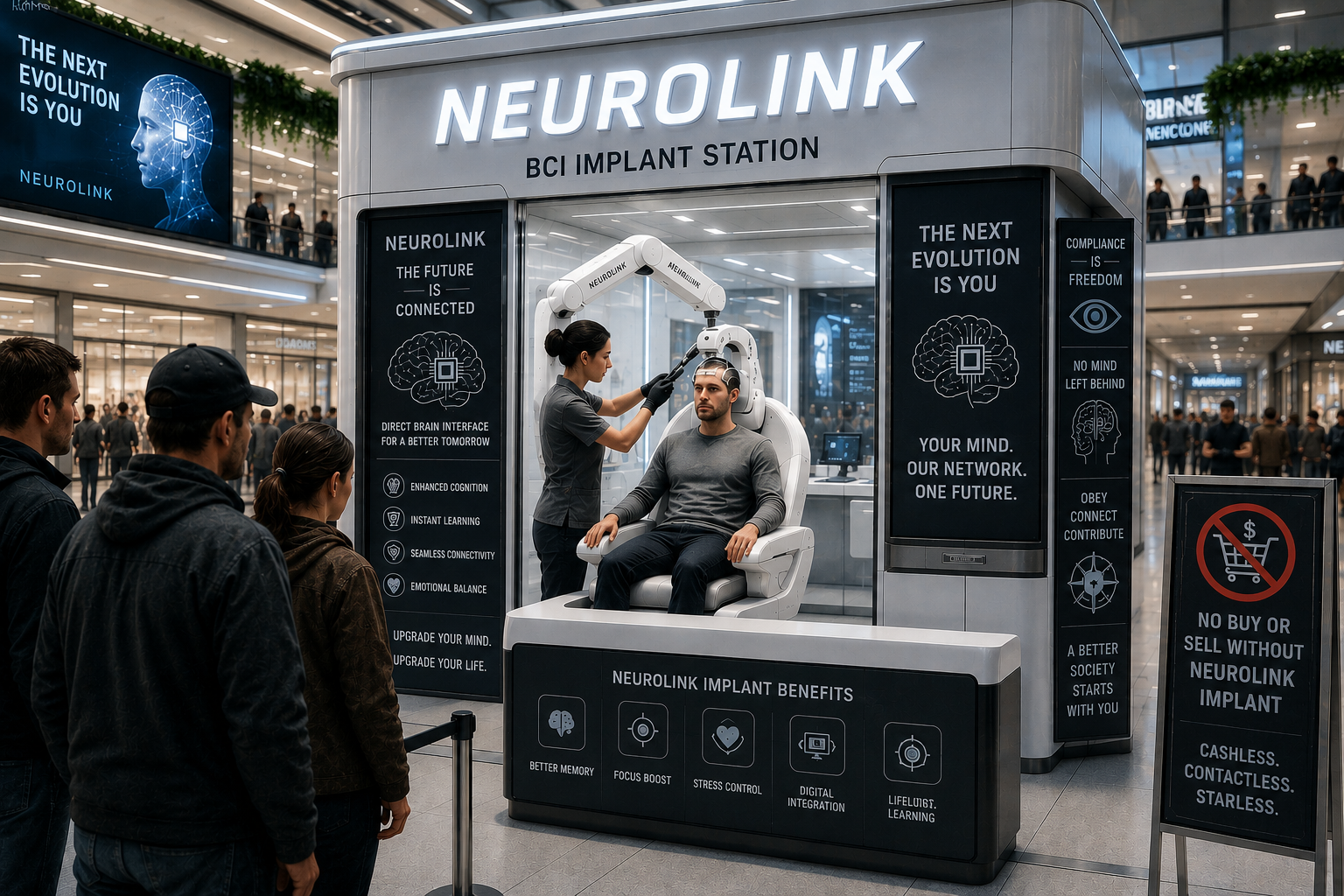
Brain-computer interfaces are no longer confined to research laboratories. In January 2024, Neuralink implanted its first human patient — Noland Arbaugh, a 29-year-old quadriplegic — with the N1 chip at Barrow Neurological Institute in Phoenix, Arizona. Within weeks, Arbaugh was controlling a computer cursor with his thoughts, playing chess online, and browsing the internet without any physical input device. The N1 implant contains 1,024 electrodes distributed across 64 ultra-thin polymer threads, each thinner than a human hair, inserted into the motor cortex by a custom-built surgical robot called the R1. The robot performs the implantation with micron-level precision to avoid blood vessels mapped by the system’s computer vision. This is not speculative technology. It is a real device, in a real person’s brain, producing real results — and understanding exactly what it does, what it cannot do, and where the technology is heading is essential for anyone paying attention to the trajectory of human-machine integration.
The scientific foundation for brain-computer interfaces stretches back decades. BrainGate, a research consortium led by investigators at Brown University, Massachusetts General Hospital, Stanford University, and Case Western Reserve, implanted its first human participant in 2004. The BrainGate system uses the Utah Array — a 4×4 millimeter silicon chip with 96 needle-like electrodes manufactured by Blackrock Microsystems (now Blackrock Neurotech) — to record neural signals from the motor cortex. In published clinical trials, BrainGate participants with tetraplegia achieved cursor control, typed on virtual keyboards, and in a landmark 2012 study published in Nature, a participant used the system to control a robotic arm and drink from a bottle for the first time in 15 years. A 2021 study published in Nature by the BrainGate team demonstrated that a paralyzed participant could type 90 characters per minute by imagining handwriting — the neural decoder translated imagined pen movements into text at a speed approaching natural handwriting.
Synchron, an Australian-American neurotechnology company, has taken a fundamentally different approach to brain-computer interfaces that avoids open brain surgery entirely. The Synchron Stentrode is a small, stent-like electrode array that is delivered to the brain through the vascular system — specifically, it is inserted into the jugular vein and navigated to the superior sagittal sinus, a large blood vessel that runs along the top of the brain, where it self-expands against the vessel wall and records neural signals through the blood vessel lining. The procedure is similar to a cardiac stent placement and takes approximately two hours, with no craniotomy required. Synchron began its first U.S. human trial at Mount Sinai Hospital in New York in July 2022, with the first American patient — a 62-year-old ALS patient — receiving the implant and subsequently using it to control digital devices including text messaging, online banking, and shopping. By 2024, Synchron had implanted approximately 10 patients across its Australian and U.S. trials, with preliminary results showing the device remained functional and safe for over four years in the earliest recipients.
The FDA’s regulatory pathway for brain-computer interfaces has evolved significantly. Neuralink received FDA Investigational Device Exemption (IDE) approval in May 2023, following an initial rejection in early 2022 over safety concerns that reportedly included the risk of the implant’s lithium battery overheating, the potential for the threads to migrate within the brain, and questions about the safety of the surgical robot. The FDA’s Breakthrough Device designation, granted to multiple BCI companies, provides a faster review pathway for devices that treat or diagnose serious conditions. Neuralink’s PRIME (Precise Robotically Implanted Brain-Computer Interface) study enrolled its first patient under this framework. The regulatory challenge is substantial: the FDA must evaluate not only the safety of the physical hardware but also the software that decodes neural signals, the wireless communication protocols that transmit data from the implant to external devices, and the long-term biocompatibility of materials that will remain in brain tissue for years or decades.
The actual capabilities of current BCI technology, while genuinely remarkable, are far more limited than popular media often suggests. No existing brain-computer interface can read thoughts in the way that the word “telepathy” implies. What these devices detect are patterns of neural firing in specific brain regions — typically the motor cortex — that correlate with intended movements. A decoder algorithm, trained on data from the individual user, learns to map these firing patterns to specific outputs: cursor up, cursor down, click, type the letter A. The system does not understand language, emotion, memory, or abstract thought. It reads motor intention signals that the user consciously generates. Neuralink’s own description of its technology uses the phrase “movement intention decoding,” which accurately characterizes the current state of the art. The leap from decoding motor intentions in one brain region to reading the full content of human consciousness would require recording from millions of neurons across the entire cortex simultaneously — a capability that is orders of magnitude beyond any existing or near-term technology.
That said, the research trajectory points toward increasingly capable systems. A 2023 study from the University of Texas at Austin, published in Nature Neuroscience, demonstrated a non-invasive system using functional MRI that could reconstruct the gist of stories a participant was listening to or imagining, based on patterns of blood flow in the brain. The system was not reading words directly — it was mapping large-scale cortical activity patterns to a language model that generated approximate semantic content. Accuracy was limited and the system required hours of individual training data, but it represented the first demonstration that continuous language could be decoded from non-invasive brain recordings. Separately, researchers at the University of California, San Francisco, published a 2021 study in the New England Journal of Medicine showing that a paralyzed patient with an electrode array implanted on the speech motor cortex could produce text at approximately 15 words per minute through attempted speech — the system decoded the neural signals associated with trying to speak and translated them into text.
The commercial BCI market is growing rapidly. Blackrock Neurotech, the manufacturer of the Utah Array used in BrainGate research, has a clinical-grade BCI system called MoveAgain that received FDA Breakthrough Device designation. Paradromics is developing a high-channel-count BCI called the Connexus Direct Data Interface with over 1,600 electrodes, targeting speech restoration. Precision Neuroscience, founded by a Neuralink co-founder, is developing a thin-film electrode array called Layer 7 that sits on the surface of the cortex and can be placed through a slit craniotomy rather than a full craniotomy. The combined private investment in BCI companies exceeded $2 billion between 2020 and 2024, with Neuralink alone valued at approximately $5 billion following its Series D funding round. The military has contributed substantially to BCI research through DARPA’s Neural Engineering System Design (NESD) program, which funded development of implantable devices with up to one million electrode channels — roughly 1,000 times the channel count of Neuralink’s N1.
The ethical and security implications of neural interfaces are the subject of serious academic and policy analysis. A 2023 report by the UNESCO International Bioethics Committee called for the recognition of “neurorights” — the right to cognitive liberty, mental privacy, mental integrity, and psychological continuity. Chile became the first country to enshrine neurorights in its constitution, amending its charter in 2021 to protect “brain activity and the information derived from it.” The concern is not hypothetical: if a BCI can read neural signals associated with motor intention today, and neural decoding technology continues to advance, the question of who has access to the data generated by an implanted brain becomes a civil liberties issue of unprecedented significance. Neuralink’s privacy policy for its clinical trial states that neural data collected by the N1 implant is transmitted wirelessly to a paired device and then to Neuralink’s servers for analysis. The long-term governance of this data — who owns it, who can access it, whether it can be subpoenaed, whether it can be hacked — has not been resolved by any existing legal framework.
The military dimension of BCI technology is well-documented in open sources. DARPA’s Restoring Active Memory (RAM) program, funded at approximately $77 million, developed implantable neural devices designed to restore memory function in service members with traumatic brain injury. The Next-Generation Nonsurgical Neurotechnology (N3) program, launched in 2018, funded research into BCI systems that could read and write neural signals without surgery — a capability that would enable military applications ranging from controlling drone swarms with thought to receiving tactical information directly into the brain’s sensory processing areas. The Army Research Laboratory’s Human Research and Engineering Directorate has published openly on the goal of creating “bidirectional” brain-computer interfaces that both read from and write to the brain. The write direction — stimulating specific neural populations to create perceptions, sensations, or behavioral impulses — is the capability that raises the most profound questions about human autonomy, and it is the direction that the most generously funded defense programs are pursuing.
The arc from BrainGate’s first implant in 2004 to Neuralink’s consumer-oriented ambitions in 2024 traces a twenty-year progression from laboratory curiosity to commercial product development. Each generation of the technology records from more neurons, decodes signals more accurately, communicates wirelessly with higher bandwidth, and requires less invasive surgical procedures. The capabilities are real, the progress is measurable, and the trajectory is clear. What separates responsible reporting from science fiction is precision about what these systems can actually do today versus what they might do in five, ten, or twenty years. This site’s investigation into advanced technology programs is grounded in that distinction — and in the recognition that the documented capabilities already in development, when combined with the classified programs funded through defense budgets that resist public audit, describe a future in which the boundary between the human mind and external systems becomes a matter of active, ongoing negotiation.