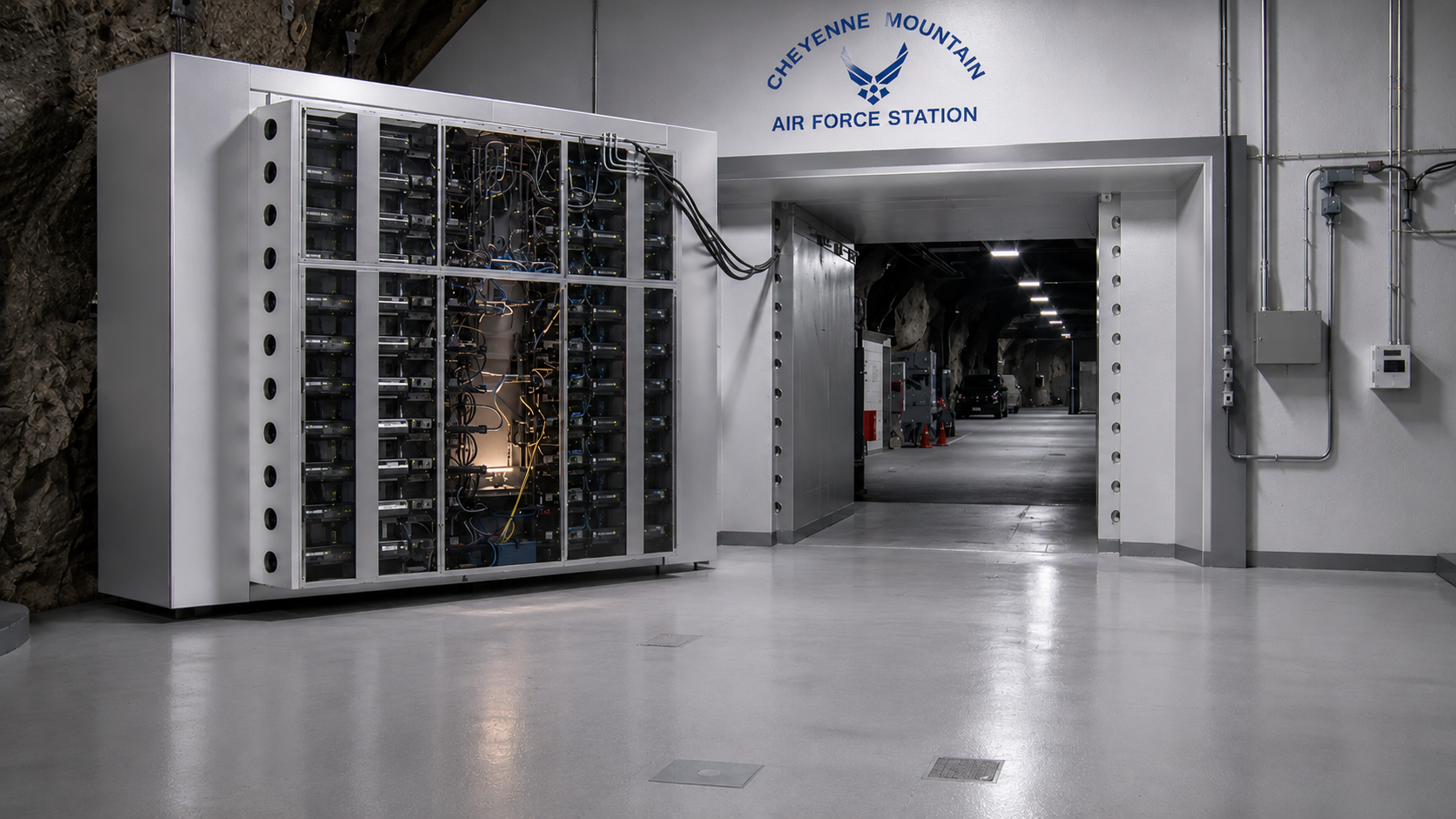
The Cheyenne Mountain Air Force Station insignia is printed on the wall beside a rack of computing hardware that represents a fraction of the processing power buried inside the mountain. The server infrastructure visible in this corridor handles the data feeds that track every satellite, missile, and aircraft operating in the atmosphere and near-Earth space. But the hardware shown here is the unclassified tier — the systems they allow to be photographed and included in official briefing materials.
The classified computing infrastructure beneath American military installations runs on hardware that does not appear in any public procurement database. The NSA’s Utah Data Center at Camp Williams alone consumes sixty-five megawatts of continuous power — enough to run approximately fifty thousand high-density server racks. Cheyenne Mountain’s power consumption has been classified since 2003. When the facility underwent a $700 million modernization program in the 2010s, the scope of the upgrade was not disclosed. Only the cost was.
Subterranean server farms solve the two problems that constrain surface-level data centers: physical security and thermal management. Mountains provide natural electromagnetic shielding and physical hardening that no above-ground facility can match. The surrounding rock mass provides a heat sink orders of magnitude larger than any cooling system. And the depth provides protection against every conventional weapon in any adversary’s arsenal. The servers beneath mountains do not merely store data. They run the systems that will continue to function after everything on the surface has stopped.
From Transhuman Genocide: The Underground Report — the book that maps what they built beneath your feet.