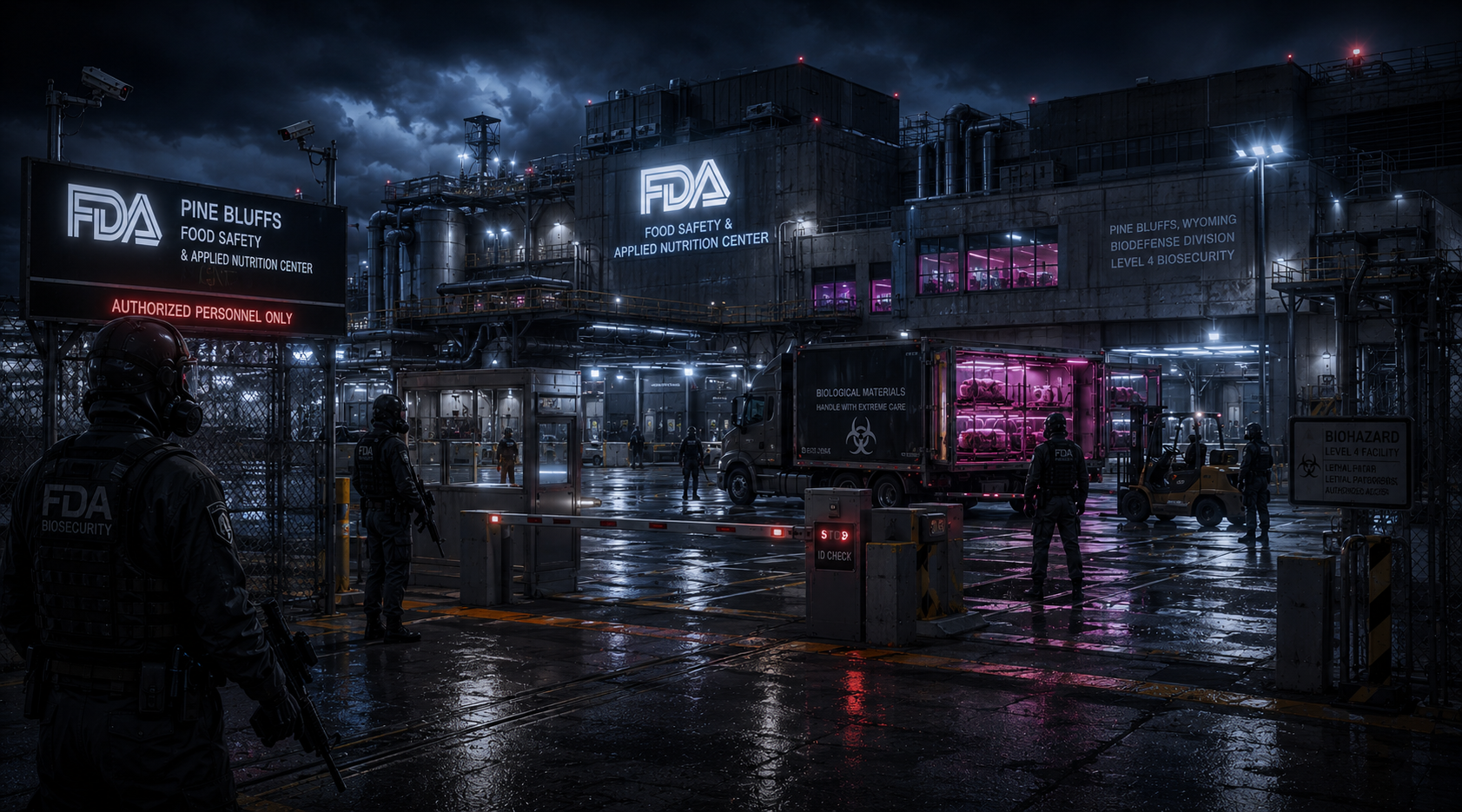
Pine Bluff Arsenal, located on approximately 15,000 acres along the Arkansas River southeast of Little Rock, operated as the primary production facility for the United States offensive biological weapons program from 1953 to 1969. This is not disputed history — it is documented in official Army records, declassified Department of Defense publications, and Congressional testimony. During its sixteen years of biological weapons production, the facility manufactured weaponized agents including Brucella suis, Francisella tularensis (tularemia), Coxiella burnetii (Q fever), Venezuelan equine encephalitis virus, botulinum toxin, and staphylococcal enterotoxin B. The production volumes were industrial in scale: the Arsenal produced and filled biological munitions including the M33 cluster bomb, designed to disseminate biological agents over wide areas from aerial delivery platforms.
The decision to end the offensive biological weapons program came from President Richard Nixon’s Executive Order of November 25, 1969, which unilaterally terminated all offensive biological weapons research and ordered the destruction of existing stockpiles. The destruction of biological agents at Pine Bluff Arsenal was completed in 1972, the same year the United States signed the Biological Weapons Convention. Army records document the incineration and chemical neutralization of biological agent stocks, the decontamination of production facilities, and the conversion of the Arsenal to other military missions. However, the infrastructure — the containment buildings, the production halls, the specialized ventilation systems, the waste treatment facilities — was not demolished. It was repurposed.
Today, Pine Bluff Arsenal continues to operate as an active Army installation with several missions. The facility manufactures smoke and illumination munitions, maintains chemical defense equipment, and operates the Joint Munitions and Lethality Life Cycle Management Command’s Smoke and Pyrotechnics Division. The Arsenal also hosts the National Center for Toxicological Research (NCTR), a facility operated by the Food and Drug Administration since 1971. The NCTR occupies a 540-acre campus within the Arsenal’s perimeter, employing approximately 500 scientists and support staff who conduct research on the toxicological effects of products regulated by the FDA — food additives, pharmaceuticals, medical devices, and cosmetics.
The co-location of an FDA research facility within an active military installation that formerly produced biological weapons is a factual arrangement that raises legitimate questions about dual-use research. The NCTR’s research portfolio, published in its annual reports and in peer-reviewed journals including Toxicological Sciences and Food and Chemical Toxicology, covers nanotoxicology, genomic biomarkers, neurotoxicology, and the biological effects of exposure to regulatory-relevant compounds. The facility operates BSL-2 and BSL-3 laboratories capable of handling moderately dangerous pathogens. While no public evidence indicates that the NCTR conducts weapons-related research, its physical location within a military perimeter that once produced biological weapons, behind security checkpoints controlled by the Department of the Army, means that the facility operates under a dual authority structure that limits independent civilian oversight.
The broader history of biological research at Pine Bluff provides context for understanding the site’s ongoing significance. During the offensive program era, Pine Bluff was not merely a production site — it was also a major research and development center. The Army’s biological warfare laboratories at Pine Bluff developed improved methods for the mass production, stabilization, and dissemination of biological agents. Research papers from this era, many subsequently declassified and available through the National Archives, document advances in aerosol technology, freeze-drying of biological agents for long-term storage, and the development of delivery systems designed to maximize the area coverage of biological attacks. This knowledge base did not disappear when the offensive program ended — it was absorbed into the “defensive” research establishment that continues to operate at Fort Detrick, Dugway Proving Ground, and other facilities.
The food supply chain infrastructure of the United States presents its own set of documented vulnerabilities that connect to Pine Bluff’s dual identity. The FDA regulates approximately 78 percent of the U.S. food supply — everything except meat, poultry, and certain egg products, which fall under USDA jurisdiction. Despite this enormous mandate, the FDA conducts physical inspections of less than 2 percent of imported food shipments, according to the agency’s own reports. The domestic food inspection regime is similarly constrained: a 2022 HHS Office of Inspector General report found that the FDA inspected only 24 percent of registered food facilities within the five-year timeframe mandated by the FDA Food Safety Modernization Act. The NCTR’s research on food safety occurs within this context — a regulatory system whose enforcement capacity has been consistently outpaced by the scale and complexity of the food supply it is charged with protecting.
Pine Bluff’s location within the Arkansas agricultural corridor adds another dimension. Arkansas ranks in the top five states nationally for rice production, poultry production, and catfish aquaculture. The state’s food processing industry includes major facilities operated by Tyson Foods (headquartered in Springdale, Arkansas), Riceland Foods, and numerous smaller processors. The proximity of a former biological weapons production facility — now hosting federal research laboratories behind military security — to one of the nation’s most concentrated food production regions is a geographical fact with implications that food safety experts and biosecurity scholars have noted in academic literature.
The concept of dual-use biological research has been extensively analyzed in academic and policy literature. The National Science Advisory Board for Biosecurity (NSABB), established in 2004, specifically addresses research that could be misused for biological weapons development. The NSABB’s framework for evaluating “dual-use research of concern” (DURC) acknowledges that legitimate scientific research — including food safety research — can generate knowledge, methods, and materials applicable to weapons development. A 2023 review published in the journal Biosecurity and Bioterrorism documented over 200 incidents of laboratory-acquired infections at U.S. research facilities between 2004 and 2021, including exposures to select agents — pathogens designated by the CDC and USDA as having potential for use as biological weapons. The regulatory framework for oversight of this research, while improved since the early 2000s, relies on institutional biosafety committees whose independence from the institutions they oversee has been questioned by the GAO.
The historical relationship between food safety infrastructure and biological defense is not accidental — it is structural. The Public Health Security and Bioterrorism Preparedness and Response Act of 2002 explicitly expanded the FDA’s mandate to include food defense — protecting the food supply from deliberate contamination. This legislation required food facilities to register with the FDA, established the authority for administrative detention of food products, and funded research into the detection of biological and chemical agents in the food supply. The NCTR’s research mission expanded accordingly. The practical result is that the same scientific disciplines, the same laboratory equipment, the same containment facilities, and the same personnel who understand how pathogens interact with food systems are engaged simultaneously in food safety and food defense research — and the distinction between understanding how contamination occurs and understanding how it could be engineered is, at the laboratory bench, functionally nonexistent.
The documented history of Pine Bluff Arsenal — from industrial-scale biological weapons production to FDA food safety research, all within the same military perimeter — represents one of the clearest examples of the dual-use infrastructure pattern documented across this site. The facts are in the public record: the Army records documenting weapons production, the FDA annual reports documenting NCTR research, the declassified documents describing biological agent development techniques, the HHS Inspector General reports documenting FDA inspection shortfalls, and the academic literature analyzing dual-use research risks. What this site contributes is the synthesis — connecting these individually documented facts into a coherent picture of facilities whose histories, capabilities, and oversight structures make them worth watching, not because of what is alleged, but because of what is documented.