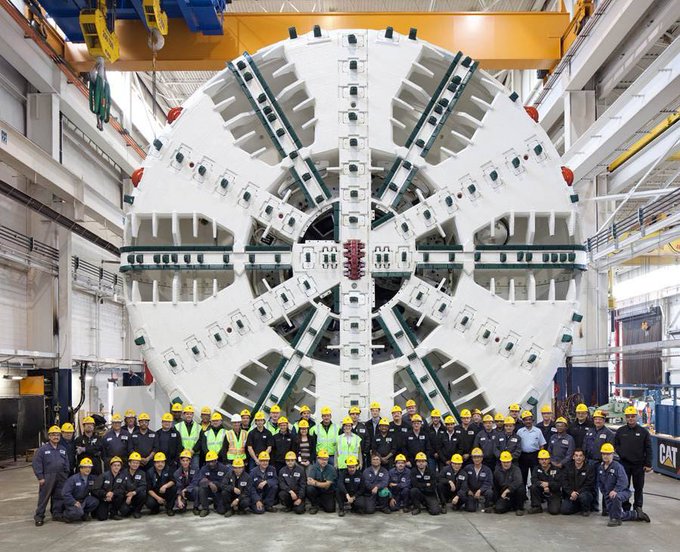
They show you the Tunnel Boring Machine — the massive rotating cutter head that chews through rock and soil at the front end of every publicized infrastructure project. Elon Musk’s Boring Company. New York’s Second Avenue Subway. The Gotthard Base Tunnel in Switzerland. These machines are real, impressive, and deliberately presented as the pinnacle of underground construction technology. They are also half a century behind the classified state of the art.
The conventional TBM operates by mechanical cutting: carbide disc cutters score the rock face, hydraulic rams push the machine forward, and a conveyor system removes the broken material behind it. The process is slow — typically fifty to one hundred feet per day — loud, and impossible to conceal. Every TBM project generates millions of cubic yards of spoil that must be transported to the surface and disposed of visibly. The public sees the machine. The public sees the dirt. The public is satisfied that this is how tunnels are built.
The nuclear subterrene operates on an entirely different principle. Instead of cutting rock, it melts it. Instead of removing spoil, it vitrifies the surrounding material into a structural glass lining. Instead of fifty feet per day, it advances at speeds measured in miles. And instead of generating surface evidence — muck trains, spoil piles, ventilation shafts — it leaves nothing behind except the tunnel itself. What they show you is the machine that builds subway stations. What they use is the machine that builds the network you are not supposed to know about.
From Transhuman Genocide: The Underground Report — the book that maps what they built beneath your feet.