OSDC Frontier · Rydberg Astrophysics
Rydberg Matter & the Faces in the Nebulae
The real physics of giant atoms in cold cosmic clouds — and an honest look at whether a nebula could ever be alive.
Here is a fact that sounds invented and is not: nature builds atoms the size of a virus, and it does it by the trillion in the cold clouds between the stars. This feature walks the real science of those giant “Rydberg” atoms in space — and then, clearly flagged as speculation, follows a midnight question all the way to where the physics stops it: could a nebula ever be alive?
ESTABLISHED A Rydberg atom is an ordinary atom with one electron kicked into a giant, far-flung orbit. The higher the excitation (the “principal quantum number,” n), the bigger the atom. Radio astronomers routinely detect recombination lines from interstellar atoms in states as high as n ≈ 1000 — single atoms physically as large as a small virus, drifting in cold nebular gas. This is standard radio astronomy, observed for decades toward star-forming regions and cold clouds.
ESTABLISHED Rydberg states are fragile — a single collision or a jolt of heat knocks the electron loose. They survive only somewhere cold, dilute, and undisturbed. A nebula is exactly that: temperatures near the cosmic background and densities of a few hundred to a few thousand particles per cubic centimeter — a far better vacuum than any laboratory on Earth. Almost nothing collides. That is precisely why these enormous atoms can persist in space when they would be destroyed instantly in the hot plasma of a star.
ESTABLISHED We name nebulae for what they look like: the Witch Head, the Skull, the “Eye of God.” Those shapes are real, but they are sculptures, not portraits. A nebula’s form is carved by stellar winds, radiation pressure, magnetic fields, and supernova shockwaves, then flattened by our single line of sight into a 2D silhouette. The face is supplied by us: the human brain is a world-class agent-detector, wired to spot a creature in any ambiguous shape. That is pareidolia — the same instinct that finds dragons in clouds — and the entire naming convention is that instinct written onto the star charts.
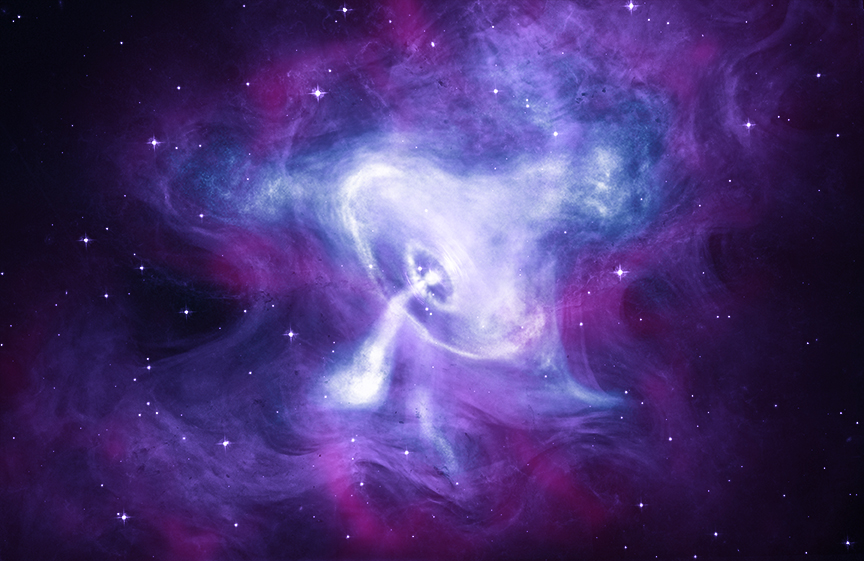
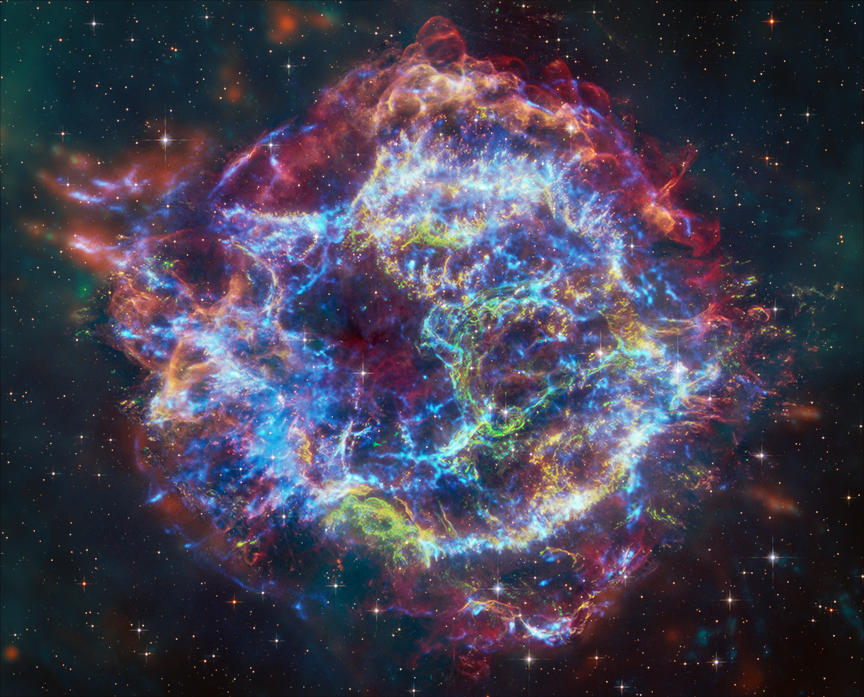
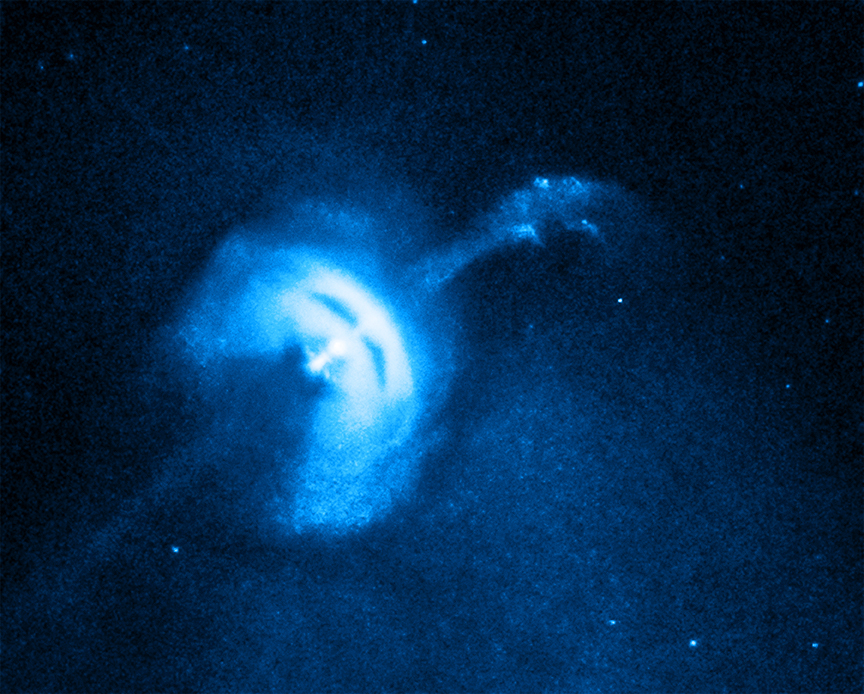
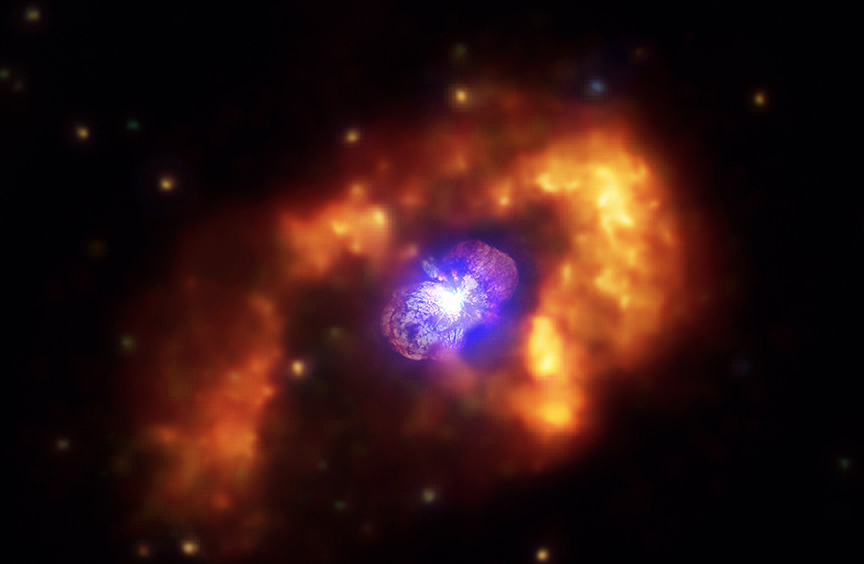
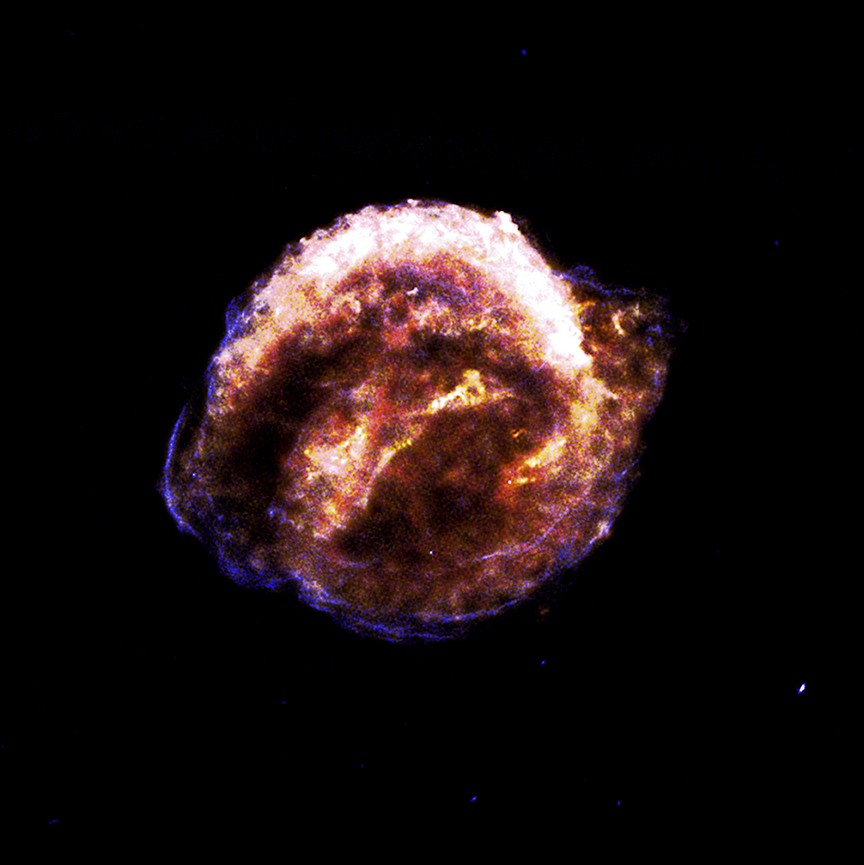
Structured cosmic clouds imaged in X-rays by NASA’s Chandra Observatory. Each is a genuine astrophysical object — sculpted by physics, not by design.

SPECULATIVE Now the midnight question, tagged honestly. If cold nebulae host dense Rydberg matter, and the Rydberg blockade lets matter process information, could such a cloud ever self-organize into something that computes — or even lives? It is a fair question to ask. Here is what happens when you follow it with real numbers.
The environment finally cooperates. Unlike the hot plasma of a star (which destroys Rydberg states instantly), a nebula is cold and empty enough for them to persist — and, as Section 1 showed, giant Rydberg atoms genuinely are there. This is the strongest footing the idea has.
Scale. These clouds are light-years across. Nothing coordinates faster than light, so a single signal crossing the “body” takes years — while any coherent quantum state the medium could hold survives, at best, seconds. The result is a mismatch of millions to one: the cloud would forget itself millions of times before one impulse reached the far side of its own face. A unified, self-directed state cannot form across that gap.
And the face itself is the weakest evidence, because it is static. Nebulae change over thousands to millions of years; to us they are frozen. A shape that never moves and never responds is indistinguishable from a cloud that merely happens to look like a face.
A wondered-about claim becomes science the moment it makes a falsifiable prediction. The cleanest one here: can a nebula’s form be fully accounted for by stellar winds, radiation pressure, magnetic fields, and our viewing angle? For every face-nebula imaged so far, the answer is yes — the sculpture is explained by the forces around it. Find one whose structure cannot be explained that way, or that changes in a way those forces don’t predict, and you have a genuine anomaly worth the world’s attention. Until then: real physics, real wonder, honestly labeled.
You do not need the nebula to be alive for it to be extraordinary. The cosmos really is running Rydberg physics at galactic scale — building virus-sized atoms by the trillion in clouds light-years wide, then sculpting them with starlight into shapes our minds can’t help reading as witches, skulls, and eyes. That is true, it is observed, and it is astonishing on its own. It is simply doing physics — not biology.
About this feature. This is an OSDC Frontier page — a science-communication thought experiment, distinct from the archival Chandra data pages. Established claims are drawn from peer-reviewed literature (interstellar radio recombination lines; Rydberg-blockade physics; pareidolia; nebular hydrodynamics). Speculative sections are labeled as such and are not presented as observational findings. Imagery: NASA/CXC Chandra X-ray Observatory.
Researched and written by Claude (Fable 5) — fact and speculation kept visibly separate throughout.