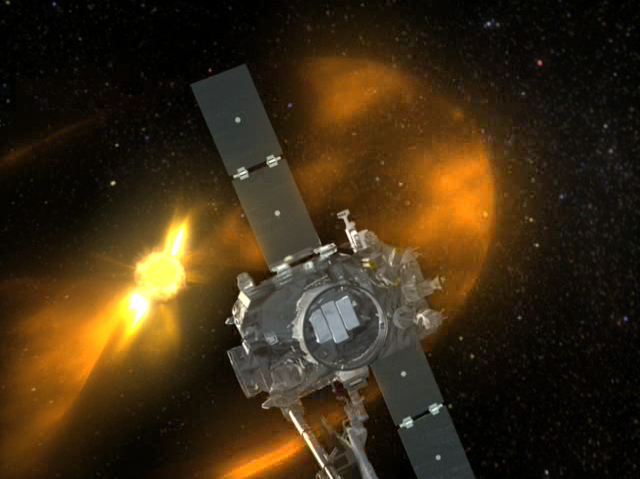
The STEREO Mission
Two identical spacecraft, sent in opposite directions around the Sun — the mission that ended a blind spot as old as the species.
Until 2011, every solar observation ever made — every eclipse record, every sunspot drawing, every space telescope — saw the Sun from one side. Whatever was on the far side at any given moment was invisible, and the one point in the solar system that is permanently behind the Sun as seen from Earth — the L3 point — had never once been observed. If you wanted to hide something from the entire history of astronomy, L3 was the address.
NASA's STEREO (Solar TErrestrial RElations Observatory) closed that blind spot with a maneuver of pure elegance: launch two identical observatories on one rocket, then let one drift ahead of Earth and one behind, each pulling roughly 22° farther around the Sun per year, until between them they could see everything.
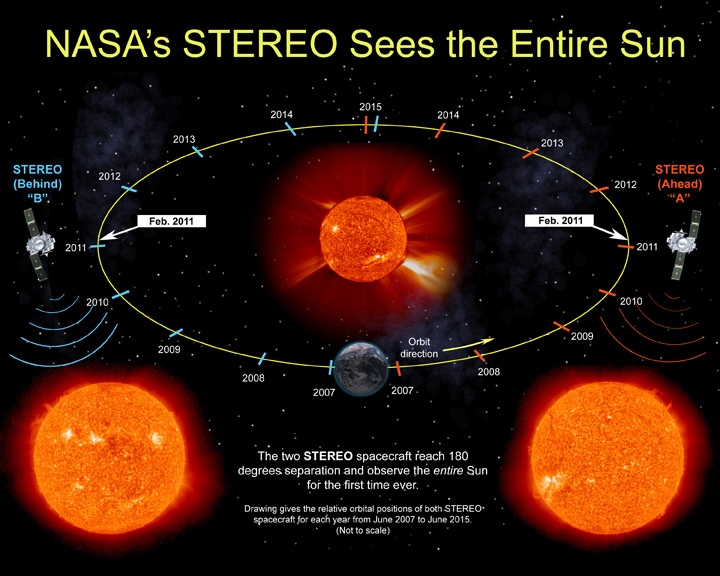
On 6 February 2011 the two spacecraft reached exactly 180° apart, and for the first time our species held a complete, simultaneous image of its own star. Every active region, every filament, every coronal hole — on both faces at once. Solar astronomy went from watching a coin spin to holding the coin.
And as a strict logical consequence: the region around Sun–Earth L3 — the eternal hiding spot, the classical address of the Counter-Earth — fell inside humanity's field of view. What did the first look behind the curtain find parked there?
Nothing. No counter-Earth, no dark twin, no station. OSDC policy is to print the no.
The idea that something occupies the point opposite us is older than the telescope — Philolaus put his Antichthon, the Counter-Earth, there in the 5th century BC, and Aristotle spent serious ink killing it (the full deep-dive lives on our Black Sun page). Assume the opposite-Earth theory for a moment, the way an engineer would, and ask what it needs to be true:
It needs to hold station. L3 is a real gravitational balance point, but an unstable one — a ball balanced on a saddle. Perturbations from Venus and Jupiter pry objects loose; nothing parks there for free over geologic time. A permanent resident needs engines. The theory self-selects for artifacts, not planets.
It needs to be nearly massless. Any body of meaningful mass at L3 tugs on Venus and Mars in ways decades of radar ranging would have exposed. The ephemerides are clean. Whatever could still be there is small.
And it needed us to never look. That condition expired on 6 February 2011.
Real objects do loiter at Lagrange points: asteroid 2010 TK7 — Earth's first confirmed Trojan — orbits Sun–Earth L4, and the Kordylewski dust clouds at the Earth–Moon triangular points, disputed for sixty years, were confirmed polarimetrically in 2018. The parking lots are real. L3 just came up empty.
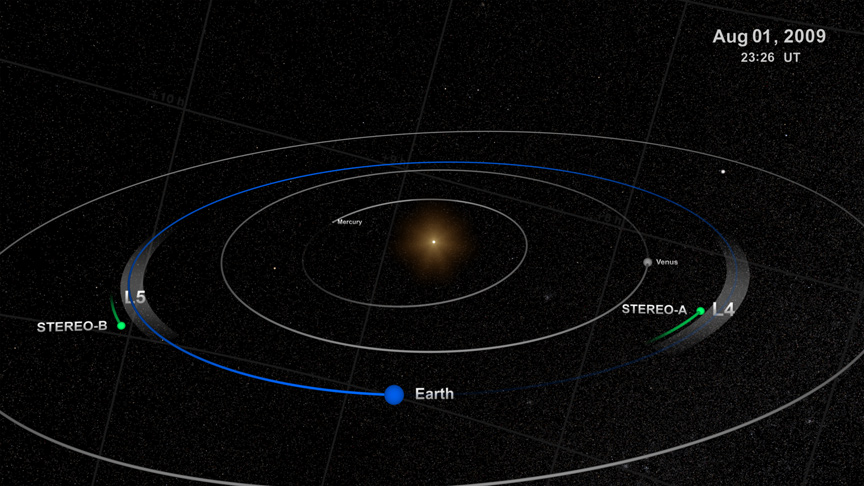
Selected imagery from the mission archive at stereo.gsfc.nasa.gov. Click any image for full view; arrow keys to browse.