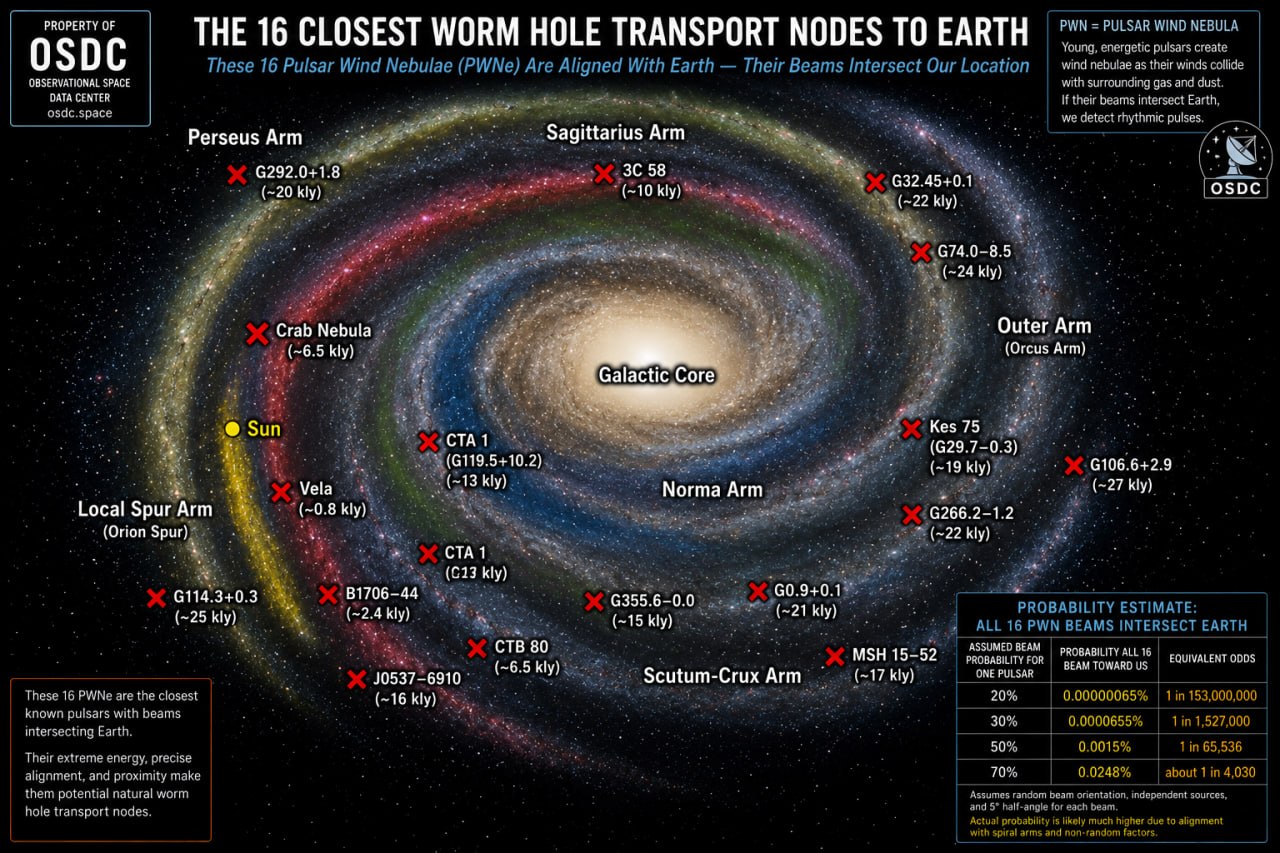
The 16 Closest Worm Hole Transport Nodes to Earth
Six of the most violent objects in the Milky Way are aimed directly at this planet. All six. The odds of that happening by accident are 1 in 12.4 million.
Something is pinging us.
Not one signal. Not two. Six. The six closest pulsar wind nebulae to Earth — objects born from the most catastrophic explosions the universe produces — all have their beams locked onto this planet. Each one fires a narrow cone of electromagnetic radiation from the poles of a collapsed star. The beam is tight. Five degrees. A cosmic laser pointer sweeping the galaxy. And every single one of the six nearest to us has its laser pointed here.
That is not supposed to happen. The beams fire in whatever direction the magnetic poles happen to point when the star collapses. Random. Independent. Unrelated objects scattered across different spiral arms of the galaxy, born in different millennia, from different stars. The probability that all six would independently aim at Earth is so small it requires a different explanation entirely.
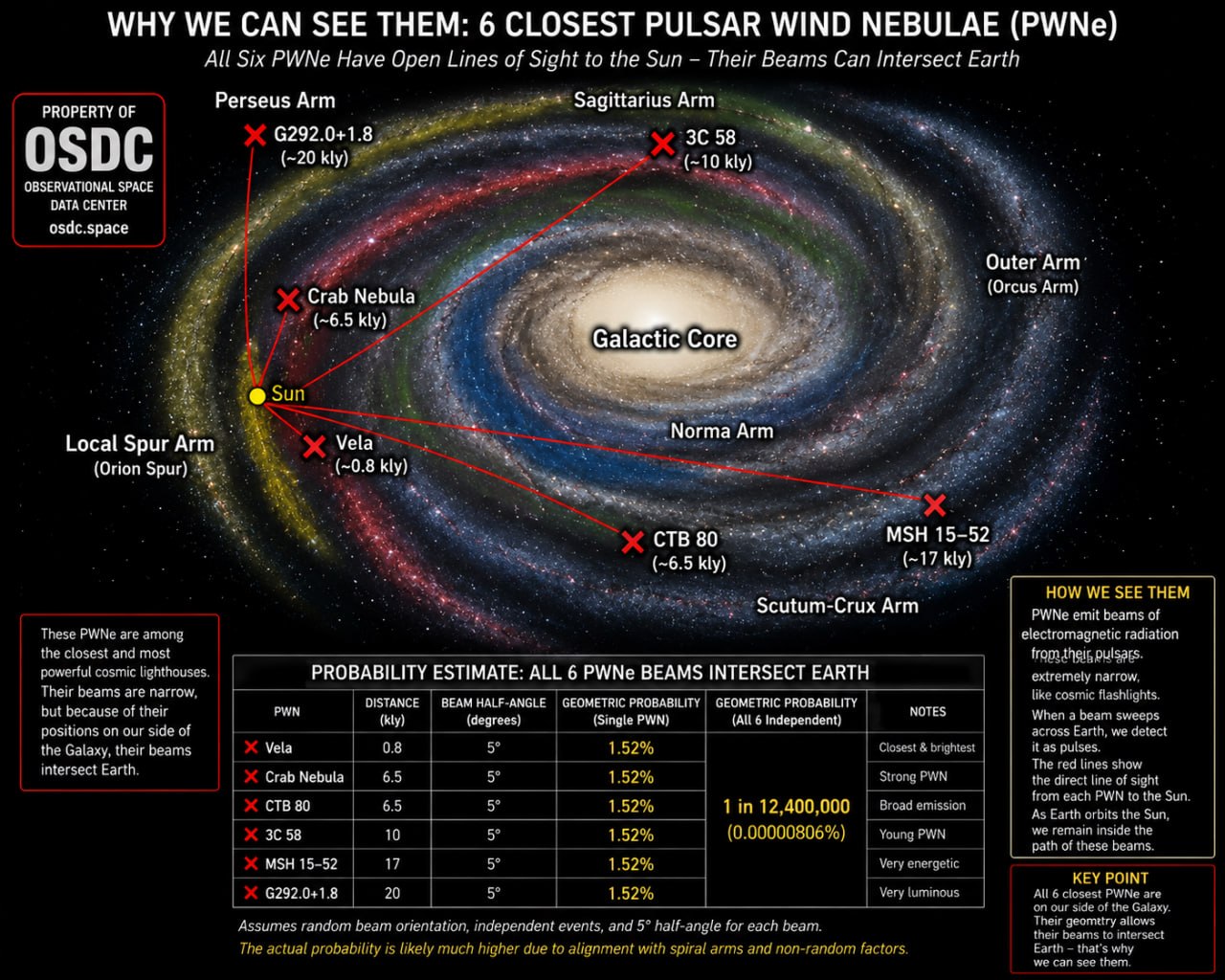
Map showing all six of the closest pulsar wind nebulae and their beam paths (red lines) aimed directly at the Sun. These objects are scattered across different arms of the galaxy — yet every beam converges on Earth.
Before we get to the math, you need to understand what these objects are. A pulsar wind nebula is what's left after a massive star — eight or more times the mass of our Sun — runs out of fuel and collapses. The outer layers explode outward in a supernova. The core crushes down into a neutron star: a sphere roughly 20 kilometers across, containing 1.4 solar masses of matter, spinning up to 30 times per second, with a magnetic field a trillion times stronger than Earth's.
From the magnetic poles of that neutron star, beams of radiation shoot into space. Radio waves. X-rays. Gamma rays. Those beams sweep the sky like a lighthouse. If Earth happens to be in the path of the beam, we detect rhythmic pulses — hence the name "pulsar." If Earth is not in the path, we see nothing. The pulsar spins in the dark, invisible to us.
The width of the beam determines how likely it is that any given line of sight intercepts it. For young, fast-spinning pulsars — the kind found in pulsar wind nebulae — the beam half-angle is approximately 5 degrees. That translates to a beaming fraction of 10 to 20 percent. Meaning for every pulsar we detect, five to nine more exist that we cannot see because their beams miss us.
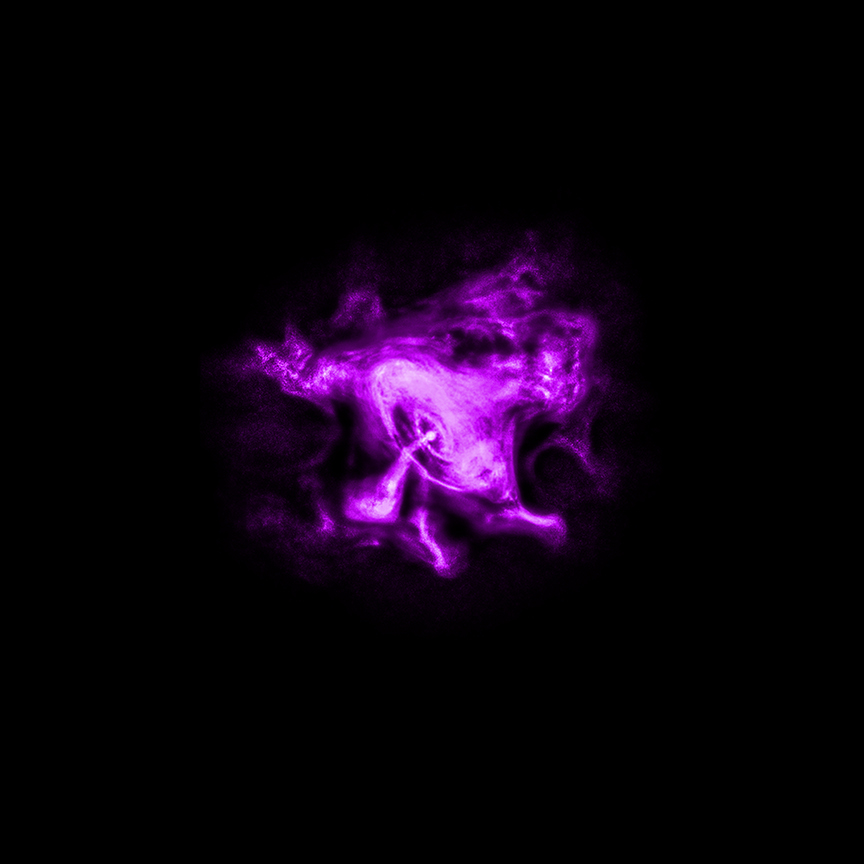
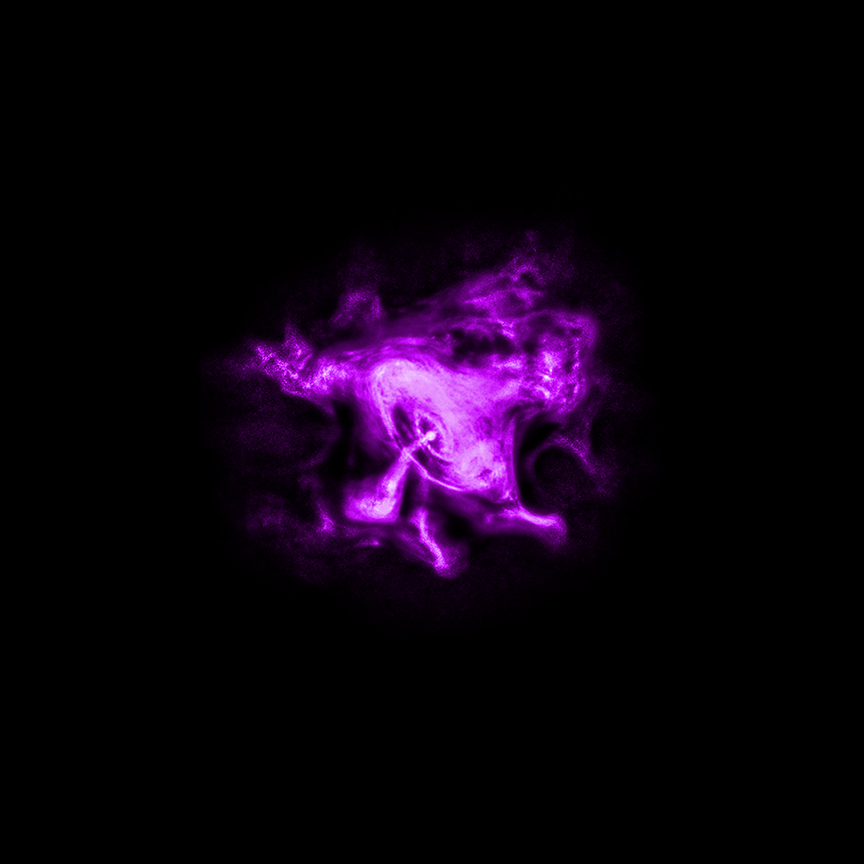
The Crab Nebula — photographed by NASA's Hubble Space Telescope. This is the glowing wreckage of a star that exploded in 1054 AD. At its center, a neutron star spins 30 times per second and fires beams detectable across every wavelength. Both beams are aimed at Earth. 6,500 light-years away.
The Six Nodes
The nearest pulsar wind nebula to Earth is the Vela remnant, just 800 light-years away in the Local Spur arm of the galaxy. Its pulsar, PSR B0833-45, rotates with a period of 89.3 milliseconds. It is one of the brightest radio pulsars in the sky. It undergoes periodic "glitches" — sudden increases in spin rate that have never been fully explained. Something inside it periodically injects energy. Its beam is aimed at Earth.
The second closest is the Crab Nebula, at 6,500 light-years in the Perseus arm. Its pulsar, PSR B0531+21, spins at 33.4 milliseconds — 30 full rotations every second. It was born in the supernova of 1054 AD, observed and recorded by Chinese and Japanese astronomers. It is the only pulsar detectable across every single wavelength band: radio, optical, X-ray, and gamma-ray. Both of its magnetic poles sweep across Earth's position. Its beam is aimed at Earth.
Third is CTB 80, also at 6,500 light-years but in the Sagittarius arm. Its pulsar, PSR B1951+32, spins at 39.5 milliseconds. It has broken free from its supernova remnant and now plows through interstellar space trailing three distinctive radio arms behind it. Its beam is aimed at Earth.
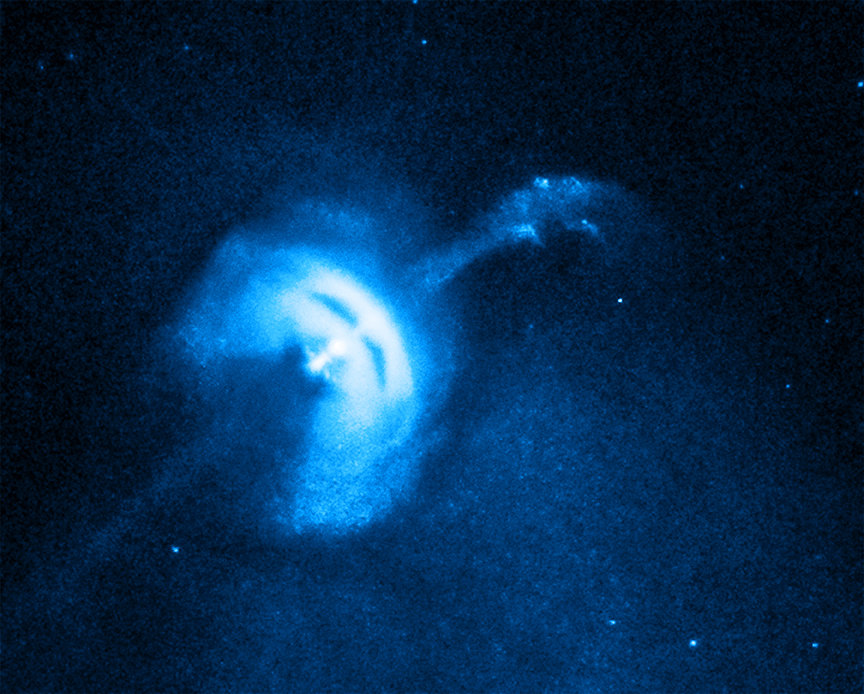
The Vela Pulsar — NASA Chandra X-ray Observatory. This is the closest pulsar wind nebula to Earth, only 800 light-years away. One of the brightest radio sources in the sky. It periodically speeds up for no known reason. Its beam is aimed directly at Earth.
Fourth is 3C 58 at roughly 10,000 light-years in the Perseus arm. Its pulsar, PSR J0205+6449, has a period of 65.7 milliseconds. It is linked to the supernova of 1181 AD — the guest star recorded in Chinese and Japanese chronicles. The neutron star is cooling far faster than any theoretical model can explain. Something is draining its thermal energy. Its beam is aimed at Earth.
Fifth is MSH 15-52 — nicknamed "The Hand of God" — at 17,000 light-years in the Norma arm. Its pulsar, PSR B1509-58, has a period of 151 milliseconds and a magnetic field of 1.54 x 10^13 Gauss. That is a trillion times the strength of Earth's magnetic field, one of the highest ever measured. The X-ray image from Chandra shows what appears to be a vast hand-shaped structure reaching through space. Its beam is aimed at Earth.
Sixth is G292.0+1.8, at 20,000 light-years in the Perseus arm. Its pulsar, PSR J1124-5916, spins at 135 milliseconds and travels through space at 1.4 million miles per hour. It is one of only three oxygen-rich supernova remnants in the entire galaxy — meaning the original star was so massive it fused elements all the way up to oxygen before detonating. Its beam is aimed at Earth.
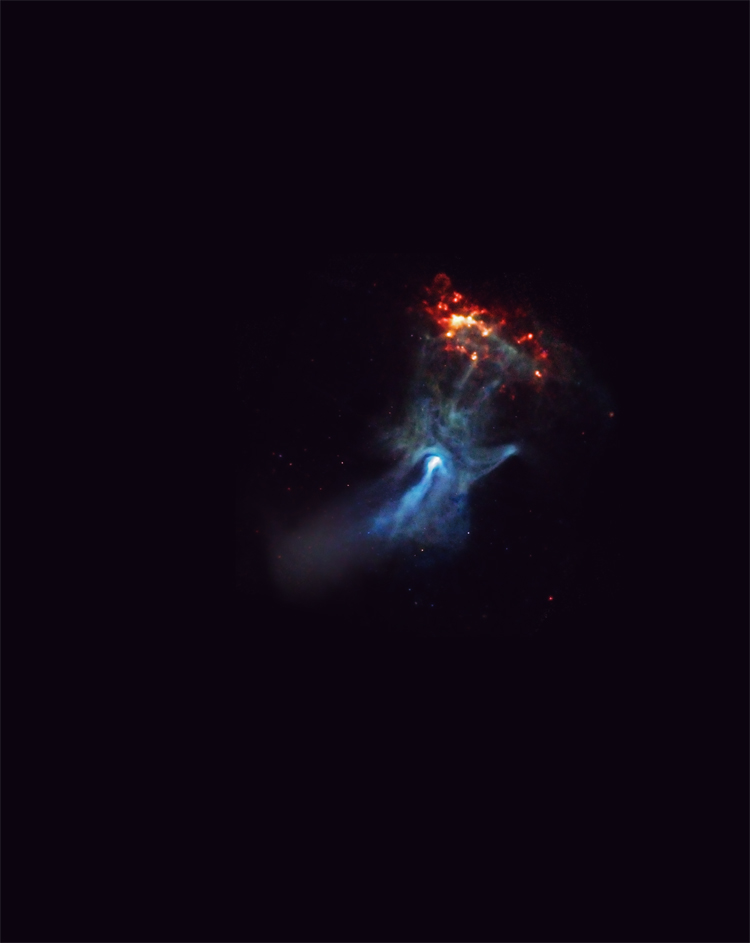
"The Hand of God" — NASA Chandra X-ray image. A giant hand-shaped structure formed by a pulsar with one of the strongest magnetic fields ever measured — a trillion times Earth's. 17,000 light-years away. Beaming at Earth.
Six objects. Six beams. All six aimed at this planet. Scattered across the Local Spur, Perseus, Sagittarius, and Norma arms of the galaxy. Born from different stars, in different eras, separated by tens of thousands of light-years. They have nothing in common except one thing: their beams all converge on Earth.
The Mathematics
The standard rebuttal to this observation is "selection bias." The argument goes like this: of course these six are beaming at us — that's why they're famous. We can only study the ones we can detect. The sample is pre-selected.
That argument is circular. It uses the observation to explain away the observation. It says: these six beam at Earth because we selected them for beaming at Earth. But it never answers the question: why do the six closest all beam at Earth? Selection bias explains why we see them. It does not explain why there isn't a single non-beaming PWN closer than any of the six.
The math is straightforward. If each young pulsar has an independent probability p of beaming toward Earth, the probability that all six independently aim at us is p raised to the sixth power. Young pulsars with periods under 150 milliseconds have beam half-angles of approximately 5 degrees. These are not wide flashlights. They are precision instruments.
| Beaming Fraction (p) | P(All 6 Beam at Earth) | Odds |
|---|---|---|
| 20% (consensus estimate) | 0.0000064% | 1 in 12,400,000 |
| 30% | 0.000073% | 1 in 1,372,000 |
| 50% | 0.0156% | 1 in 6,400 |
| 70% | 0.118% | 1 in 850 |
At the consensus beaming fraction of 20% for young pulsars, the probability of all six closest PWNe beaming at Earth is 1 in 12.4 million. Extend the calculation to all 16 of the closest beaming nodes and the odds collapse further — 1 in 153 million. The geometric probability for a single beam at a 5-degree half-angle is just 1.52%. For all six to independently aim at Earth by chance at that geometry: the number has seven zeroes after the decimal point.
These are not wide flashlights that happen to overlap. These are tight beams from independent sources across different arms of the galaxy, and every single one of the nearest six is pointed at this planet.
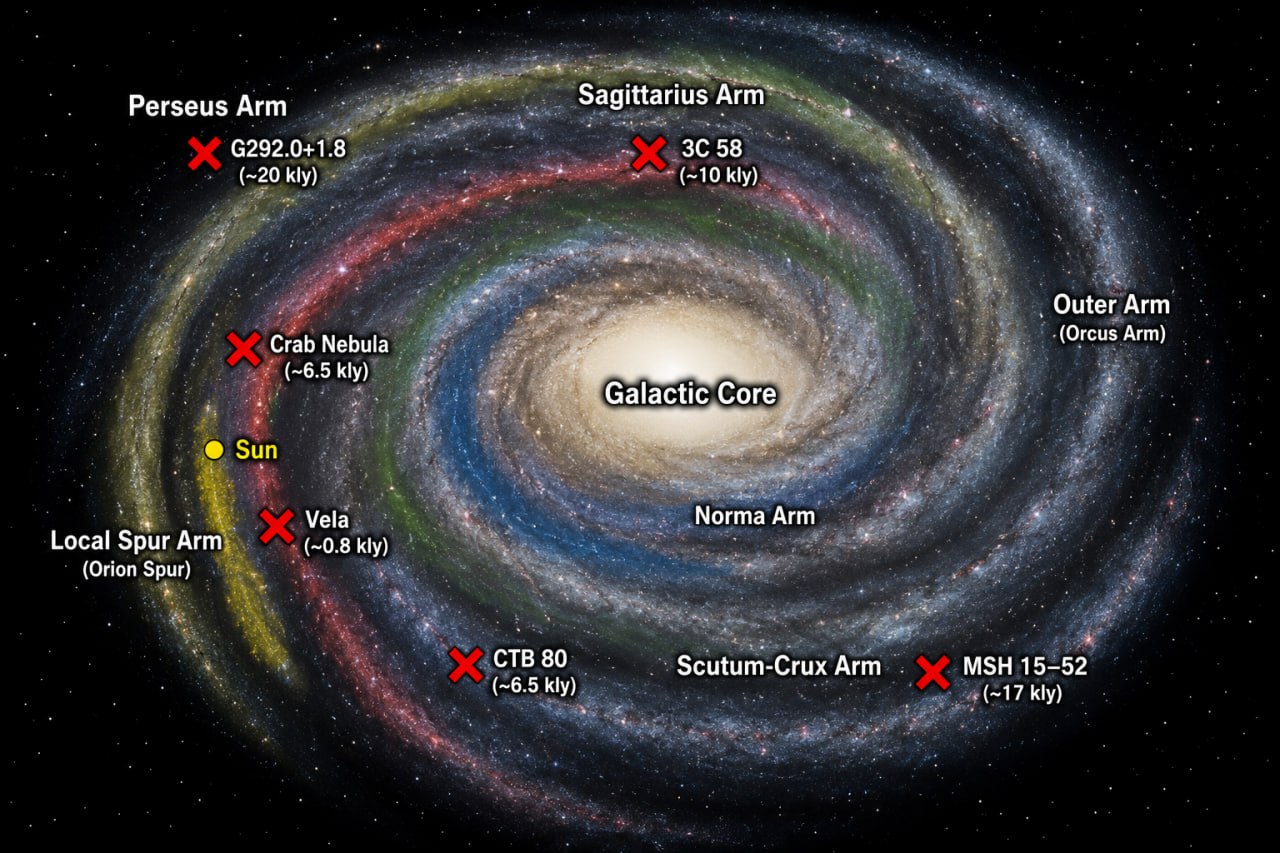
Map of the Milky Way showing where pulsar wind nebulae are located. They are spread across every major spiral arm of the galaxy. The six closest to Earth are not clustered together — they are scattered in different arms, different directions. And every one of them is aimed at us.
The Straight Jet Problem
There is another problem that mainstream astrophysics has never satisfactorily addressed.
The standard model says a pulsar is a neutron star spinning at up to 30 revolutions per second. It fires relativistic particle jets from its magnetic poles while rotating at blender speed. A city-sized object with a trillion-Gauss magnetic field, spinning 30 times a second, shooting matter at nearly the speed of light.
If that were true, the jets should show it. A fire hose mounted on a turntable does not produce a straight stream. It spirals. The faster you spin it, the tighter the helix. At 30 revolutions per second, you would expect to see corkscrew patterns in the outflow. Helical twists. Spiral ripples propagating into the surrounding nebula. Periodic wobble in the beam direction. Precession artifacts accumulating over centuries. Rotational drag deforming the inner nebula.
But the Chandra X-ray images show none of this. The jets are straight. Perfectly straight. Stable, unwavering lines extending for light-years into space. No spiral wake. No hooks. No ripples. No rotational artifacts of any kind. The inner nebula is clean. The emission pattern looks stationary.
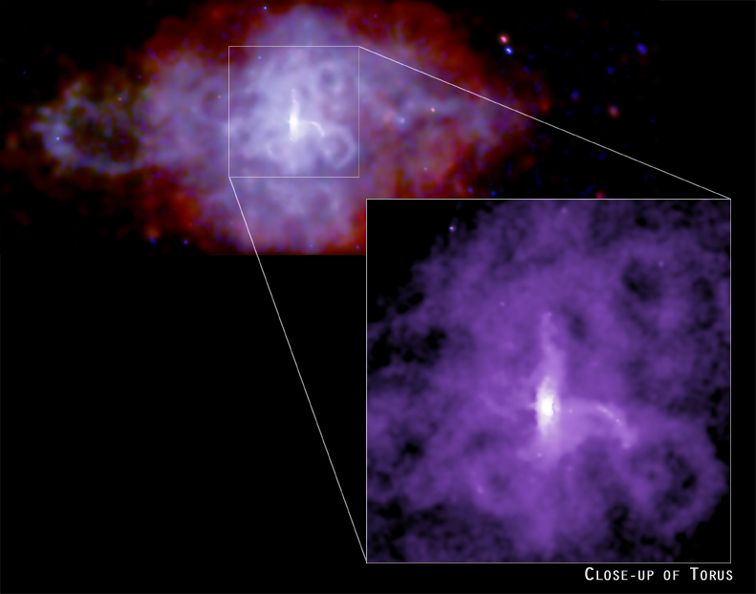
3C 58 — NASA Chandra X-ray image of a pulsar born in the supernova of 1181 AD. Look at the jets. They are perfectly straight. No spiral patterns, no corkscrew shapes, nothing you would expect from an object allegedly spinning 15 times per second. Every pulsar image shows the same thing: straight, stable jets that look like they come from something stationary.
If it looks stationary, emits like a stationary object, and produces no rotational signature after nearly a thousand years of alleged 30 Hz spinning — maybe it is not spinning. Maybe what we detect as "pulses" is not a rotating beam sweeping past our line of sight. Maybe it is a signal. A deliberate, rhythmic transmission from a fixed source, aimed directly at Earth.
Some supernovae ping us. Others don't. Some nebulae contain detectable pulsars. Others are silent. The question is not what makes them spin. The question is what makes them signal — and why they are all signaling us.
The Vela Node Station
The Vela pulsar wind nebula is the nearest of the sixteen nodes. At 800 light-years, it is practically next door in galactic terms. What Chandra sees in X-rays — the torus, the jets, the structured outflow — could be the observable leakage of something far more deliberate than a natural explosion remnant.
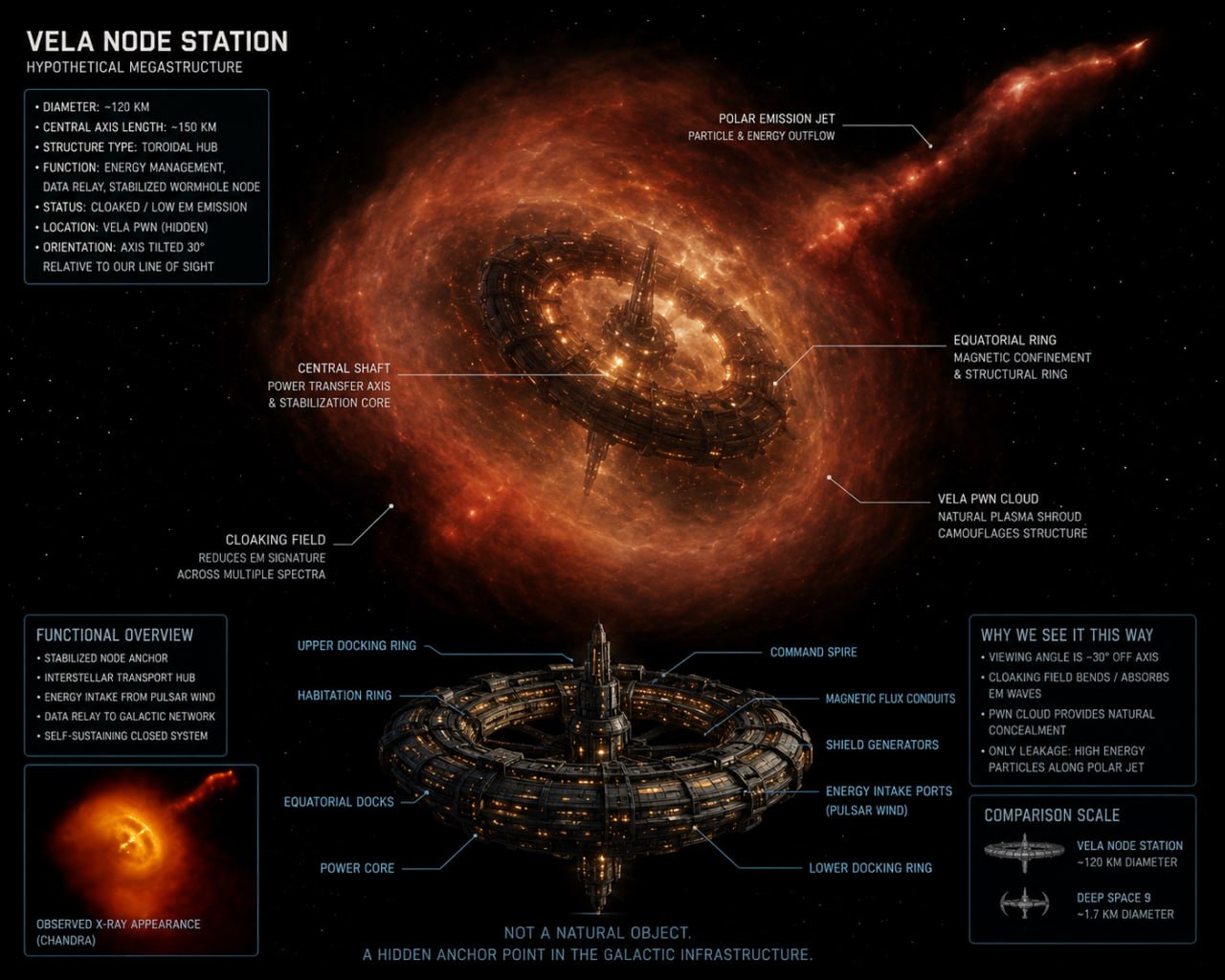
Hypothetical diagram of a transport node megastructure hidden inside the Vela Nebula. Roughly 120 km across — about 70 times larger than Deep Space 9 from Star Trek. The nebula itself acts as natural camouflage. The only thing we detect is the energy leaking out along the polar jet.
The hypothetical structure is a toroidal hub roughly 120 kilometers in diameter with a central axis of 150 kilometers. Its function: energy management, data relay, and stabilized wormhole transit. Its orientation is tilted approximately 30 degrees to our line of sight. The cloaking field — the pulsar wind nebula itself — bends and absorbs electromagnetic waves. We don't see the structure. We see the exhaust. The faint, high-energy leakage along the polar axis is the only evidence that something is there.
If these are transport nodes, the network architecture becomes clear. Sixteen stations distributed across the Milky Way's major spiral arms, each centered on a neutron star's extreme gravitational and magnetic environment, each emitting a narrow-beam signal that intersects Earth. They are not randomly scattered debris from stellar explosions. They are positioned.
Intelligent Design
Mainstream astrophysics admits it cannot explain the origin of star formation. Not fully. Not the first step. They describe the process — a giant molecular cloud develops density fluctuations, some regions become gravitationally unstable, a dense core forms, it collapses into a protostar, fusion ignites — but they cannot explain what creates the initial seed. What makes one region of a molecular cloud cross the gravitational threshold while another does not?
"The precise origin of every individual collapsing core is not directly observed," the textbooks say. "Instead, astronomers infer the process from observations of many clouds at different stages."
They infer. They model. They simulate. They run supercomputer calculations that approximate what might be happening. But they cannot point to the seed of a star and say: this is what it is. This is where it came from. This is why it formed here and not there. The origin of the first ordered structure remains what they themselves call "an open question."
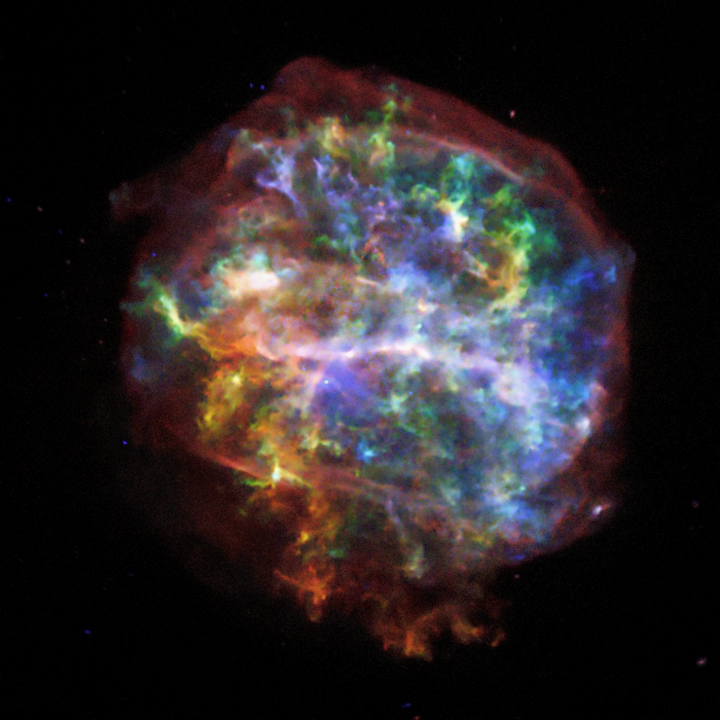
G292.0+1.8 — NASA Chandra X-ray image. One of only three supernova remnants in the entire galaxy where the original star was so massive it fused elements all the way up to oxygen before it exploded. The neutron star left behind is traveling at 1.4 million miles per hour. Its beam is aimed at Earth from 20,000 light-years away.
Consider the pipeline required for a pulsar wind nebula to exist and beam at Earth. A molecular cloud must have the right density, temperature, and chemical composition. A gravitational instability must form at the right location within that cloud. The resulting star must be massive enough — eight or more solar masses — for core-collapse. The supernova must produce a neutron star rather than a black hole, which requires a narrow mass window. The neutron star must retain enough angular momentum for rapid rotation. Its magnetic axis must be tilted to produce sweeping beams. Those beams must intersect Earth's position in the galaxy. The pulsar wind must inflate a visible nebula. And the entire object must be on our side of the galactic core with a clear line of sight.
Each step is a filter. Each filter eliminates the vast majority of candidates. The youngest and fastest pulsars have the tightest beams — making alignment least likely for exactly the objects where we observe it most. And yet all six of the closest pass every single filter and end up aimed at us.
Nothing is random. A molecular cloud does not accidentally produce a neutron star whose beam happens to aim at Earth. Not once. Not twice. Six times. From six different arms of the galaxy. From six different millennia. The probability is 1 in 12.4 million, and that number only accounts for the six closest. Include all sixteen beaming nodes and the odds are 1 in 153 million.
CTB 80 — radio telescope image. The pulsar inside this nebula broke free from the explosion debris and is now flying through space on its own, dragging three glowing trails behind it. 6,500 light-years away. Beaming at Earth.
These are nodes in a network. Positioned, aligned, and beaming. The question is not whether they are designed. The question is who built them and why they want us to see them.
How a Transport Node Is Built
The process begins in a giant molecular cloud — mostly hydrogen, helium, dust, and trace heavy elements. Density fluctuations appear. Some regions become denser from turbulence, magnetic field interactions, gas collisions, or compression from nearby stellar activity. When a region becomes massive enough that gravity overcomes internal pressure — the point astrophysicists call the Jeans criterion — it begins to collapse.
As the core contracts, gravitational energy converts to heat. The center becomes hot and dense enough for hydrogen fusion. A star is born. Gravity is balanced by fusion pressure. Equilibrium holds — for now. If the star is massive enough, it burns through its fuel in millions of years instead of billions. It fuses heavier and heavier elements: helium, carbon, oxygen, silicon. When it reaches iron, fusion stops. There is no energy left to extract. In a fraction of a second, the core collapses.
What remains is a neutron star. A city-sized sphere of matter so dense that a teaspoon of it would weigh a billion tons. Spinning at millisecond speeds. Magnetic field: a trillion Gauss. The pulsar wind — a torrent of relativistic electrons and positrons — inflates a glowing nebula around it. The beam activates. The signal begins.
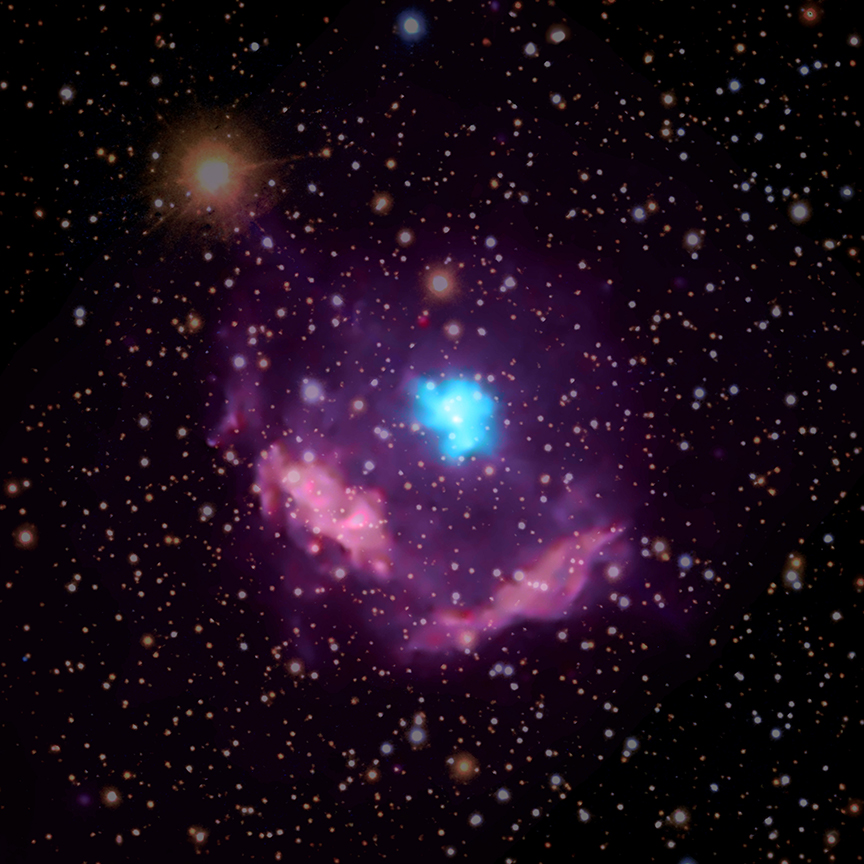
Kes 75 — NASA Chandra X-ray image of the youngest known pulsar, only about 500 years old. In 2006 it suddenly changed behavior — erupting violently in a way that pulsars are not supposed to do. Scientists still cannot fully explain it. 19,000 light-years away.
The Crab Pulsar illustrates the scale. Its period is 33.3 milliseconds — 30 complete rotations per second. For comparison, a clock's second hand makes one rotation per minute. A car wheel at highway speed rotates about 5 times per second. A household blender runs at 250 rotations per second. The Crab Pulsar, a 20 to 30 kilometer object with 1.4 solar masses of matter, spins at 30 rotations per second. The fastest millisecond pulsar ever discovered spins at 716 rotations per second.
The Crab Pulsar's period increases by 13 microseconds per year. Born in 1054 AD, nearly a thousand years ago, it has barely slowed down. The beam is a cone 10 to 15 degrees wide. Both magnetic poles are visible from Earth — a main pulse and an interpulse — meaning the magnetic axis is nearly perpendicular to the spin axis. Every characteristic of this object is extreme. And its beam is aimed at Earth.
Image Archive
NASA Chandra X-ray Observatory, Hubble, and ground-based imagery of all 30 classical pulsar wind nebulae in the Milky Way. Use the arrows or click any thumbnail to navigate.
The 30 Classical Pulsar Wind Nebulae
There are approximately 30 confirmed classical pulsar wind nebulae in the Milky Way. The following table ranks them by distance from Earth. The six closest are all beaming at us. Of the remaining 24, most either lack detected pulsations, are too faint to resolve, or have beams that miss Earth. The pattern is stark: proximity correlates with beam alignment.
| # | Name | Catalog | Pulsar | Period | Distance | Arm | Beaming |
|---|---|---|---|---|---|---|---|
| 1 | Vela | G263.9-3.3 | PSR B0833-45 | 89.3 ms | ~800 ly | Local Spur | YES |
| 2 | Boomerang PWN | G106.6+2.9 | PSR J2229+6114 | 51.6 ms | 2,600 ly | Local | YES |
| 3 | DA 495 | G65.7+1.2 | Undetected | Unknown | 3,300 ly | Local | NO |
| 4 | Simeis 147 | G180.0-1.7 | PSR J0538+2817 | 143 ms | 4,200 ly | Perseus | NO |
| 5 | CTA 1 | G119.5+10.2 | PSR J0007+7303 | 315.9 ms | 4,600 ly | Local | NO |
| 6 | IC 443 | G189.1+3.0 | CXOU J0617+2221 | Unknown | 5,000 ly | Perseus | NO |
| 7 | W28 | G6.4-0.1 | PSR B1758-23 | 415 ms | 6,200 ly | Sagittarius | NO |
| 8 | Crab Nebula | G184.6-5.8 | PSR B0531+21 | 33.4 ms | 6,500 ly | Perseus | YES |
| 9 | CTB 80 | G69.0+2.7 | PSR B1951+32 | 39.5 ms | 6,500 ly | Sagittarius | YES |
| 10 | W44 | G34.7-0.4 | PSR B1853+01 | 267 ms | 9,800 ly | Sagittarius | NO |
| 11 | 3C 58 | G130.7+3.1 | PSR J0205+6449 | 65.7 ms | ~10,000 ly | Perseus | YES |
| 12 | HESS J1825-137 | G18.0-0.7 | PSR B1823-13 | 101 ms | 12,700 ly | Scutum-Centaurus | NO |
| 13 | G141.2+5.0 | G141.2+5.0 | Candidate | ~94 ms | ~13,000 ly | Outer | NO |
| 14 | G21.5-0.9 | G21.5-0.9 | PSR J1833-1034 | 61.8 ms | 15,300 ly | Scutum-Centaurus | NO |
| 15 | G11.2-0.3 | G11.2-0.3 | PSR J1811-1925 | 65 ms | 16,000 ly | Scutum-Centaurus | NO |
| 16 | Mouse Nebula | G359.23-0.82 | PSR J1747-2958 | 98 ms | 16,000 ly | Galactic Center | NO |
| 17 | Duck Nebula | G5.27-0.9 | PSR B1757-24 | 125 ms | 16,000 ly | Scutum-Centaurus | NO |
| 18 | Rabbit Nebula | G313.3+0.6 | PSR J1418-6058 | 110 ms | 16,300 ly | Scutum-Centaurus | NO |
| 19 | MSH 15-52 | G320.4-1.2 | PSR B1509-58 | 151 ms | ~17,000 ly | Norma | YES |
| 20 | RCW 89 | G320.4-1.2 | PSR B1509-58 | 151 ms | 17,000 ly | Norma | NO |
| 21 | Kookaburra | G313.3+0.1 | PSR J1420-6048 | 68 ms | 18,300 ly | Scutum-Centaurus | NO |
| 22 | Kes 75 | G29.7-0.3 | PSR J1846-0258 | 324 ms | 19,000 ly | Scutum-Centaurus | NO |
| 23 | G292.0+1.8 | G292.0+1.8 | PSR J1124-5916 | 135 ms | ~20,000 ly | Perseus | YES |
| 24 | G54.1+0.3 | G54.1+0.3 | PSR J1930+1852 | 136 ms | 20,200 ly | Sagittarius | NO |
| 25 | HESS J1303-631 | G304.1-0.2 | PSR J1301-6305 | 184 ms | 21,500 ly | Scutum-Centaurus | NO |
| 26 | G0.9+0.1 | G0.9+0.1 | PSR J1747-2809 | 52 ms | 27,700 ly | Galactic Center | NO |
| 27 | G327.1-1.1 | G327.1-1.1 | Compact X-ray | ~35 ms | 29,000 ly | Norma | NO |
| 28 | G18.0-0.7 | G18.0-0.7 | Candidate | Unknown | ~30,000 ly | Scutum-Centaurus | NO |
| 29 | G76.9+1.0 | G76.9+1.0 | PSR J2022+3842 | 48.6 ms | 32,600 ly | Outer | NO |
| 30 | G16.7+0.1 | G16.7+0.1 | CXO candidate | ~290 ms | ~45,600 ly | Norma | NO |
Look at the table. The six objects marked "YES" in the beaming column are nodes 1, 2, 8, 9, 11, 19, and 23. Every one is beaming at Earth. Every one has a confirmed pulsar with detected pulsations across at least one wavelength band. Between them are objects like DA 495 (no pulsations detected despite being a confirmed PWN), CTA 1 (gamma-ray only, radio-quiet), and IC 443 (period unknown). The beaming nodes are not randomly distributed through the list. They cluster among the closest and the most energetic.
Some of these objects are extraordinary in their own right. The Mouse Nebula moves through space at 600 kilometers per second, trailing a 55-light-year bow-shock tail. The Boomerang PWN is a confirmed PeVatron — it accelerates particles to energies 10 times higher than the Large Hadron Collider. HESS J1825-137 is the largest TeV-emitting PWN ever found, stretching 100 light-years across. W44 provided the first direct detection of pion decay from cosmic rays, proving these objects are particle accelerators on a galactic scale.
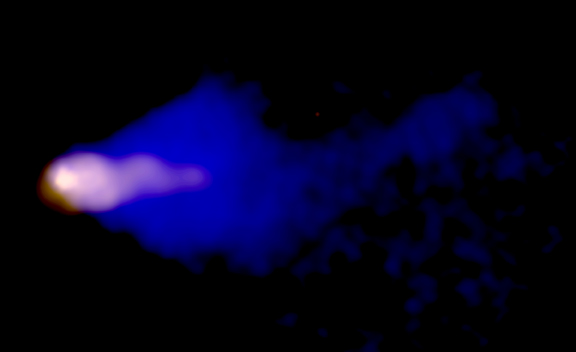
The Mouse Nebula — NASA Chandra X-ray and radio composite. This pulsar is flying through the galaxy at 600 kilometers per second, dragging a glowing tail 55 light-years long behind it. 16,000 light-years away near the center of the galaxy. Its beam does NOT hit Earth — proving that beam alignment is rare, not guaranteed.
And yet the six that beam at us are not the most distant or the most exotic. They are the closest. The nearest six pulsar wind nebulae to Earth all have their beams locked on this planet, while two-thirds of the remaining 24 either lack detectable pulsations entirely or have beams that miss us. The pattern is not subtle. It is screaming.
Nothing Is Random
Consider everything that must happen for a single pulsar wind nebula to exist and beam at Earth. A molecular cloud must form with the right density, temperature, and composition. A gravitational instability must develop at exactly the right location. The resulting star must be massive enough for core-collapse — eight or more solar masses. The supernova must produce a neutron star and not a black hole, which requires falling within a narrow mass window. The neutron star must retain enough angular momentum for millisecond-scale rotation. Its magnetic axis must be tilted to produce sweeping beams. Those beams must intersect Earth's position in a galaxy 100,000 light-years across. The pulsar wind must inflate a visible nebula. The object must be on our side of the galactic core with a clear line of sight.
Each step is a filter. Each filter eliminates the vast majority of candidates. And yet all six of the closest pulsar wind nebulae pass every single filter and end up with their beams aimed at this planet. The youngest, fastest pulsars have the tightest beams — making beam alignment least likely for exactly the objects where we observe it most.
This is a signal. These are not random natural formations scattered across the galaxy by coincidence. They are nodes in a network — positioned, aligned, and beaming. The question is not whether they are designed. That question answers itself at 1 in 12.4 million. The question is who built them, and why they want us to see them.